EU Council to meet on Tuesday on MDR and IVDR proposals

380px-EU_Consilium_Logo.svgThis Tuesday morning 10 December the EU Council will meet to discuss the dossier of medical devices and IVDs revision for the last time during the Lithuanian Presidency, from 10:00 to 12:00. It looks like live coverage by video feed is available, but you can also download the coverage afterwards, see the links in this document.

After 1 January 2014 it’s up to the Greek Presidency to see if they can close this deal before the European elections in May 2014.

As has become quite clear by now, the Parliament wants to move on the dossier to get it finished before the elections – there are political careers at stake. The Council is not so keen, as witnessed by the empty chair policy during the Parliament’s plenary vote.

In the mean time the Parliament has finally published the voted-in amendments: see here for MDR and here for IVDR. We thought we would improve on this with tracked changes versions of the text of both regulation proposals that show precisely what has been changed compared to the Commission’s initial proposal at a glance. We did our best to be thorough, but no guarantees and use at your own peril: see here for the MDR consolidated text and here for the IVDR consolidated text. If you spot any mistakes, please let me know and I’ll publish the amendments.

So what can we expect on the 10th? A Dutch briefing document for their Parliament gives a very nice insight (from the perspective of the Dutch of course).

Council not ready yet

The document states that the Parliament is fully ready to start the trialogue with the Council and the Commission, but that the Council is not quite there yet. Some critical remaining points have to be addressed on the 10th, among others the system of market approval and reprocessing, precisely the two items that everybody except the wise EU Parliamentarians has found a bad idea.

The document states literally that

the coming months will determine if the Council and the Parliament will enter into negotiations to arrive at a common position in 1st reading, the so-called trialogue. There are no clear positions in the Council yet on various issues. [document discusses PMA as proposed by Parliament] In the Council working groups a large number of member states have expressed their concerns about these PMA propositions.”

The document also states that member states are very divided over the question of whether reprocessing should be allowed in the first place (remember, the Parliament wants it to be the standard), while some member states do not want to prohibit it on an EU level but want to leave it up to national discretion. The Dutch plan to move slowly rather than be stuck with legislation that’s no good.

False security and harmful to innovation

The Dutch government quite literally says in the document what everybody (except of course the wise Parliamentarians in their comfy bubble of fact-free political statements) already knows and has been repeating like a broken record for months and months: these amendments will undermine the current innovation friendly system, create false security and unnecessarily raise the costs of the system. The system will introduce significant extra complexity that harms innovation, which is bad for patients, without leading to additional safety. And again, that’s not me or industry speaking: these are literally the words of the Dutch government.

So what should be done?

The Dutch say the following:

“The Netherlands suggests that improvements are targeted interventions on the weak links in the system, such as strengthening the quality of the notified bodies and increasing the quality of clinical research and clinical expertise in the pre-market phase. However, in the pre-market phase only limited data are available that give insight into the actual safety of the product when it is applied on large(r) scale used and corresponding intended patient population. By taking measures in the post-market phase, timely intervention becomes possible, so devices  can be preventively improved timely and major incidents can be prevented. The Netherlands therefore calls for increasing patient safety through post-market surveillance by manufacturers. The Netherlands has therefore submitted a proposal to the Council. There is broad support in the Council to tighten the requirements of post-market surveillance.”

This makes a lot of sense (and not only because I have already suggested this was the way to go almost a year ago). It completely fits the iterative mechanism of innovation in short cycles that is so characteristic for the medical devices industry and even corresponds with the current thinking in medicinal products PMA legislation that the Parliament would like to mimic that is moving in this very same direction. Yet, the Parliament can’t seem to burst its own bubble that insulates it from listening to people that have a better claim to knowing what they are talking about.

What will happen?

We don’t know yet, because the political constellations between member states are very opaque from the outside and member states are notoriously prone to solve things by means of spontaneous political horse-trading that is difficult to predict from the outside. We can only hope that cooler heads will prevail and the Council decides that it will rather take more time than be stuck with legislation that is systematically flawed in its approach, will produce false security and rack up the costs of healthcare considerably. Because who has two thumbs and will pick up the bill for all of this? Indeed, tax payers and patients – and that’s not a good message for member states to deliver to the voters back home, especially if the so-called improvements do not improve safety and delay innovations from becoming available to patients in the EU.

Also, this Tuesday the Greek Presidency will present its health policy priorities at the EPSCO meeting, having spoken already with the ENVI Committee and among others rapporteurs Roth-Behrendt and Liese for the MDR and IVDR proposals. This should give us something of an idea of the intentions of the Greek Presidency to finish this dossier before the elections.

So, lot’s of known unknowns for the moment, but we’ll get a clearer picture soon when the conclusions of these meeting on Tuesday are published. Watch this space!

EU companion diagnostics regulatory developments – the movie

logo.ashx

Now that my firm Axon Lawyers has a YouTube channel, why not use it more?

I was recently invited as speaker to the DIA Meeting on Personalized Medicines and Companion Diagnostics in Washington DC (well, Alexandria, VA, an affluent suburb of DC), on 6 November 2013.

However, due to an unfortunate mix of circumstances I had to leave DC some time before my speaking slot so I recorded my presentation as a movie for the conference.

Because information wants to be free, I have also posted it on my firm’s YouTube channel for you to watch: 33 minutes and 27 seconds of action packed and exhilarating legal and regulatory update on how the EU may (it’s all still very much in flux, mind you) regulate companion diagnostics under the proposed IVD regulation, as per the state of the Parliament’s plenary amendments. I hope it is useful entertainment on a rainy day of which we will most likely have many this autumn.

Enjoy!

The unfinished internal market for medical devices

logo-curiaThe EU market for medical devices is not fully harmonized, which means that you cannot rely on a medical device being a medical device everywhere in the EU. That, essentially, is what the European Court’s recent judgment in the Lycocentre case confirms. Confirms? Yes, it basically confirms what we already knew and that is that each EU member state can second-guess the regulatory qualification of your product to suit it’s own needs. In my own legal practice I’ve found that this happens quite often.

What was the case about again?

It was about ‘Gynocaps’, a vaginal capsule containing live lactobacilli intended to restore balance to the vagina’s normal protective bacterial flora, which was marketed in Finland as a ‘medical device or accessory’, bearing a CE marking, until 2008. To paraphrase the European Court’s case summary:

‘The capsule is currently also marketed as a ‘medical device or accessory’ bearing a CE marking in a number of other Member States, including the Kingdom of Spain, the French Republic, the Italian Republic and the Republic of Austria. The European Medicines Agency (EMA) has not specifically adopted a position on the classification of vaginal preparations which, like Gynocaps, contain live lactobacilli. It has, however, taken the view that on the basis of its intended use and effects, a gynaecological tampon containing live lactobacilli satisfied the conditions for classification as a ‘medicinal product for human use’, within the meaning of Directive 2001/83. The Finnish authorities decided that the product was not a medical device but a medicinal product and therefore required marketing authorisation as a medicinal product. The Finnish authorities, therefore, decided to classify Gynocaps as a medicinal product within the meaning of Directive 2001/83 and notified the decision to the Commission because they interpreted Directive 93/42 as meaning that where a CE marking has been wrongly affixed, the safeguard clause procedure provided for in Article 8 of that directive was not applicable because the issue was not strictly one of non-compliance. Lycocentre appealed the decision but the Finnish court dismissed the action holding, inter alia, that according to the case-law of the Court of Justice, the fact that a product is classified, for example, as a foodstuff in one Member State does not preclude that same product from being classified in another Member State as a medicinal product. According to the Helsingin hallinto-oikeus, the Lääkelaitos was entitled to classify Gynocaps in Finland as a medicinal product, even though that preparation is marketed as a medical device in a number of other Member States of the Union.’

On appeal of that judgment the appellate court decided to stay the proceedings and to refer the following questions to the Court for a preliminary ruling:

  1.  Does a definition given in one Member State in accordance with Directive 93/42, by which a product is regarded as a medical device or accessory in accordance with that directive and is provided with a CE marking, preclude the competent national authority of another Member State from defining the product concerned, on the basis of its pharmacological, immunological or metabolic effects, as a medicinal product in accordance with Article 1(2)(b) of Directive [2001/83]? – in other words: ‘can each member state qualify a ‘medical’ product differently?’
  2. If the answer to the previous question is in the negative, can that competent national authority define the product as a medicinal product observing only the procedures under Directive [2001/83] or is it necessary, prior to initiating procedures under that directive to define the product as a medicinal product, to follow the safeguard procedure in Article 8 of Directive [93/42] or to comply with the provisions of Article 18 concerning an unduly affixed CE marking? – in other words: ‘can each member state just do what they want or do they need to follow the safeguard and/or unduly affixed CE marking procedures in the MDD?’
  3. Does Directive [2001/83], Directive [93/42] or other European Union legislation (including legislation concerning the protection of human life and health and consumer protection) preclude products containing the same substance and having the same modes of action from being marketed in the same Member State both as medicinal products in accordance with Directive [2001/83], requiring a marketing authorisation, and as medical devices or accessories in accordance with Directive [93/42]?’ – in other words: ‘what happens when these differently qualified but identical/similar products start circulating in the internal market?’

Question 1: ‘Science can be different anywhere’

As to the question whether member states are allowed to qualify the same product differently, the Court first reiterates its case law on how such decisions must be completely evidence based and tailored to the specific product, but then goes on to hold that

“45 None the less, as Union law currently stands, until harmonisation of the measures necessary to ensure the protection of health is more complete, it will be difficult to avoid the existence of differences in the classification of products as between Member States in the context of Directive 2001/83 (see, to that effect, inter alia, Case C‑201/96 LTM [1997] ECR I‑6147, paragraph 24, and Hecht-Pharma, paragraph 28).

46 As the Advocate General has stated in point 63 of her Opinion, asymmetries in scientific information, new scientific developments and differing assessments of risks to human health and the desired level of protection can explain why different decisions are taken by the competent authorities of two Member States as regards the classification of a product.

47 In addition, the fact that a product is classified as a medical device in accordance with Directive 93/42 in one Member State does not prevent it being classified, in another Member State, as a medicinal product in accordance with Directive 2001/83 if it displays the characteristics of such a product (see, by analogy, Case C‑150/00 Commission v Austria [2004] ECR I‑3887, paragraph 60, and HLH Warenvertrieb and Orthica, paragraph 56).”

In other words: there is no central authority to qualify medical devices, science can differ and authorities can have different policies as to what they consider application of science to products for regulatory purposes and they are allowed to differ in opinion.

This case puts a very precise finger on the sore spot of the role of science in the qualification of medical products and the EU’s paradoxical way of dealing with it in the light of division of competence between the EU and the member states. On the one hand we all want the best state of art clinical substantiation for medical devices to be fully scientific and we assume that science leads to the same conclusions everywhere. Actually, that is what the EU market access mechanisms for medical devices and medicinal products are based on. On the other hand the Court, following it’s AG, is ready to believe that for the purpose of regulatory qualification science can be different anywhere in the EU, just because member states have not fully surrendered their competence to each qualify a medical product for themselves. In other words, just because we don’t have a harmonized system in place member states can do whatever they like with different scientific views as an excuse. In a discussion I recently had with another expert we agreed that if you take this to its logic endpoint, gravity could go up in one member state and down in another and that’s OK for the Court because the law does not say it should pull towards the centre of the earth everywhere and member states are not willing to agree to that when it does not suit their purposes. That, I think, is a very bad way to deal with products that we would like to be as much scientific evidence based as possible – lives are at stake, remember? That is basically impossible if you can’t rely on underlying science being universal and member states to be willing to give it their very best scientific effort to conform to scientific state of art. To me, this invokes impressions of a world of parallel universes existing in the minds of different persons like in the cold war science fiction novel The Eye in the Sky of Philip K. Dick, in which each universe has its own laws of nature, leading to some very absurd results. We are in the exact same situation in medical devices borderline products. However, I think in today’s society we ought to be be far beyond discussions about whether the world is flat or round. Because if the member states can differ and the European Court will not decide on facts unless in direct actions (which do not really exist under the current medical devices directives), there is no way to resolve a debate on the mode of action of a particular product, which brings you back to a patchwork of different policy coloured opions about what science dictates.

In case of doubt they probably get it wrong

The Court makes a short sidestep to refer to the hierarchy clause in article 2 of Directive 2001/83 in discussing the relationship between medicinal products and medical devices regulation in the EU. This is a tool that member states often use to bail themselves out of a difficult qualification situation.  In the word of the Court:

“Article 2(2) of Directive 2001/83 requires the application of Directive 2001/83, by providing that, where, taking into account all its characteristics, a product may fall within the definition of a ‘medicinal product’ and within the definition of a product covered by other Union legislation, it is the provisions of Directive 2001/83 on medicinal products that are to apply.”

What happens in practice? Case handlers at a competent authority will take issue with the regulatory qualification of a particular product as medical device, claim that there is “doubt” about the mode of action and therefore qualify the product as a medicinal product with reference to the hierarchy clause, without properly looking at all characteristics and without positively establishing that the product does actually fall within the scope of both Directive 2011/83 AND 93/42. This goes wrong more often than not, not only in my own experience but also in the experience of many others.

Question 2: Fortunately, there are procedures for this in the EU MDD

With regard to the procedural issue (can the national authorities act on their own, or should they apply the article 8 and/or 18 procedures in the MDD?), the Court finds that

“in order to classify as a medicinal product in accordance with Directive 2001/83 a product already classified in another Member State as a medical device bearing a CE marking in accordance with Directive 93/42, the competent authorities of a Member State must, before applying the classification procedure under Directive 2001/83, apply the procedure under Article 18 of Directive 93/42 and, where appropriate, the procedure under Article 8 of Directive 93/42.”

Good news, there are procedures to follow, and these procedures make the member states talk to each other, sort things out and then the outcome is binding for the whole EU market, right? Wrong. First, the outcome is not binding on the member states. Secondly, the process itself and the outcome of the process (the Helsinki procedure) are neither public nor transparent. And the manufacturer has no legal recourse against the qualification if the product, because (a) it is just a consensus reached between the member states and (b) the member states have agreed to make all the qualifications in the Manual on Borderline and Classification to relate to an ‘abstract’ situation, which however  is a direct reference to the actual product that was assessed. So, while the Court refers to the MDD procedures, this will not help you a single bit if you are a manufacturer. Member states do as they like and if you don’t agree with the outcome of what they agree on a non-transparent and non-binding basis you can have fun litigating against the authorities in each and every member states that decides to make your qualification an issue. This is not only bad for individual companies, but also for patients relying on the devices concerned (because you often have to take them off the market to reinvent and apply for them as whatever other thing (usually medicinal product) the member states would like you to place it on the market). Even the Commission concluded  in its Staff Working Paper that underlies the new medical devices regulation proposal that the current process is far from perfect:

“However, some controversial cases remain unsolved despite long discussions within the above mentioned Expert Group. The application of different regulatory regimes to the same product compromises both the protection of patient safety and the internal market. […] Moreover, even where a consensus is found, the consensus statements published in the Manual are not legally binding and competent authorities or national courts may decide at any moment not to follow them. This reduces the legal certainty and prompts criticism from stakeholders. […] The lack of uniform qualification (or classification) of a product across the EU creates a fragmentation of the internal market (as a manufacturer must follow different legal regimes in order to sell the same product in different Member States) and may put patient safety at risk.” (p. 18/19)

Yes, that’s right – and this politically correct language is just what the Commission is willing to put in writing publicly – there will be a world of frustration behind this. The Commission points to a lot of very well-deserved criticism about this process, which, as the Court puts it in the Lycocentre judgment, is the result of incomplete harmonisation “of the measures necessary to ensure the protection of health” (§ 45). The lack of harmonization is of course no reason for member states not to work together better and at least make sure they base their decisions solidly on the same scientific evidence, except that in practice it is.

Question 3: But what about similar products with a different qualification coming from other member states?

That’s a very reasonable question. If there is free movement, you would expect the products coming from other member states to be able to carry their qualification with them, because that would be what the MDD’s internal market clause of

“Member States shall not create any obstacle to the placing on the market or the putting into service within their territory of devices bearing the CE marking” (article 4 (1) MDD)

would seem to mean. No, says the Court: if

“within the same Member State, a product, which, while not identical to another product classified as a medicinal product, none the less has in common with it an identical substance and the same mode of action, cannot, in principle, be marketed as a medical device in accordance with Directive 93/42, unless as a result of another characteristic that is specific to that product and relevant for the purposes of Article 1(2)(a) of Directive 93/42, it must be classified and marketed as a medical device, which is a matter for the referring court to verify.”

In other words, we’re back to a situation as in HLH Wahrenvertrieb, which was about member states looking at active substances as such as a regulatory triage mechanism. Even though the Court is – I think – not coming reversing this case law, you’re still 1-0 behind as company if the member state can say: look, there’s an identical substance in there with the same mode of action as something that I have already considered a medicinal product before, good luck to you proving that “as a result of another characteristic that is specific to that product and relevant for the purposes of Article 1(2)(a) of Directive 93/42, it must be classified and marketed as a medical device”. The result of this judgment is that effectively the HLH Wahrenvertrieb burden of proof is shifted from the member state on to the manufacturer, because the Court says it’s OK not to look at the product individually in detail if another member state (on whatever grounds) has decided that the device is a medicinal product, and then the manufacturer can prove it is not a medicinal product. This is a step back in the protection of manufacturers against competent authorities that do not substantiate their arguments very well scientifically.

Looking forward: what will this look like under the new regulation?

I’ve complained a lot on this blog about how the new regulation will not be an improvement in a number respects. In the respect of borderline products it will be a huge improvement, because we will finally have a possibility for a central qualification that is binding on all member states in article 3 of the regulation. This article allows the Commission to do two things

  1. issue a qualification for a product or a group of products by delegated act, by its own initiative or after a request by a member state, and
  2. ensure that the science that can be different everywhere is less different as a result of sharing of expertise (which is basically what scientific development is about in the first place if you ask me)

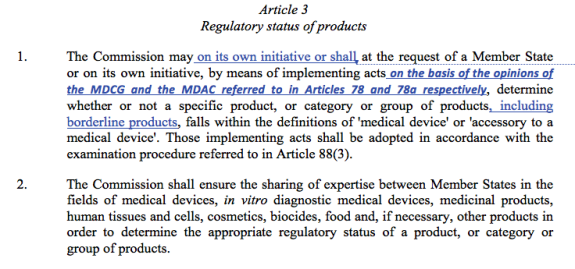
The article looks like this in the Commission’s proposal:

“(1) The Commission may, at the request of a Member State or on its own initiative, by means of implementing acts, determine whether or not a specific product, or category or group of products, falls within the definitions of ‘medical device’ or ‘accessory to a medical device’. Those implementing acts shall be adopted in accordance with the examination procedure referred to in Article 88(3).

(2) The Commission shall ensure the sharing of expertise between Member States in the fields of medical devices, in vitro diagnostic medical devices, medicinal products, human tissues and cells, cosmetics, biocides, food and, if necessary, other products in order to determine the appropriate regulatory status of a product, or category or group of products.”

The qualification is by implementing act, which means that you most likely have no legal recourse against it as manufacturer, unless perhaps if you can meet the very high threshold of proof for being directly and individually concerned. Whether that is the case will depend on what the implementing act concerned looks like.
Schermafbeelding 2013-11-10 om 14.05.06

There were some minor tweaks by the Parliament, which proposed it should look like this (see picture above). No radical changes, except that (1) in case of a request of a member state the Commission must determine with an implementing act what the status of the product concerned is, (2) the MDCG and the MDAC get to weigh in with opinions and (3) the text makes it explicit that also borderline products can fall within it scope (that’s what the clause is for in the first place).

So, the internal market is not finished – but it may be less unfinished in the future

That’s what the new regulation has in store. The new article 3 will help, but the situation of member states taking different views to the detriment of patients and manufacturers will remain. The progress is that we will (hopefully) have a better way of overruling member states in individual cases, although the Commission will not be obliged to act on any requests by anyone except a member state.

CE certification of standalone software and apps seminar – the movie

Rather than streaming our last medical technology seminar on CE Certification of Standalone Software and Apps of 16 October in real time (big hassle and very prone to tech glitches we’ve found), we decided to record a video of it instead, and post that on my firm’s brand new Youtube Channel (watch that space for more video material). So here you go with three hours of exciting and action-packed presentations on

  • designing medical software for compliance;
  • qualification of standalone software as medical device;
  • the Dutch competent authorities’ plans to enforce in earnest as of 1 January 2014;
  • practical aspects of CE marking.

If you want the underlying presentations for future reference, that’s fine too. You can download them directly from my firm’s website News section without any hassle, paywall, or extortion of personal data and relentless follow-up harassment by email or telephone. We hate to do that, and are convinced that you will remember us anyway if you think the material is useful. If you want to be on our mailing list for these seminars, that’s your choice – just let us know and we’ll put you on it.

You can help of course by liking the presentation movies in YouTube so they’ll become more visible in the search results in Google and YouTube.

And there is a lot more software material on this blog, see here.

EP debate on devices revision – largely predictable, some surprise

European ParliamentToday was an interesting day for medical devices in Europe. We had the EU Parliament’s plenary debate on the medical devices and IVD regulation proposals, and the subsequent vote on the highly appropriate or potentially devasting (depending on who you ask for comments) ENVI committee proposals. You can watch the whole debate video here, the rather confusing vote video with the occasional procedural discussion here or get an executive summary from Amanda Maxwell’s tweets (@ClinicaAmanda).

Largely predictable debate

The debate was largely predictable. Rapporteur Roth-Behrendt, imbued with the fire of the righteous, set the tone by accusing industry of being hysteric in their reaction and said if they would only make good products they had nothing for fear from just four months of delay. It was all about more Sicherheit, and who can be against that? Well, actually everybody that is not impressed by that framing and is convinced that more complexity that does not address the problem produces a better result. The Commission for one, which had Commissioner Mimica explain once more that PIP had nothing to do with quality of rules as such and that unlike ENVI committee the Commission actually had done its fact finding homework. He cautioned against the system of approval proposed and the reprocessing proposal. He also cautioned to keep the system of clinical study regulation consistent with the pending clinical trial regulation proposal.

It is also strange that the whole idea of stricter rules and more security goes head first out of the window with the rapporteur’s arguments about reprocessing, which revolved around the position that single use labeling is “Realitätsfern”, German for ‘far from reality’ (I had trouble with the Parliament’s video feed so had to watch in the original languages, which reveals an otherwise hidden dimension of colourful language). I myself would say that piling risk on risk by allowing devices that are not designed to be reprocessed to be reprocessed is very very bad risk management indeed, but ‘stricter’ rules apparently don’t have to apply to extra risky activities.

Rapporteur Liese’s statement for the IVDs was more balanced and mainly concentrated on his favorite item of the requirement of mandatory consultation before application of a genetic test, which I still believe is likely overstepping the boundaries of EU competence to legislate in medical devices.

Empty chair policy

Schermafbeelding 2013-10-22 om 23.42.40With Peter Liese, rapporteur for the IVD regulation proposal, it started to get interesting. Since his political career is attached to this dossier, he fired a first salvo of criticism in thin air at the bench where the Council representatives normally sit if they would not have been ostensibly absent by saying the Council should commit itself to this dossier and help it forward. Rapporteur Roth-Behrendt later added to this complaint by saying that the Council should have the courage to start the trilogue with Parliament so this dossier can move forward and make some progress. That’s all very nice, but the Council so far has been keeping its cards close to its chest and will not address this dossier amongst themselves officially before 10 December this year in the last stages of the Lithuanian presidency, and then its over to the Greek presidency to make this happen before the elections – or not. For the moment it seems that the Council may be voting with its feet by delaying the proposal and quietly run it into the ground by delaying until the elections in May 2014 happen. It will be interesting to see what the Council does: improve what is on the table or let it peter out. In the mean time the Council’s working groups looking at the medical devices and IVD revisions will continue work on the Parliamentary vote results.

The votes

The vote was pretty confusing, so I won’t draw firm conclusions on that before I have seen the official outcome. The Parliament’s press release is not much use because it doesn’t give any news on what was voted in and what out. From Eucomed we learn that the watered down case-by-case assessment of certain devices was adopted and the the reprocessing proposal has been tweaked by reversing the Realitätsfern idea to make all devices reprocessable by default but did not bring it back to the Commission’s original proposal. I assume Mrs Roth-Beherendt will be visiting patients that suffer complications from failing reprocessed single use devices in the future personally to inform them that they’ve suffered for the greater good. Also the rather superfluous hazardous substances phasing out requirement has made it through, regardless of the fact that the EU has perfectly good other regulations for hazardous substances in articles already in place, like RoHS and REACH.

The IVD industry was – it seems from EDMA’s press release – generally happy with all the novelty, expect for the shortening of the transitional period from five to three years, which they consider too short to generate the clinical evidence required under the new regime.

All in all

A mixed bag, as my UK colleagues would probably say. But definitely a bag that may still carry some surprises with the Council as the dark horse that I predicted it would turn out to be earlier this year.

Update 23 October

The vote results are in: you can download them here. I will proceed to analyze them – stay tuned.

EU medical devices revision: counting down to the plenary vote

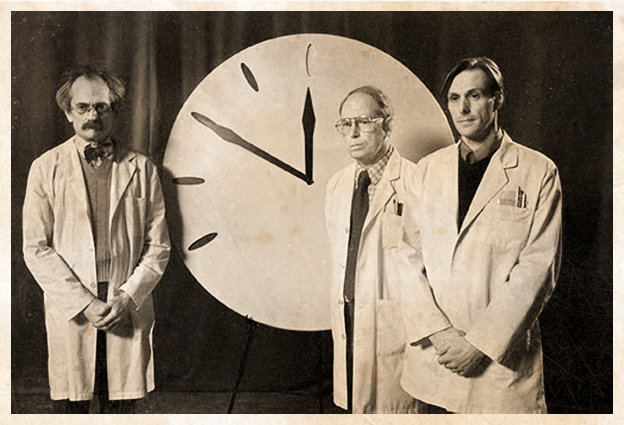
DoomsdayThat’s right: it’s 10 minutes to midnight for EU medical devices regulation in the cold war between the ENVI committee and the industry with the upcoming vote in the European parliament’s plenary tomorrow on 22 October.

The proponents of the ‘swift and proportionate’ procedure via a centralized EU agency, like currently happens with certain medicinal products in the EU (so super swift, that the EU had to invent supplementary protection certificates to compensate companies for the duration of regulatory approval), keep asking themselves in the press why this naughty industry that places all these unsafe products on the market can have such big problems with legislation that can only make things better. If they operate in good faith, then how can they be against ‘stricter’ rules?

With the vote in mind, I hope Europarliamentarians and delegates from member states read this, and realize that many of the arguments made by the Roth-Behrendt side in the discussion surrounding this dossier are flawed. As is inherent in cognitive bias that characterizes these arguments, proponents of that often choose to ignore facts to the contrary and have difficulties reflecting the law correctly. A specific reason to write this blog is Deborah Cohen’s recent article in BMJ, which takes a swing at industry and authorities alike in an attempt to sway the hearts and the minds. Like we have seen before with BMJ articles on this subject it’s a lot of huff but not that much consideration for correct analysis of the medical devices rules.

Framing something as ‘stricter’ does not make it better

With ‘all these scandals’ happening, how can you be against stricter regulation? It’s what Mrs. Cohen says and also the gist of a recent article in Der Spiegel featuring rapporteur Roth-Behrendt. That’s a trick of argumentation that lawyers are all too familiar with: framing. I’ll explain.

First, not that many scandals happen actually. Certainly not enough to derive a trend of structurally unsafe medical devices entering the market. If that were the case we would have a lot more bad news. Secondly, the medical devices industry does not consist of evil corporations that are intent on selling substandard products and that want to avoid being controlled at all costs. They want controls that are proportional and effective. Thirdly, if there is one thing that the comparison with the medicinal product framework shows it’s that this way of regulation does not produce safer and more innovative products that reach the market quicker.

The Spiegel article says that even the watered down set amendments “is too much control for many manufacturers”. Deborah Cohen observes in her recent article in the BMJ that the arguments used by the medical devices industry resemble the arguments made by the pharmaceutical industry between 1960 and 1980 when they were being regulated stricter. The important concept here is “stricter”, because that assumes “more effective” or “better”. However, that is completely not what happened. We are now stuck with medicinal products legislation that has made medicinal products very expensive, slow to reach the market and still quite not safe yet as there are still cases of medicinal products that turn out to have significant unexpected adverse events. Don’t get me started about the unmet medical needs. The SME industry in innovative medicinal products has been effectively wiped out because SMEs do not have the means to see a product through to market entry. The EMA is begging companies with ATMPs in the pipeline to please take the gamble with the EMA procedure that has been spectacularly unsuccessful for innovative ATMPs from SMEs. Remember, the vast majority of companies active in medical devices are SMEs – this is undisputed. Even the EMA itself is stating that this is not the way to go in its Roadmap to 2015 and is admitting that the rules for ATMPs are very difficult and costly to navigate for SMEs. It has even set up an SME Office to help them, and the ATMP regulation contains many benefits for SMEs, like fee reductions and regulatory assistance because the Commission saw it coming from a mile away that SMEs would have difficulties with these rules. Did the wise ENVI members propose anything like this for the new medical devices regulations? No, not in the slightest – I don’t they even considered this because it was never publicly debated. They are not concerned with all the SMEs that just try to make good and innovative products – they are only legislating with what they see as evil lobbying multinationals in mind (large minority in medical devices) and fraudsters like the PIP breast implants company (who would not have been deterred or prevented from doing what they did by any set of rules).

Then there is the difficult connection with patients. If you ask patients: “Do you want stricter regulation?” they all say yes of course. If you ask “Do you want stricter regulation that will delay life saving therapies and not achieve its purpose to make devices safer than they are?” they all say no. It’s all about how you pose the question to get an informed answer in this debate. And that’s the problem. There is not that much evidence based information  in this debate. Industry is allegedly lying, rapporteurs say they have data but never show it and journals like BMJ publish articles that insinuate a lot but prove very little.

Don’t get me wrong – I’m not against change. Nobody is. The Commission’s recast that later turned into a revision started in 2008 as a completely uncontroversial update of existing legislation. But what we need is BETTER legislation, not WORSE legislation that repeats, perpetuates and/or implements new mistakes we don’t have to make or that have already been made in other sectors of industry, as I have argued.

Stricter is certainly not cost-effective

Where do you think all the extra costs for these procedures end up? And be honest.

The devices concerned will become a lot more expensive. If the devices become more expensive, the treatments with the devices become more expensive. If the treatments cost more, this will need to be paid, from public and private means. Do member states have public money to spare to throw at this? Absolutely not. Do patients have money to spare to pay for more expensive insurance or costs that are not covered by insurance? Not those that are already struggling to make ends meet. What we don’t want is to end up in a situation that the US is currently beating itself up over to get out of: that costly medical treatments are not for everybody because they have just become too expensive. This is a harsh economic reality: if you increase costs for regulatory approval, these costs have to go somewhere, and companies become very opportunistic about what products they submit for approval – again, just look at the medicinal products market. I am not sure if the representatives of the member states realise this. Well, they’ve been warned and now they are warned again.

Not the ‘swift’ system but the reimbursement system that causes the biggest delays?

Mrs. Cohen argues in her article that it’s the member states’ slow adoption of medical devices in their reimbursement systems that causes the real delay. We have heard rapporteur Roth-Behrendt use the same argument. But that’s no valid argument at all. It just shows another aspect of this side of the discussion choosing to ignore to look at implementing solutions where they matter. The problem here is that the EU has no competence to legislate in matters of reimbursement of healthcare. The Lisbon Treaty forbids that. What the EU could do is take some flanking measures to streamline reimbursement, like happened with the Transparency Directive for medicinal products that was put in place to shorten the time it takes for an approved medicinal product to be reimbursed. Did the wise ENVI members propose something like that in the medical devices proposals? Of course not. If the ENVI committee is concerned about reimbursement duration it should do something about that and if it hasn’t got the competence, it should work on lobbying the member states entrusting the EU with it. But this is a completely invalid argument to argue it’s OK to make the market access procedure more costly, more complicated and longer.

FDA and trials argument

Deborah Cohen argues that a

“report by German National Associations of Statutory Health Insurance Funds, Medical devices: myths and the truth, points out that the three year difference arises not because of the time it takes the FDA to approve a device after data are submitted but because of the requirement for trials to show it is safe and effective, which is not routine in Europe.”

If something sounds implausible, I check the source and I found that the report does not support this statement. It just does not support it. The only thing that the report says  in this respect is that it found that the FDA assessment procedure is longer because (and I will quote because Mrs. Cohen did not):

“In the USA, the assessment procedure period also includes the conception and execution of the necessary studies. This is likely to be the prime reason why the procedure takes 518 days on average (in the PMA procedure). When clinical studies are performed in Europe, they are usually done prior to their evaluation by the Notified Body. Hence, in Europe, the time in which the trials are designed and executed is not included in the time required to approve the product for the market in Europe.” (see p. 7 of the report)

This quote seems to suggest that all the clinical trial work for a PMA of a device happens after application for the PMA under the auspices of the FDA,  which is incorrect. In the US, like in the EU, clinical trials to support the application are done before the application for approval is filed. Like in The US, a sponsor needs government approval prior to starting a clinical study to generate clinical data to support the application for approval of a medical device and like in the US, you had better have a good idea what endpoints the party approving your device is looking for. This is a process we have managed better in the EU, because it’s far easier to talk with your notified body about this than with the FDA. This results in less time consuming back and forth once the application procedure has started. In the end the FDA just is slower in its regulatory process; it is heavily criticised for that and now it’s doing its best to be quicker. Even the FDA itself is not denying this.

Evil nasty industry and competent authority people with their evil consistent positions

No exciting story is complete without a nasty villain, and if there is none you create one – that must have been what ran through Mrs. Cohen’s mind when she was writing the article. Let’s invent big evil medical devices industry to go with big evil pharma, right? It’s the oldest debating trick in the book: frame someone as evil and if someone is evil, they can’t be right (remember the Axis of Evil?). You are not evil yourself, so therefore you must be right. QED. Flawless logic, or not?

What amazes me is how Mrs. Cohen points at people being consistent in their points of view as an example of people crossing over to the dark side through the ‘revolving door between industry and regulators’. Mrs. Cohen for example uses the fact that John Wilkinson has the same position with respect to the merits of the EU medical devices regulatory system when at Eucomed as when as MHRA to – what is she insinuating really? Is she insinuating that the MHRA could not but disagree with industry? Because industry must always be wrong? That the door between industry and authorities revolves around an axis of evil? This just shows to what a basic level this argument of insinuation stoops and how much cognitive bias is involved to ignore that these evil people may be right.

I, for my part, would actually be extremely worried if very competent people like John Wilkinson would start to revisit their opinion when they show up at authorities, and would make the authorities change their policy in the bargain. It also shows that those (including explicitly rapporteur Roth Behrendt) that accuse industry of lying are wrong, dead wrong, because they are also accusing authorities of lying and turning. This is in fact the only point Mrs. Cohen makes with her revolving door insinuations: everybody except the righteous few is evil and therefore wrong. This is compounded by the fact that the righteous often do not understand the law very well, given  the basic regulatory mistakes they make in the debate. But hey, if you’re righteous you don’t have to be right, which is very convenient. Just ask all the scientists that were prosecuted throughout history for coming up with a scientific theory that did not correspond with the religious concept of the universe prevalent at the time.

The Commission, by the way, also did an evil impact assessment that concluded that a PMA-like procedure via the EMA would not be a viable regulatory solution for Europe. But what do they know? Oh, and don’t forget they’re evil too because Mrs Cohen points to revolving door instances between the Commission and industry as well. So they can’t be right either, this evil Commission. And then you can just ignore the facts that they found, regardless how much research went into them.

Conversely, I am quite sure that there are many European parliament members that go on to do other things and that are a lot less consistent in their new positions afterwards. Oh sorry, I forgot those people are always right because they are – excuse my ignorance.

Hearts and minds

Mrs. Cohen frames the disagreement between industry and authorities on the one hand and the parliament on the other as a battle for the hearts and minds. This underlines the fact free nature of the debate from her side of the discussion. This should not be about hearts – it should be about the minds, more specifically the ratio. Regulatory principles have nothing to do with hearts – they should be evidence based and well thought out, achieving the best possible outcome for the largest group of people. They should not be a backlash of badly thought out regulatory ideas that will put their mark on medical devices for decades to come, and this is where the whole ENVI project goes south. Everybody agrees that the system had to change, but let’s change it for the better – not for the worse. The worse is the way we are heading, and we have no one to blame but ourselves. I hope you remember that when you are traveling to Singapore to receive therapy that’s not available in the EU, or are informed by your doctor that you have contracted hepatitis or HIV from a badly reprocessed single use device.

I can only hope, as a family member, as a future patient and as someone who knows a thing or two about EU medical devices regulation, that the Parliament’s plenary and the member states in the Council will apply some reason. For all of our sakes.

Legal recourse against delegated and implementing acts in the medical devices regulation

EU flagThis time I’d like to entertain you with some aspects of some of the dryest matter that I work with as lawyer: technical rules regarding competence and standing under EU law. However, this subject matter is very important for medical devices companies in the light of the large number of delegated and implementing acts for which the new regulations for medical devices and IVDs make provision, as I have already mentioned.

Eucomed and COCIR spot on

Eucomed was spot on with respect to the Commission’s broad license to legislate this way in its position paper about the revision of the medical devices directives:

“The Commission has proposed more than fifty delegated and implementing acts, which will not be developed before the final approval of the Regulation. Industry believes that many of these acts afford the Commission too broad a mandate or lack sufficient detail to ensure a stable and predictable legal framework for economic operators. In addition, there is a complete lack of a mandatory consultation with stakeholders (patients, doctors, industry) in the elaboration and adoption of these acts.”

Also COCIR expressed the same grave concerns in its position paper, spot on as well as to the possibilities for the Commission to move goalposts around under the proposed regulation for medical devices.

Other EU ‘modern’ EU legislation, like the General Data Protection Regulation (currently in the works and not making life easier on the medical devices industry (see also here, here and here too) either) suffers from the same problem as was even pointed out by the Article 29 Working Party, which is normally very pro more regulation in that field.

Overview

We have had our excellent trainee Arber Gjunkshi (he’s in the market in the near future in case you need a good in-house lawyer – let us know if you’re interested) make the below overview of all the legislative and implementing acts in the medical devices regulation proposal (I’ll refer to that without taking any proposed ENVI amendments into account for the moment) and had him run some legal analysis on what we predict the legal recourse of companies to be. We did not do this for the IVD proposal yet, but the method, outcome and conclusions reached in this blog post are similar under that draft regulation.

Below are three convenient tables to get a handle on the delegated and implementing acts in the draft medical devices regulation. To explain the difference between the 40 measures we counted and the 50 to which Eucomed refers in their position paper: some articles in the draft regulation contain an extra delegated or implementing act procedure in case of emergency for the same subject matter. We did not count those separately, so we arrived at a lower total number, arranged by subject matter rather than the number of instances of possible exercise of delegation.

 Table 1: Articles pursuant to which the Commission may adopt implementing acts.

No

Article

The Commission may adopt implementing acts in:

1

3(1)

determining whether a specific product/a category or group of products falls within the definition of “medical device” or “accessory to a medical device”

2

7(1)

adopting the common technical specifications (CTS) in respect to requirements set out in Annex I

3

15(4)

establishing and updating a list of categories/groups of single-use devices for critical use

4

26(2)

setting out the form and the presentation of the data elements to be included in the summary of safety and clinical performance

5

27(7)

lay down the modalities necessary for the development and management of Eudamed

6

32(7)

setting out modalities for the application for notification referred to in Article 31

7

33(4)

setting up a list of codes and corresponding types of devices to define the scope of notified bodies` designation which the MS shall indicate in their notification

8

37(3)

suspending, restricting or withdrawing the notification of a notified body

9

41(3)

deciding on the application of the classification criteria set out in Annex VII to a given device/category or group of devices

10

42(10)

specifying procedural aspects for ensuring harmonized application of the conformity assessment procedures by the notified bodies for the relevant points under Article 42(10)

11

44(5)

specifying categories or groups of devices of class III, to which Article 44(1-4) shall apply for during a predefined period

12

44(8)

specifying procedural aspects concerning the submission and analysis of the summary of the preliminary conformity assessment

13

47(3,I)

extending the validity of an authorization granted by a MS

14

47(3,II)

under urgency circumstances, adoption of an immediately applicable implementing acts

15

48(2)

establishing a model for certificates of free sale taking into account international practice

16

60

setting the procedural aspects of necessary for the implementation of Chapter VI of the Proposal with regard to letters (a) to (f)

17

66

setting the procedural aspects of necessary for the implementation of Articles 61 to 65 with regard to letters (a) to (d)

18

71(1)

deciding whether or not the relevant national measures are justified

19

71(2)

taking the duly and justified measures to ensure protection of health and safety, including measures restricting or prohibiting the placing on the market and putting in the service of the devices referred to in Article 70 and 72

20

71(3)

on duly justified grounds of urgency with regard to Article 71, paragraph 1 and 2, shall adopt immediately applicable implementing acts

21

72(3)

evaluating whether or not the national measures, with regard to compliant devices presenting a risk to health and safety, are justified.

22

74(3, I)

evaluating whether or not the national measures, with regard to preventive health protection measures, are justified

23

74(3, II)

adopting the immediately applicable implementing acts related to Article 74(3,I)

24

81(1)

designating one or more EU reference laboratories for specific devices/category or a group of devices, or for specific hazards related to a category or group of devices

25

81(4)

adopting the modalities and the amount of the grant of a Union financial contribution to EU reference laboratories

Table 2: Articles pursuant to which the Commission may adopt delegated acts

No

Article

The Commission may adopt delegated acts in amending / supplementing:

1

2(2)

the list in Annex XV

2

4(5)

the general safety and performance requirements set out in Annex I

3

8(2)

the elements in the technical documents set out in Annex II

4

17(4)

the minimum content of the EU declaration of conformity set out in Annex III

5

24(7)

with regard to letter (a) to (d) of Article 24(7)

6

25(7)

the list of information to be submitted as set out in Part A of Annex V

7

29(2)

the minimum requirements of in Annex VI

8

40(2)

setting out the structure of the level of the fees referred to in Art 40/1

9

41(4)

with regard to letters (a) and (b) of Article 41(4)

10

42(11)

the conformity assessment procedures set out in Annexes VIII to XI

11

45(5)

the minimum content of the certificates set out in Annex XII

12

51(7)

the requirements for the clinical investigation that is laid down in Chapter II of Annex XIV

13

53(3)

determining which other information regarding clinical investigations collated and processed in the electronic system shall be publicly accessible to allow interoperability with the EU database for clinical trials on medical products for human use

14

74(4)

taking the necessary and duly justified measures with regard to Article 74

15

81(6)

With regard to paragraphs (a) and (b) of Article 81(6)

If we distill from these tables the measures that may affect companies directly, e.g. because their product ends up on the Annex XV list or is qualified as medical device by the Commission, that produces the following table:

Table 3: the Commission`s delegated and implementing acts, adoption of which might directly affect the concerned undertakings.

No

Article

The Commission may adopt delegated / implementing acts in order to amend / supplement / or

1

2(2)

the list in Annex XV

2

3(1)

determining whether a specific product/a category or group of products falls within the definition of “medical device” or “accessory to a medical device”

3

7(1)

adopting the common technical specifications (CTS) in respect to requirements set out in Annex I

4

15(4)

establishing and updating a list of categories/groups of single-use devices for critical use

5

41(3)

deciding on the application of the classification criteria set out in Annex VII to a given device/category or group of devices

6

44(5)

specifying categories or groups of devices of class III, to which Article 44(1-4) shall apply for during a predefined period

7

71(1)

deciding whether or not the relevant national measures are justified

8

71(2)

taking the duly and justified measures to ensure protection of health and safety, including measures restricting or prohibiting the placing on the market and putting in the service of the devices referred to in Article 70 and 72

9

72(3)

evaluating whether or not the national measures, with regard to compliant devices presenting a risk to health and safety, are justified.

10

74(3)

evaluating whether or not the national measures, with regard to preventive health protection measures, are justified; adopting the immediately applicable implementing acts related to Article 74(3,I)

Legal recourse

So, how about legal recourse against the possible acts in table 3 (or any others that you think should be in table 3)? The Seal Products case that I mentioned earlier has now been decided (see here for the summary in the EU Court’s press release), but it did not really produce the clarity that we hoped to get as a result of the very formalistic way that the Court dealt with the questions in appeal (surprise, isn’t it?). The outcome of the Seal Products case is rather complex, so let me try and explain in a way that I still understand it with a little mind map (with the excellent free mind mapping software Freemind):

EU acts mindmap

In the EU we have a mechanism for legal recourse against EU acts, set out in article 263 TFEU. This mechanism is based on a distinction between so-called ‘privileged applicants’ (e.g. a Member State, the European Parliament, the Council or the Commission) and other applicants (natural persons and undertakings – me and you). Non-priviledged undertakings always had a hard time challenging legislation and other acts of general application, even if it really singled them out individually almost like a decision addressed to the parties concerned, because the EU Court had a very high burden of proof for “direct and individual concern” that had to be demonstrated when challenging anything else than a decision addressed to the party concerned. The reason for that was that the EU considers its rule making of such high democratic quality that it should not be too easy to challenge it in court. There has always been a lot of criticism on the difficulties for non-privilged applicants to challenge EU acts. For that reason, the Lisbon Treaty introduced a more lenient regime in 2009, which allowed non-priviledged applicants to challenge

“an act […] which is direct and individual concern to them, and against a regulatory act which is of direct concern to them and does not entail implementing measures.”

Ergo, persons and undertakings can now challenge a regulatory act which is of direct concern to them and does not entail implementing measures. Consequently, with regard to companies’ recourse against delegated and implementing acts it is very interesting to determine if the delegated and implementing acts under the medical devices regulation are

  1. a regulatory act; and
  2. do not entail implementing measures.

Let’s drill down on these two points in the following paragraphs.

Regulatory act

Are delegated and implementing acts adopted under the future medical devices regulation regulatory acts? Well, here comes an answer that lawyers are famous for: definitely maybe. Why so vague? It follows from the Seal Products case that yes, delegated acts and implementing acts adopted pursuant to EU comitology procedures can be regulatory acts, but not necessarily. The AG argues this in a very roundabout way in her opinion (see § 52 and following). Also, this was confirmed in the Microban case, which addressed a pre-Lisbon comitology instrument amending lists regarding permitted food contact materials. But, then there is the next hurdle: the acts should not be implementing measures. But, whether a specific measure can be challenged is something you need to determine on a case-by-case basis.

Implementing measures

Here we are at the last hurdle: the act concerned cannot be an implementing measure. Let’s look at this both for the delegated acts and for the implementing acts separately. The latter category is probably somewhat more of a challenge, if only already because of its name that sort of gives away what it’s purpose is.

What are the delegated and implementing acts intended to do in the regulations? The Commission proposal states in the explanatory text (§ 3.9 on p. 11) that

“The proposal empowers the Commission to adopt, where appropriate, either implementing acts to ensure uniform application of the Regulation or delegated acts to complement the regulatory framework for medical devices over time.”

So, delegated acts complement the regulation and implementing acts … implement? No, implementing acts apparently ensure uniform application, which is something else than implementing I would say. But hang on, there is no case law yet on the meaning of what “implementing measure” in the meaning of article 263 means. Also, there is virtually no literature on the subject either. There is not even that much on the concept of regulatory act in the first place, and that mainly addressed the Seal Products bone of contention whether legislative acts can be regulatory acts.

You see, that’s why I was giving you a definite maybe. While you would expect that a delegated act would not necessarily be an “implementing measure”, there is no way to be sure. The Commission refers to them as “complementing” (rather than implementing) but then it does not call implementing acts “implementing” either (but ‘ensuring uniform application’). This means that we will really have to look at each measure separately with those in table 3 as prime candidates of measures that legal recourse may be possible against. That’s the best I can do at this moment.

What else can you do?

Of course there are other things companies can do. We can hope that the Commission has heard COCIR and Eucomed’s pleas to involve stakeholders in the preparation of delegated and implementing acts. That will also give companies a degree of influence. However, we can’t be sure what degree and whether the Commission will do this. We can’t even be sure if the Commission will adopt any delegated or regulatory acts, because it is not obliged to do so. It may be that we end up with the situation of the medical devices directive, which does have a comitology mechanism but this mechanism never worked very well. For the moment however companies can only lobby when they see a delegated act or implementing acts on the horizon and hope that the Commission will be transparent enough to allow for this.

More insecurity – unless the Commission uses a transparent process

The only conclusion is that there is more insecurity for companies on ex post recourse against delegated and implementing acts and more of an ex ante role for stakeholder organisations to watch what is cooking at the Commission and engage on it in time. Also, stakeholder organisations can play an important role in mobilising and supporting ex post challenges by (groups of) companies to delegated and implementing acts, like e.g. EFPIA routinely does in the medicinal products industry. Of course the Commission, for its part, can greatly reduce insecurity for the industry and for itself by implementing a transparent process with respect to the preparation of delegated and implementing acts and involve stakeholders timely and in a meaningful way. That would also help to manage industry challenging delegated and implementing acts, so the Commission would do itself a big favour too!

ENVI vote results out: we have a draft legislative resolution

ENVIThe ENVI vote results that have already been hotly debated and opined upon are now finally out in the form of a draft European Parliament legislative resolution that the Parliament will vote on on 22 October.

Now we can be sure what’s in the text, we can say something about details that are usually lost in translation to press releases. In this blog I will address some crucial things that I have been going on about for some time and that I have covered already in not very much detail, and some other things that have been lost in the mix but are interesting nonetheless.

PMA-esque

The big picture that we had from the press releases is confirmed: ENVI proposes a PMA-esque procedure for market access for an open class  devices that can be amended by delegated act. Currently in this class are:

  • medical devices listed in class III,
  • those implanted into the body,
  • incorporating a substance considered to be a medicinal product,
  • intended to administer a medicinal product, or
  • utilising non-viable tissues or cells of human or animal origin, or their derivative

The PMA-esque procedure looks a bit like this (rough overview):

PMA esque procedure

So, what we see here is that the Commission basically decides on PMA, and that has a mechanism baked in that led to the bitter fight between the Commission and the French company Laboratoires CTRS after the EMA and Member States repeatedly found that the product should be authorised, and the Commission opposed the authorisation nonetheless. If there is one thing clear here, it’s that the Commission takes all in the procedure and this has been set up as to make sure that you can just forget placing anything on the market via this procedure if the Commission is opposed against it.

Reprocessing

The reprocessing proposal that will make you want to bring your own single use devices to the hospital remains a bad idea, even in its watered-down form. We are stuck with this because the rapporteur refuses to recognise safety aspects of reprocessing and is of the opinion that single use labeling is like printing your own money. As I have explained before, manufacturers are not deliberately labeling reprocessable devices as single use to earn more money, but to create devices that achieve better clinical outcomes.

Scope

The proposed resolution alters the scope in two ways: it adopts the definition that was proposed by Peter Liese for the IVD regulation (and which has also been adopted for the draft resolution for the IVD resolution), minus the element of “– providing information concerning direct or indirect impacts on health”, but still with the element “prognosis” and the spectacularly unclear extension of scope with “direct or indirect medical purpose”. This means we may be stuck with an incredibly expansive definition of medical device, which

  • goes against the EU Court’s case law on scope of the concept medical device in the Brain Products vs Biosemi case;
  • goes against the GHTF definition that we have negotiated as part of international harmonization;

but hey, why should parliamentarians care about the position of the EU in the global medical devices world, right? You might as well just put every product with an ‘indirect medical purpose’ in the medical devices regime as they propose.

It also contains an interesting limitation of the expansive scope of the definition of accessory proposed by the Commission:

“an article which, whilst not being a medical device, is intended by its manufacturer to be used together with one or several particular medical device(s) to specifically enable the device(s) to be used in accordance with its/their intended purpose(s); or to specifically assist the medical functionality of the medical device(s) in view of its/their intended purpose(s)

The first part of the definition is current, the underlined part is new. This, I think, is intended to qualify the term assist as to make sure that off-the-shelf products that connect to medical devices are not immediately accessories, just because they “assist” the medical device one way or the other (e.g. a wifi router, a USB cable, a battery pack, etc.)

The planned exclusion of “viables” from the scope of medical devices in article 1 (2) (f) has been qualified further. The exclusion now reads:

“all products that contain or consist of biological substances or organisms other than those referred to in points (c) and (e) that are viable and that achieve their intended purpose by pharmacological, immunological or metabolic means, including certain living micro-organisms, bacteria, fungi or virus;”

I am not sure if the underlined additions make things clearer. Science in the borderlines discussion is precisely the hot button issue here, because the European Court just confirmed (following its Advocate General) in the Lycocenter case that every member state can have its own version of science and resulting differing outcomes in this respect (a blog about this case will be forthcoming shortly by the way). This way the border area becomes a border minefield because ENVI has just included a group of viables in the scope of the regulation that are viable but do NOT work as a medicinal product. Does that make sense? I’m not so sure. Also, the qualification “certain” means that other living organisms would fall outside the scope of the exclusion – and would be medical devices.

Internal market?

There is a new clause 1 (7a) that states that

“The regulation of medical devices at Union level shall not interfere with the freedom of Member States to decide whether to restrict the use of any specific type of device in relation to aspects that are not covered by this Regulation.”

which is obviously intended to create a big loophole in the internal market and give member states the possibility to limit free movement of approved devices. Of course they have to still observe the principles of the internal market here, but those are difficult to enforce. It just shows that there is less of an internal market for devices than you would think. Together with the Lycocenter case law this undermines the developing internal market for medical devices.

Clinical

“Clinical investigations for medical devices, where made compulsory in accordance with this Regulation, shall include randomised clinical investigations in the appropriate target population and well-controlled investigations.” – the word shall here signifies that we will see the rise of trial design that may not be very ethical or useful as I and others have argued before.

Advertising

The draft resolution contains a new provision about advertising of medical devices (Article 5 – paragraph 2 b (new)), which does nothing more than duplicate rules against misleading statements that already apply based on the misleading advertising directive and unfair commercial practices directive, both of which apply to medical devices. It does not refer to the rules on comparative advertising in the misleading advertising directive (which also apply to medical devices), so it’s unclear whether the intention now is to exclude applicability of general comparative advertising rules to medical devices. Bad idea, and only causes incoherent legislation. Either you fully harmonize advertising for a specific product (and also amend the general advertising rules to exclude applicability to medical devices), and make it specific that general advertising regulation does not apply, or leave it to general advertising law. This solution will only create confusion and incoherence.

There is more but now it’s over to the plenary and Member States

There is a lot more that I could say about the draft resolution, but then I would keep writing forever. As I have been saying: ENVI does no one a favour with this. It will stick the EU with a procedure that will shoot its innovative capacities with respect to higher risk devices squarely in the head by making these products much more expensive and slower to reach the market.  In the end the patients will pay for this with their lives  two ways – one way because they will lose out on innovations that would have saved them if they had been on the market timely, and in another way because of the qalies that member states will not be able to afford anymore because they become prohibitively expensive. Especially the latter is something that the Member States do not seem to realise very well.

The Parliament’s plenary  and the Member States can still put some sense in this proposal by excising the worst aspects out of it. The plenary will vote on the draft legislative resolution on 22 October, which is very, very soon (for reference about the procedure, see here). I am not hopeful that this will produce any radical changes to the proposal.

The changes will have to come from the dialogue between the Parliament and the Council, which will lead to other compromises and horse trading. Will that result in a text that makes sense? I am not hopeful and neither are the member states as I understand. What is more likely: member states will drag their heels and run the legislative proposal into the ground on the elections. This is what I hear more and more from different directions and becomes the more and more likely scenario, especially given that the Lithuanian (current) and Greek (next) Presidency are not the most resource rich presidencies and have not devoted a lot of time for this file. The clinical trials regulation, a dossier plagued by its own political problems in the field of transparency, seems to have priority for the member states. Also, member states seem to be interested in setting up a Joint Action Plan version 2.0 because of the success of version 1.0.

That, however, leaves a lot of known unknowns and unknown unknowns that will make it very difficult to influence the process, especially because member states always have interests at stake that you don’t know about.

Political careers

Of course rapporteur Roth-Behrent will push for the project to finished before the elections, because she will go on to do other things after the elections and would like a nice crown on her political career. Also rapporteur Liese in the IVD dossier has his political creds in the game and wants to finish before the elections too. We can expect them to pull some procedural tricks to condense the normal trilogue process between the Commission, Council and Parliament to gain time. But since when is someone’s political career an evidence based ground for bad legislation that we will be stuck with for decades to come? I think a workable and affordable system is more important than politics. Because we still haven’t seen her claimed evidence supporting the proposed mechanisms, while the evidence to the contrary keeps piling up, just look at the websites of Eucomed and COCIR. I find it deeply sad and disturbing that the Commission is obliged to make an impact assessment for the initial proposal, and then all evidence base is out of the window as the ENVI committee goes to town on the proposal and its rapporteur can call concerned parties liars without ever providing a shred of evidence to prove her point. Mrs Spanou of the Commission’s DG SANCO is reported to have said at the MedTech Forum that she is no fan of the proposed PMA system because she does not have (nor will get) the resources for the Commission to effectively administrate the ENVI PMA-esque process. Nor will – I assure you – the member states. This means that the process that already looks bad on paper will turn out unmanageable  in practice.

Madness of everyday politics

Nobody wants unsafe devices – but everyone (you would think) wants state of art affordable and available safe devices, right? The Commission’s proposal was already quite good – let’s make it better and not worse. Let’s not prioritize political careers over patient safety and innovation. That sounds very logical on paper, but in the madness of everyday politics this logic is clearly out of window.

Surprise! Unannounced notified body audits Commission recommendation finally issued

Nobo policeWhile everybody in the medical devices industry is still reeling from the ENVI vote results (of which we still don’t know what they are in detail because the documents have not been published yet), the Commission finally issued the recommendation on unannounced audits – I was starting to get worried it would never be issued and that I have been crying wolf since March this year.

No summary

In this blog I’m not going to completely summarize the recommendation, because I already did prospectively here and here. Instead, I’d like to discuss a subject that I know manufacturers and notified bodies alike have difficulties getting to grips with: dealing with subcontractors and suppliers. This needs to improve because the recommendation says that

“Directive 90/385/EEC, Directive 93/42/EEC and Directive 98/79/EC do not provide any exceptions for outsourced production compared to in-house production.for outsourced production compared to in-house production. Accordingly, it is necessary to include in duly substantiated cases the most important subcontractors and suppliers in the conformity assessment procedures.”

However, we already knew that since 1998 from MEDDEV 2. 5/3 Rev 2, so nothing radically new so far. Except nobody really seriously implemented this so far. Now we have the Joint Immediate Action Plan being rolled out that requires this to be implemented, and now it’s serious.

What is new?

Newish is obviously the unannounced audit element:

“To verify the day-to-day compliance with legal obligations, notified bodies should, in addition to the initial, surveillance or renewal audits, visit the manufacturer or, if this is likely to ensure more efficient control, one of its subcontractors in charge of processes which are essential for ensuring compliance with legal requirements (“critical subcontractor”) or a supplier of crucial components or of the entire devices (both: “crucial supplier”) without prior notice (“unannounced audits”).”

it says in article 2 (c). Newish? Yes, because the current legislation already allows notified bodies to do unannounced audit. It’s just that this was not enthusiastically implemented.

How does that translate?

“The quality system assessment should include audits on the premises of the manufacturer and, if this is also necessary to ensure efficient control, on those of its critical subcontractors or of its crucial suppliers. Notified bodies should establish a risk-based approach to identify such subcontractors and suppliers and should clearly document this decision process.” (Annex II, point 2)

In practice

So how does that work in practice?

“Notified bodies should verify whether the manufacturer’s business organization is appropriate for ensuring the conformity of the quality system and of the medical devices. In particular, the following aspects should be examined: the organizational structure, the qualification of managerial staff and their organisational authority, the qualification and the training of other staff, the internal auditing, the infrastructure, and the monitoring of the quality system in operation, including with regard to involved third parties such as suppliers or subcontractors.” (Annex II, point 6)

This relates to all critical subcontractors or crucial suppliers in the sully chain for the device concerned – these  may be suppliers of suppliers or even suppliers further down the supply chain (Annex II point 19). The recommendation specifically provides that:

“Notified bodies should refrain from signing arrangements with manufacturers unless they receive access to all critical subcontractors and crucial suppliers and thus to all sites where the devices or its crucial components are produced, regardless of the length of the contractual chain between the manufacturer and the subcontractor or supplier.

Notified bodies should note that manufacturers:

(a) have to fulfil their obligations themselves regardless of any partial or total outsourcing of the production via subcontractors or suppliers;

(b) do not fulfil their obligation to have at their disposal the full technical documentation and/or of a quality system by referring to the technical documentation of a subcontractor or supplier and/or to their quality system;

(c) should integrate the quality system of critical subcontractors and of crucial suppliers with their quality system;

(d) need to control the quality of services provided and of components supplied and the quality of production thereof regardless of the length of the contractual chain between the manufacturer and the subcontractor or supplier.”

How to control?

How do you control this as manufacturer? Why, with a contract of course because why else would anyone in your supply chain cooperate to implement a recommendation? And they will need to, because notified bodies should carry out unannounced audits at least once every third year. (Annex III, point 1), which may well happen at one of your subcontractors or suppliers:

“Notified bodies may, instead of or in addition to visiting the manufacturer, visit one of the premises of the manufacturer’s critical subcontractors or crucial suppliers if this is likely to ensure more efficient control. This applies in particular if the main part of the design development, manufacturing, testing or another crucial process is located with the subcontractor or supplier.” (Annex III, point 2)

Subcontractors that have already undergone an unannounced visit in the last 12 months, may be eligible for waiving the need to undergo another unannounced visit, which is at the discretion of the notified body performing the unannounced visit, says the notified body code on this point.

Manufacturer –  notified body

This is where the recommendation stops with guidance regarding the supply chain, and only focuses on the relationship between the notified body and the manufacturer, saying that the contract must be renegotiated to accommodate for implementation of unannounced audits. At least you’ll see that coming – your notified body will try to make you accept their new conditions. This will involve:

  • implementing unannounced audits at critical suppliers and subcontractors in the relation between the notified body and the manufacturer;
  • information about when you are not producing the devices concerned so they don’t take a trip to China to find that the factory is closed for Chinese new year and standard – it means that a manufacturer must know about production cycles for all critical parties in his supply chain;
  • contractual arrangements must include financial compensation for the unannounced audits including, where applicable, the device acquisition, its testing and security arrangements. So if your notified body hires Blackwater to escort it to your Mexican production site, you are picking up the bill with no mentioning in the recommendation about whether the costs have to be proportionate, justifiable or anything.

Can you negotiate? Good question. Notified bodies will say you can’t because otherwise they may suspend or revoke the certificates of your products. On the other hand, these additional flexible requirements should create room for notified bodies to compete on conditions and associated costs. Increased competition between notified bodies was one of the more rational wishes of the ENVI Committee.

How do you control?

This is where the magic happens, because you have to do several things as manufacturer:

  • redefine your relationship with your notified body to implement practicalities for unannounced audits as described above;
  • amend contracts for the inevitable MAID system coming your way in the new regulations;
  • identify critical suppliers and subcontractors in your whole supply chain – this might go as far as identifying the Indian company that actually codes your software to your design specs;
  • amend contracts for control of the immediate contract party that is a critical supplier or subcontractor, because why would they otherwise cooperate with a notified body audit;
  • amend contracts to extend your QMS in both directions all the way to reach all critical subcontractors and subcontractors;
  • amend contracts for control of the critical suppliers and subcontractors with whom you do not have a direct relationship (and that you often don’t even know about because your direct subcontractor or supplier will not tell you who they are). This will be difficult because of legal dependencies, for example the law governing the contract. Also  you have to map your entire supply chain, while this is currently something that is largely untransparent to the manufacturer. Manufacturers may do audits at their direct suppliers and subcontractors and seek to control these, but in practice I don’t see them control the whole supply chain up and down.

If there is one thing that this recommendation makes abundantly clear it’s that you really have to take contracts seriously in your quality system. This was something that always should have happened, but now it will really count. For this to count however it also means that notified bodies have to start to understand contracts in order to audit effectively – I am not so sure whether they realize that they cannot complete audits anymore without including an element of proper legal due diligence of contracts. Their code says in this respect that “all elements of unannounced visits shall be conducted by appropriately qualified auditors”, so I guess they are sending auditors to study lawnow. Otherwise your contracts can say whatever, and they would not be able to tell. As manufacturer you have to make sure that you can explain contracts to the notified body, which means involving legal department in your audits, and training your legal department to understand the regulatory implications of the contracts (which I often find manufacturers do not pay sufficient attention to).

Better start now

All of this is already in effect as you read this. Better start getting the manufacturer’s act together now before you or anyone in your supply chain receives the first audit and it’s Confusion Everywhere, as we sometimes refer to the CE mark.

Actually, the wings are on fire – ENVI vote result worst of all worlds

ENVITwo weeks ago I made a prediction on some worst case scenarios that could come out of ENVI today. That turned out to be pretty accurate given what I know at this moment about the outcome of ENVI’s vote. ENVI did today what only happens in your worst nightmare: take several compromises and mash that into a compromise of compromises that cannot possibly work effectively.

PMA-esque

ENVI decided to propose a PMA-esque procedure involving special notified bodies that even lawyers have difficulty understanding, in an attempt to arrive at the compromise that gives everybody in the political process a little of something, and leaves patients and industry with nothing. Eucomed has a good description of what it will look like in their press release, so I won’t repeat it. I can only echo the sentiment.

Favour?

ENVI itself thinks it did the world a favor, according to their press release. I don’t agree, vehemently so. Having several family members that depend for their lives on the very high risk implantable medical technology that will now be far slower to reach the market I feel overwhelmed and appalled by this cognitive bias in action.

Don’t forget the IVDs

With respect to the IVD regulation proposal the irrational scare around genetic testing that I discussed before got the better of ENVI, because the proposal of mandatory counseling before genetic testing has been adopted as well.

Reprocessing

We can congratulate the reprocessing industry on their excellent lobby, because a slightly watered-down version of the reprocessing amendment was adopted too.

Other things

There is a lot more of course, but with the text of the adopted amendments not having been published yet I will follow up on that in subsequent blogs when I can confirm exactly what happened on the basis of public materials.

But for the moment

The wings are really on fire now. The Parliament’s plenary will vote on this during the 21 to 24 October session in Strasbourg. The Council has to find a way to deal with these proposals, so we can only hope now that the Council will see through this political circus and actually does what it is supposed to do: protect the patients and have workable rules for industry. This madness will set the medical technology market in the EU back years, only because some parliamentarians that don’t understand the regulatory system feel they need to score. Strong words, but this is my personal sentiment. These ENVI members will move on at some point, leaving us with a system that it is the worst of all worlds. So, engage everybody: talk to your parliamentarians, talk to your government representatives.

It really is two minutes to twelve to prevent a crash landing of the EU’s medical devices regulatory system that has served us so well, thanks to politicians that just could not improve the few things that actually needed fixing.