The results are in: EU Study on Corruption in Healthcare Sector

Schermafbeelding 2014-03-09 om 10.18.31This spring holiday I took the recently published Study on Corruption in the Healthcare Sector with me as holiday reading and that proved a good choice. The 332 pages long study was commissioned by the European Commission (EC) Directorate-General Home Affairs and involved cooperation between Ecorys, the European Healthcare Fraud & Corruption Network (EHFCN) and individual country correspondents in 28 European Union Member States.

It serves as input to the first EU Anti-Corruption Report, which is part of the overall anti-corruption strategy initiated by the European Commission in 2011.

Objectives

The study’s objectives are to

  • enable a better understanding of the extent, nature and impact of corrupt practices in the healthcare sector across the EU; and
  • assess the capacity of the Member States to prevent and control corruption within the healthcare system and the effectiveness of these measures in practice.

The focus lies on three areas of healthcare: (i) medical service delivery (various forms of informal payments); (ii) procurement and certification of medical devices; and (iii) procurement and authorisation of medicinal products.

Useful for compliance counsel

As I have been able to determine for myself, this focus makes the study report very useful tool for compliance counsel and/or staff in a larger medical devices (or any healthcare) company that does business in Europe and that has to match business compliance obligations in multiple areas and under different statutes with international dimensions, like the US FCPA and UK Anti-Bribery Act.

The study uses the term ‘corruption’ quite loosely. In the study this term covers a plethora of practices that a company may be faced with (and possibly engage in) when doing business in the healthcare sector in the EU, like misuse of influence, bribery and unethical marketing practices. It gives a nice typology of modalities corruption in healthcare, lists a large number (86) of case studies and in the process does a great job of describing compliance risks in the respective member states (although the writers of the report clearly received more input from some member states than from others).

What industry is not to allowed to give, doctors shouldn’t be allowed to ask

The study does a good job of describing the dilemma of lack of funds for training and (continued) education for physicians and the widely held expectation that industry will pony up the required funds one way or the other without being allowed to expect anything special treatment or consideration in return because that would be unethical.

The study clearly describes the – in my view – often neglected / overlooked role of the medical profession and healthcare institution management in initiation and perpetuation of unethical practices. While the study focuses on prosecution of individual doctors, it does not mention very positive developments like in the Netherlands (the study often refers to the Netherlands) where the associations of hospitals and doctors have also adhered to the self regulatory GMH Code. This way the loop has been closed – albeit with some firm coercion from the Ministry of Health to make the medical profession take their responsibility in this respect. This kind of closing the loop is – in my view – the only way to reduce unethical behavior in the healthcare market. You may say that I suffer from professional cynicism, but as long as the demand side still can expect behavior that is deemed unethical when exhibited on the supply side, unethical supply and unethical demand will always find a way to connect and it is in practice pretty difficult to determine what side initiated the unethical practice.

Certification fraud

The report also has a section discussing certification fraud / corruption with respect to medical devices, which is interesting in the light of recent accusations addressed to the notified bodies following the PIP breast implants and metal-on-metal hip implant cases that they are not well equipped to be gatekeeper for medical devices market access that played an important part in the medical devices directives revision. I must say I was a bit disappointed by the discussion in the report, which was somewhat thin and the conclusion seems to suggest issues the report does not support. The study report spends some time defining possible risks, like the alleged revolving door between industry and notified bodies / regulators, and describes developments in the new notified bodies code of conduct by Team NB. However, it does not discuss to a single concrete case and suffices to state that:

“Within the areas of pharmaceuticals and medicals devices very few cases have reported concerning the specific issues of authorization and certification. This may be the result of the rather technical nature of these processes that are only known in detail by a small number of people in each country. This may have influenced the identification of issues and nature of interview respondents in several countries.”

It may have also been that just almost no cases exist in this respect, which is the study seems to want to deliberately overlook as another plausible conclusion.

Procurement

Personally I was very happy with the good work on compliance issues in procurement and the detailed topology of all the ways that procurement processes can be unduly influenced both from the outside and from the inside. The study gives a balanced overview of things by also discussing the doctors’ and healthcare institutions’ role in procurement compliance issues. If your company sells via tenders in the EU, this is a section of the study you should definitely read.

Local differences

The study describes the different ways that member states are dealing with the compliance issues in healthcare, and proves what everyone in EU compliance matters already knows: there is no one size fits all solution that works in the same way in every member state. The issues are also not of the same type and prevalence in each member state.

The study goes into a lot of detail when describing the different systems that member states use: self-regulatory rules as well as criminal, administrative and civil law. It shows how some approaches worked and how some failed. Interestingly it also tries to show how the failed approaches failed because they failed to provide the right (dis)incentives, with unintended consequences as result.

Recommendations

As a conclusion the study recommends that

“to address drivers of corruption that prevail in all EU MSs, EU-wide policies are needed. At the EU level it is recommended to a) set clear and effectively enforced general anti-corruption rules (e.g. UK Bribery Act and US Foreign Corrupt Practices Act), b) introduce independent and effective judicial follow up on corruption cases, and c) implement sound and transparent general procurement systems. General public procurement policies should also apply for the healthcare sector.

Another aspect that can be addressed at EU level concerns self-regulation, for example through a Code of Conduct or Code of Ethics. Industry organisations at the EU level, such as EUCOMED and EFPIA, have these already in place for their members. Self-regulation should also be organised at a national level. The good practices in the Netherlands and the United Kingdom illustrate that conditioned self-regulation can be an effective way of regulation a sector. It is recommended to find the right balance between formal regulation (legislation) and self-regulation and clearly define how the two function in parallel and complement each other.”

That is easier said than done however. The European Commission does not have any formal tools to make groups of companies work together and in practice the different groups in medicinal products and medical devices do not always cooperate smoothly. Cooperation in self-regulation will need to be a bottom-up approach, like the process of convergence that EDMA and Eucomed have started under the MedTech Europe name. But we have the Dutch on the case now trying to see if they can get an EU level policy started by gathering support from the other member states for addressing HCP-industry relations in the draft medical devices regulation. So far they have not gotten much traction, which shows that the member states are divided on this.

At national level the study recommends effective sanctions, transparency and active reporting by media, patient groups and individuals. Not the most surprising of conclusions perhaps, but that is often the case with empirically answered questions that do not falsify the initial intuitive answer to the research hypothesis.

Useful stuff in the annexes

The annexes contain useful very useful information for companies, such as

  • case studies;
  • overview of perceptions of corruption in the member states;
  • country reports per member state, with very convenient descriptions of the healthcare systems (including reimbursement systems) and compliance phenomena observed; and
  • a corruption risk checklist.

In other words, a wealth of useful information that you would otherwise pay a consultant a lot of money for. Use it at your advantage.

Want to know more?

Aline Lautenberg, the General Counsel – Director Legal & Compliance of Eucomed puts the study in the context of other developments in her recent blog post here. The report and other developments will be discussed at the Global MedTech Compliance Conference in Barcelona on 20-22 May. See you there!

3D printing of custom medical devices under future EU law

European ParliamentLately I have thought a lot about future-proofing of the new EU regulation proposals for medical devices and IVDs, specifically with respect to the development of 3D printing of individualized (custom) medical devices – which is well on its way with more and more companies joining the fray. With companies like Siemens and GE investing big in manufacturing processes for complex parts in e.g. aircraft engines, it’s just a matter of time before Moore’s law seriously takes off in 3D printing.

Think devices like prosthetic limbscustom exoskeletons, but also a wide variety of implants, like a an electronic glove for the heart that functions as pacemaker. Is the proposed medical devices regulation sufficiently equipped to regulate custom devices that are manufactured by 3D printing across the full risk profile spectrum?

My conclusion is: not even close, which is why we need to rethink the regime for custom made devices now that the regulations are still in the process of adoption. Here are some thoughts of mine in that respect.

Proposed low regulatory burden will not work

The big added value of 3D printed medical devices is the unlimited potential for customization of the devices, so they can be produced precisely to fit the individual patient’s needs and measurements. Custom made medical devices however currently enjoy a very light touch of regulation under the current MDD, and are proposed to continue to do so under the new regulation. The Explanatory Memorandum to the MDR states that

“Manufacturers of medical devices for an individual patient, so called ‘custom-made devices’, must ensure that their devices are safe and perform as intended, but their regulatory burden remains low.”

That kind of approach is of course perfectly OK for low risk medical devices traditionally produced by custom medical device manufacturers like orthopedic shoes, but is a lot less appropriate for high risk stuff like 3D printed orthopedic implants.

Annex I Essential Requirements and prescribers

Custom-made devices will still need to meet all Annex I requirements under the new MDR like they must under the MDD, but the only safeguards are the manufacturer’s diligence, the prescription that defines the custom made device and the ex-post controls exercised by competent authorities. This will not change under the new rules as they are currently proposed. Is that sufficient control? I am not so sure, even after the implementation of the Joint Immediate Action Plan and a possible action plan version 2.0 that I have heard rumors about.

What will change is the group of people allowed to prescribe a custom-made device. If the Parliament has its way, this will be extended to all “professional users” that are “appropriately qualified” (consisting of “a doctor of medicine, a dental practitioner or any other professional user”), which potentially is a frightfully big group of people with potentially very different levels of professional qualification and expertise. It’s also not clear what the member states are still allowed to do here since the proposal is a regulation, intended to give the member states only the freedom of implementation defined in the statute. This means that member states will each take their own view of what an appropriately qualified professional user is and this will likely become another situation of straight up CE (Confusion Everywhere). I think this really needs a more coherent approach.

Industrial manufacturing process / customization vs custom-made

We already know from existing guidance that custom-made devices cannot be mass-produced. This is clarified in the new regulation proposal as follows in one of the Parliament amendments to the MDR to article 2(3) MDR, which contains the definition of custom-made device:

“However, mass-produced devices which need to be adapted to meet the specific requirements of a doctor of medicine, a dental practitioner or any other professional user and devices which are mass-produced by means of industrial manufacturing processes in accordance with the written prescriptions of doctors of medicine, dental practitioners or any other authorised person shall not be considered to be custom-made devices;”

Indeed, in the EU regulatory logic such devices are customizable ‘standard’ medical devices. The question is whether this excludes individualised 3D printed devices or not. That will really depend on whether 3D printing is considered an “industrial manufacturing processes in accordance with […] written prescriptions”. There are good arguments to say that it is. The available EU guidance on custom-made products says that mass-production according to individual specifications can still constitute a non-custom made medical device. In the field of other regulated life sciences products such as ATMPs authorities have been very quick to find without almost no exception that the cells or tissues have been produced with an industrial manufacturing process, purely because the perceived risk profile invariably prompts them into a precautionary regulatory approach and shelter under the heaviest regulatory regime so they can never be wrong – at least, that is my personal experience with authorities in the field. You could also argue that 3D printing is customisation of a standard virtual device defined in a software model rather than custom production according to a production process that is not already fully determined in advance, which would be the case for a true traditional custom-made device.

At present, we don’t know yet where this will land, but it would be a good idea for the Commission to provide guidance on how it sees this. To me, an industrial manufacturing process is characterised by a standardised production method, which intends to ensure that each device is produced in the exact same way, using the same materials and the same manufacturing template, taking into account customization features that are implemented in the production process. This seems to fit manufacturing of individualised devices by means of 3D printing pretty well – and fits 3D printing of non-individualised devices without any doubt. Basically, 3D printing of custom devices is mass-production of devices that are customized in the production process, rather than producing ‘custom conceived and built devices one at a time’. The current custom-made devices regime assumes that the prescription specifics and the expertise of the custom device manufacturer are sufficient safeguard for the safety and performance of the device. This may be true for many of the traditional custom made devices, but will arguably not be sufficient for higher risk devices produced with a production process that the prescription cannot really change anything about, except provide for customization specifics.

Production quality requirements

A way to deal with the regulatory insufficiency is to require that manufacturers of higher risk 3D custom printed devices (e.g. implantable and/or invasive custom-made devices) shall be subject to a conformity assessment based on product conformity verification as specified in Section 7 of Part A of Annex X (see our consolidated text). This would provide for initial and regular follow-up notified body control of the production process, and an ex ante and continuing audit of whether the production process is capable of producing devices that meet the Annex I requirements as required. This solution has my own personal preference, because it does exactly what is needed in solving the production quality dilemma and can be inserted in the current text of the proposal with such minimal invasiveness that it should not even be controversial.

Input material medical device?

Yet another (or complimentary) way to control quality of 3D custom printed devices would be to require CE marking of the input material. This approach would require taking the view that the printing material is equal to, for example, CE marked filling materials that are used for creating a dental filling. That would fit current policy in the EU Guidance Note For Manufacturers Of Custom Made Medical Devices , which sets out specifically in this regard:

“Intermediate products specifically intended for manufacture of custom-made devices may also be considered as medical devices. This applies essentially to dental alloys, dental ceramics, modular components for prosthesis, if the intended purpose of such products is specifically related to medical devices.”

Since it is the intended purpose of the input material  that counts, manufacturers could be required to use CE marked input material. This would apply even if the input material is completely generic material, just like completely generic industrial gasses like oxygen must be licensed as medicinal products in a number of member states if they are to be used for medical purposes.

Regulate lower risk like home brew IVDs?

If 3D printing of all types of devices remains within the custom-made devices regime, I think the EU should consider some revisions to the custom-made devices regime. Characteristic for 3D printing is that it concentrates manufacturing in one place, and limits reliance on suppliers (except for the raw materials input for the printer). On the other hand, because anybody that can obtain the software models for devices can print them anywhere you can install a 3D printer (like in my own garage) quality systems become very very important. More so even if you would come to the conclusion that individualised 3D printed devices do not consitute devices fully subject to medical devices regulation. Yet, quality system requirements are precisely what is lacking in the new rules with respect to custom-made devices. As a result, 3D printing regulation in the medical devices field in the EU is not really scalable, unless you would bring 3D printing out of the scope of the custom made devices scope alltogether by taking the policy decision that 3D printing using software defined models consitutes manufacturing using an industrial process. Especially for higher risk 3D printed devices this seems a way to go, because it would involve certification of the quality system and production process by a notified body, ensuring a degree of ex ante controls on production and quality system.

A way to solve this for lower risk custom devices would be to include a regime analogous to the home brew IVDs regime set out in article 4 (5) of the IVD regulation proposal. This regime focuses on quality system requirements for the production of home brew IVD devices and makes sure that lab developed tests have at least been developed in an accredited laboratory, with the other requirements (e.g. ex-post notification to member state) being remarkably similar. This approach would help ensure that at least the production environment is controlled, which would be important for higher risk devices.

Several ways to Rome

As I have shown, there are several ways to Rome in this case, and it’s important that we take one. Proverbially speaking, your life is not complete if you’ve never visited Rome. I have pointed to a lot of instances of not very well-considered over-regulatution in the medical devices regulation proposal on this blog, but regulation of custom 3D printed devices is one area that is definitely stuck in the past given the developments in this field. If this technology delivers on its promises – and all the signs point to that it will – it will very soon be an important regulatory item the medical devices regulation cannot afford to not have seriously considered, especially because adaptation of regulation to new technologies (like nanotech) is one of the important drivers for the new regulation proposal.

EU mHealth regulatory requirements and update: why the NO in innovation?

mHealth is one of the big promises worldwide to reduce costs of healthcare and empower patients. The challenges in mHealth are roughly the same in the EU and US: watch Rock Health’s Halle Tecco’s speech in the Stanford Technology Ventures Program identifies systemic challenges facing healthcare in America and shares examples of companies working to address these opportunities for change. It struck me that the systemic challenges she identifies are remarkably similar between the US and the EU, which means that business models valid for the US can be ported to the EU with relatively few minor changes. As a result, it doesn’t really matter where you start your mHealth company.

EU challenges

Yet, in the EU considerable challenges remain with the regulatory landscape in full flux, as you can see in my recent presentation in the Mobile Medical Apps roadshow at various US universities:

Regulatory rubble

Especially in the EU the mHealth sector faces major regulatory challenges that go beyond mere regulation in flux. These concern regulation that makes business models in mHealth prohibitively complex and are sometimes outright impossible to comply with. I was reading this very innovative blogpost about regulatory barriers to innovation in online services: Regulatory rubble: the confusing (and harmful) message Europe is sending its entrepreneurs. This blog argues that the regulatory situation in Europe has been nothing shy of incredibly confusing – and damaging – for entrepreneurs, despite all the innovation-friendly rhetoric. It struck me how what Roxanne Varza writes about online services in general is also completely applicable in the fledgeling EU mHealth market.

Stuck in the past

Entrepreneurs in the mean time complain about the general innovation climate in Europe, saying that the EU is stuck in the past too much, maintaining rules that make disruptive technology impossible. This was confirmed recently in Brussels at the Informa Medical Devices Revision conference, where companies and authorities alike agreed that current medical devices regulation leads to situations in which companies cannot possibly be compliant and the only solution is to not enforce certain rules. That is no way to provide a reliable basis for companies, large and small. to start business. In situations like this EU commissioners can be positive about the app market all they want, but this positive spin will not work for the mHealth market if they do not work to provide a regulatory framework that can lead to compliant apps in the first place. Yes, you can always mention some successes, but for a structural flow of those we should move from a scenario of EU successes “regardless” of EU regulatory conditions to a scenario of EU successes “because of” EU regulatory conditions. And that is nowhere on the horizon in the mHealth market.

The NO in innovation

I have described the most pressing regulatory issues affecting the mHealth market in more detail in an article in the newest issue of the new journal eHealth Law & Policy, and the publisher has kindly allowed immediate republishing of the article on this blog:

EHLP February – 2014 Pages 18-20

These are:

  1. paper labeling requirements for apps (I kid you not);
  2. a proposed new definition of medical device that is potentially all over the place by proposing to regulate anything with an “indirect medical purpose” and the Commission dragging its heels for considerable time now with publication of a Green Paper that should clarify this;
  3. the lack of a centralized EU qualification mechanism to determine for the whole EU if medical software as device or not; and
  4. data protection rules under development that seem likely to turn out very different every month (while these are crucial to any business model that involves health data)

As I conclude in the eHealth Law and & Policy article: the EU should put its regulation where its mouth is if it wants a viable ecosystem of mHealth app developing companies to develop in Europe. If there is one thing true about mobile health it’s that the companies in that field are mobile. They will pack up and leave to other places  if they have to wait for years for the EU to clear its regulatory rubble that puts the NO in innovation, because as investors show: the business model is the same everywhere.

Guest post: Organisational models and corporate criminal liability under Italian law

Italy_flag

No one is an island, and neither is my firm. We have the honor to cooperate with the excellent Italian law firm Italy Legal Focus in the Alliance of European Life Sciences Law Firms, which includes boutique life sciences firms from France, Germany, Italy, the Netherlands and the UK.

Paola Sangiovanni from Italy Legal Focus – in my experience the best and most practical medical devices lawyer for the Italian market – has kindly offered to contribute to my blog with an update on business compliance in Italy, with a discussion on organizational models of companies in relation to business compliance enforcement:

WHICH ORGANIZATIONAL MODEL WILL SHIELD AN ENTITY FROM CORPORATE CRIMINAL LIABILITY UNDER ITALIAN LAW?

By

Paola Sangiovanni of ITALY LEGAL FOCUS

THE ENACTMENT OF LEGISLATIVE DECREE 231

At the time of its enactment in 2001, Legislative Decree no. 231 had a revolutionary impact on the Italian legal system as it subverted a basic tenet of Italian criminal law according to which corporations bore no criminal liability. The assumption that only individuals could be directly subject to criminal sanctions was erased and a system aimed at punishing corporations for crimes committed by individuals to their advantage or in their interest was created. A specific set of sanctions able to punish the corporation and its shareholders was devised: monetary sanctions and blacklisting sanctions (inclusive of the prohibition to carry on the business activity and the appointment of receivers), which may also be ordered on an interim basis, apply instead of arrest and imprisonment of individuals.  The exercise of understanding how sanctions originally envisaged for natural persons apply to corporations is still ongoing. For example, a recent court decision (Supreme Court no. 44824 of September 26, 2012) has stated that bankruptcy of the corporation is not equal to death of the offender and thus does not extinguish the crime, thus contradicting prior judgments of lower courts (e.g., Court of Milan October 20, 2011).

THE PRINCIPLE OF LEGALITY

Along with the horrific prospect of monetary fines up to 1.5 million Euros and disqualification from contracting with the Italian public administration (which is the source of vital revenues for many companies, especially in the life sciences field) came a couple of good news.  First of all, criminal liability of the corporation is subject to the principle of legality, i.e., it arises only if certain specific crimes listed in Legislative Decree no. 231 are committed.  A corporation, therefore, does not have to face the Italian criminal code in its entirety and may focus on a subset of crimes. The list of crimes has however been increased time and again by the Italian legislator and crimes giving rise to corporate liability now span from terrorism to money-laundering (and with each new addition that initial sense of relief gradually fades…).

AN EXEMPTION FROM LIABILITY

In addition, Legislative Decree no. 231 expressly provides for an exemption from criminal corporate liability when the following circumstances are proven:

  • prior to the commission of the fact, the management body has adopted and effectively implemented organizational and management models adequate to prevent crimes similar to those of the type that occurred;
  • an internal corporate body (organismo di vigilanzahaving autonomous powers of initiative and control has been entrusted with the task to oversee the application and compliance with such model, has ensured that the model is updated, and its vigilance has not been omitted or insufficient.

The key to shielding a company from criminal corporate liability is apparently easy as there are only two main ingredients required for this recipe: an “organizational model”, and an effective vigilance body.  Once both are proven by the defendant, then the burden of proof shifts to the prosecutor. As often highlighted by case law, criminal corporate liability is not strict liability (responsabilità oggettiva), but applies only as a consequence of “organizational negligence” (colpa di organizzazione). The concept of “colpa di organizzazione”, which appeared in case law as early as in the decision of the Court of Palermo of July 1, 2005, was well clarified by the Supreme Court in its decision no. 27735 of July 16, 2010. A useful discussion of the same principle can also be found in the decision by the Court of Milan of March 8, 2012, which argues that negligence in organization is constituted by planning negligence, management negligence and vigilance negligence. But what is exactly an organizational model and which are its essential features in order for it to be an effective ground of exemption from liability?

WHAT IS AN ORGANIZATIONAL MODEL?

In the course of the last decade or so, many corporations have tried to understand what an organizational model is, and how to set up one.  The industry associations CONFINDUSTRIA (see The latest guidelines by CONFINDUSTRIA have been updated on March 31, 2008), representing industrial companies, and ASSOBIOMEDICA, in the name of medical device manufacturers, have gone as far as drafting guidelines in order to shed light on this exemption from liability.  In particular, ASSOBIOMEDICA has just released interesting Guidelines on this subject in November 2013.

Such guidance is very welcome as, in fact, Legislative Decree 231 deals with the issue only in a few sentences and the interpreters have been left with the difficult task of… making sense of them. The Court of Milan (Ufficio Indagini Preliminari, November 3, 2010) has however excluded that the indeterminateness of Legislative Decree no. 231/2001 can give rise to a breach of the Constitution. A useful hint comes from the legislator’s requirement that a model meets the following conditions (which also serves as step-by-step method on setting up a model):

aidentifies the activities which may give rise to the commission of crimes;

b) provides for specific protocols aimed at programming training and executing the decisions of the corporation in relation to the crimes that must be prevented;

c) identifies ways to manage financial resources adequate to prevent the commission of crimes;

d) foresees obligations to inform the vigilance body required to oversee the functioning and compliance of models;

e) introduces an adequate disciplinary system aimed at sanctioning any lack of compliance of measures set forth in the model”. (Section 6, paragraph 2)

The first step explains what I like to describe as the “soul searching” activity that the corporation must carry out in order to answer the following question: which business activities can lead to the commission of crimes? This also illustrates why a “cut & paste” organizational model will never work, since the law deems that the corporation has adequately prevented the commission of the 231 crimes only after understanding where and how likely they are committed. An organizational model must, at any given time, be extremely customized to its business, market, organizational structure and to the actual activities of the corporationAdditionally, certain scholars argue that the legislator could not possibly suggest any preventive measures due to the constitutional principle of freedom of economic enterprise.

Once risks are in focus, measures can be set up in order to prevent corporate crimes. The company is free to determine which measures to adopt, but preventive measures need to be sufficiently effective so that an individual must have fraudulently eluded them in order to commit the crime.

Only the corporation itself can determine which measures are appropriate and effective: measures, in fact, can range from a code of conduct to organizational measures, from policies, procedures and protocols mapping and regulating business activities to controls and monitoring systems adequate to verify if the prescriptions by the corporation are actually followed by employees. Specific attention is given to financial resources, which Legislative Decree no. 231/2001 believes should be managed with sufficient protocols, separation of functions and controls as to prevent any crimes from being committed with corporate funds. Last but not least, an organizational model needs some “teeth”: if employees do not abide by the rules, they need to be adequately sanctioned.

So, back to our original question: what is an organizational model? It is a system of structural and prescriptive measures that organizes a business in the most effective way to prevent the commission 231 crimes. In other words, the organizational model is not just a document, but reflects and memorializes the efforts undertaken by a company in order to prevent the commission of crimes foreseen by Legislative Decree 231/2001.

THE ORGANIZATIONAL MODEL’S WATCHDOG

The system is only regarded as effective if it is supervised by a specific body of the corporation (organismo di vigilanza, or ODVhaving “autonomous powers of initiative and control” (Section 6 Paragraph 1). Much debate has been sparked by these few words of Legislative Decree 231/2001. The latest amendments to Legislative Decree no. 231 of 2001 allowing the board of statutory auditors (collegio sindacale), the supervisory committee (consiglio di sorverglianza) and the committee for management control (comitato per il controllo della gestione) to serve as organismo di vigilanza have given rise to further critiques as many scholars disagree on the ability of such bodies to have sufficient independence and adequate professional competence. See, e.g., the white paper of March 27, 2012 by Associazione dei Componenti degli Organismi di Vigilanza ex D.Lgs. 231/2001. If such words need to be interpreted as requiring autonomy, independence, continuity of action and competence, then the corporation is faced with a difficult task: finding one or more people who will be independent yet knowledgeable about the corporation’s activities, free and autonomous to make decisions yet informed about what is going on within the company. The near impossible balance is often achieved by appointing a mix of internal and external individuals who can bring professional skills, but also perspective, to the job. ASSOBIOMEDICA’s guidelines point out that the above requirements must be referred to the body in its entirety, and not to the single members of the organismo di vigilanza (Note that others disagree on this point (e.g.,  Carlo Piergallini “Paradigmatica dell’autocontrollo penale (dalla funzione alla struttura del “modello organizzativo” ex d.lg. n. 231/2001)”, on Cassazione Penale, fasc. 1, 2013, pag. 0376B), and add that the body’s activity must be full-time, a feature rarely found in practice. The model must also set forth adequate information flows that sufficiently inform the ODV on activities within the areas at risk.

SO WHICH ORGANIZATIONAL MODEL DOES PROVIDE AN EXEMPTION FROM CRIMINAL CORPORATE LIABILITY?

On the basis of the opinion of scholars, guidelines and case law on this issue, the answer is fairly simple: an effective one. What does this mean? Unapplied codes of conduct, policies and protocols are not going to help. A beautifully crafted model without a documented history of controls, monitoring and suggested sanctions by the ODV will not get very far. A passive ODV will show that the company is aiming at a pretense of compliance, rather than targeting actual compliance.

Interesting tips can be drawn from the assessment carried out by court appointed experts on the organizational models of pharmaceutical companies accused of criminal liability in connection with a fraud investigated by the office of prosecution in Bari, which ended with plea bargain. The experts concluded that the models were insufficiently preventing the concerned crimes. Although the protocols were “appreciably implemented”, the ODV was deemed to be too marginal within the life of the corporation, audits on the use of financial resources did not occur, while very high incentives to sales staff were granted – see the thorough analysis of Matteo Vizzardi “Prevenzione del rischio-reato e standard di adeguatezza delle cautele: i modelli di organizzazione e di gestione di società farmaceutiche al banco di prova di un’indagine peritale” published in Cassazione Penale, March 2010, no. 3.

In conclusion, the organizational model must become a living system, known to employees, strictly applied after adequate audits, and giving rise to sanctions in case of lack of compliance. A court must be able to see that the organizational model has truly become the DNA of a company, who has tried its very best to prevent that its business activities can lead to criminal conducts.

Further info? Contact Paola at Italy Legal Focus

EU Eudamed database for medical devices: La Sagrada Familia or Chartes cathedral?

Schermafbeelding 2014-01-24 om 00.20.37I had the pleasure of presenting at the Informa Conference on the Medical Devices Directives and the Revision in Brussels today. An nice conference with a good overview of what is coming our way in terms of EU medical devices regulation 2.0 – or not.

Everything to everyone

My subject was the Eudamed database under the revision project – in other words what functions the currently existing Eudamed database will have under the new medical devices regulation (and I haven’t even looked at the IVD regulation, but it’s functions will be largely similar under that regulation so this presentation gives you a good mutatis mutandis overview for IVDs – even for the clinical part as IVDs will be subject to clinical investigation of their own (interventional clinical performance studies).

Eudamed

Source: Jacques Thielen (Medtronic) Informa Post Market Surveillance and Vigilance Conference Berlin February 2013

The Commission has clearly envisaged that the Eudamed database that provokes many a swear word in a multitude of languages from its current users because of its dubious speed and less than stellar usability, just to mention a few points, will become everything to everyone in its 3.0 version. The four existing pillars of the current Eudamed cathedral (as it is starting to be called) will be updated and two more will be added.

The Parliament threw in access to the database for basically everyone, as well as mandatory user friendly interface and a 7th pillar that is not in this picture for (special) notified bodies and certificates.

More in detail

There is a lot more to it, which you can see in my below presentation at the conference:

But: will it be ever be built?

The question now is: will the Commission pull this off? I have heard very cynical remarks both off and on the record about this, and certainly made some of my own, given the speed with which Eudamed was developed so far and given what it currently offers. So we’ll have to see what kind of cathedral it will be: the Chartes cathedral (a very nice one indeed and impressively built in 25 years) or the Sagrada Familia in Barcelona, a flamboyant hodgepodge of design from different eras but mainly under Gaudi influence, under construction since 1885 and currently (if donations allow) planned to be finished in the first 1/3 of the 21th century, give or take a few years. Of course, it can always be worse: in the end the Cologne cathedral took 600 years to complete, but let’s start optimistically. Everybody knows that very complex and highly political IT projects never suffer delays.

Another option is that the cathedral does not even get built any time soon, or not in this design, because it is becoming more and more likely by the week that the Greek presidency will not complete the revision dossier before the elections. And we’ll only have to see what Eudamed 3.0 will look like when the regulations get back into the legislative process in some shape or form after the elections.

Axon seminar Intellectual Property Licensing Update

The life sciences sector is a moving and shaking place when it comes to IP and IP licensing. Licenses are the proverbial fabric of the industry. For that reason my firm thought it would be a nice idea to do an update seminar to discuss recent developments relevant to licensing, like the revision of the EU technology transfer block exemption and the newly proposed directive on know-how protection. Also, we like to make and keep things practical, so we will have a lot of discussion on practical aspects of negotiation and drafting of licenses in the life sciences sector and of course the common and not so common pitfalls.

Interested? You’re very welcome to join us on Wednesday 12 February in Amsterdam in the late afternoon – it’s free, you can bring all your colleagues and we’ll have drinks afterwards. RSVP and more information are in the invitation below.

140212_Licensing_Update

Netherlands medical devices compliance update

Rijksoverheid_logo_02Last week I attended the Eucomed Compliance Committee meeting in Brussels, and presented on some of the compliance developments going on in the Netherlands with respect to medical devices. Just like all other member states, the Netherlands had to play their part in executing the Joint Immediate Action Plan. Also, they have some ideas of their own, some of which they want to lobby into the medical devices and IVD regulations that are currently underway in the EU legislative process.

My presentation is here and the summary of what I presented follows right after:


What are they up to?

So what are the Dutch up to these days? The Dutch have clearly decided that they are going to make a difference in the medical devices space, which I much applaud as there was certainly room for improvement. The Dutch have taken a very sensible stance in the revision project, and are clearly serious about applying more intensive scrutiny to the Dutch market. The competent authority is increasing its staff for medical devices, which is a good thing because so far it was really strapped for recourses in devices enforcement. However, as we will see below, I think that they sometimes put the focus on the wrong things or color outside the lines of the law in their enthusiasm.

European lobby to incorporate HCP interaction regulation in the EU regulations

The Dutch have started a lobby in Brussels to incorporate HCP interaction regulation in the regulation proposals, as was confirmed by a communication of the Dutch Healthcare Minister to Parliament on 19 December 2013. At present this subject is harmonised up to an extent at EU level by branch associations codes (Eucomed, COCIR, EDMA), but these are not law and the Dutch would like to have these standards hardwired in EU law. Yes, notwithstanding that this is royally late in the day of the legislative process (they haven’t gotten much traction so far, the Minister writes herself) and notwithstanding that the Dutch government has just leaned on industry to set up its own self-regulatory system for the Netherlands in a very short time frame, which it is now seems to be proposing to make obsolete again.

Given that the Dutch are not gaining much traction in Brussels and that they are probably betting on the regulation proposals not being finished in time before the elections, they have a plan B and are planning to incorporate HCP interaction rules in the Dutch act on medical devices in any event. The Minister of Health indicated that she will make a proposal in 2014, with a view to entry into force early 2016.

Double jeopardy in clinical investigations

There seems to be a development of the Dutch competent authority not being very satisfied with the work of the Ethics Committees (yes, the very committees that the Parliament wants in the loop for clinical investigation approval according to its amendments to the medical devices regulation) with respect to clinical investigation approvals.

Currently the medical devices directive contains a notification requirement for approved studies in article 15 (1) of the Medical Devices Directive. The Dutch competent authorities seem to have started the policy that they will use this notification requirement as a basis for a second approval of clinical studies. They have started to send companies letters that they can’t start their already Ethics Committee approved investigation until they have satisfied additional competent authority requirements set out in the letter, which may overlap with what the Ethics Committee already did and/or address completely new subjects.

This is not only in contravention of the Medical Devices Directive mechanism for clinical trial approval, but also against the Dutch Clinical Trials Act itself, which provides for the division of competence between the Ethics Committees and the competent authority and is pretty explicit about the competence of approval of clinical trials with medical devices being reserved to the Ethics Committees. Granted, the competent authorities can enforce after a clinical trial has started on grounds of violation of GCP, but that’s something very different from an additional test as a condition to start a clinical trial.

This new way of doing things is administrative practice, which does not have a basis in law (since there is no attribution of competence to do this), so it may just be the competent authority asserting its authority to the market and doing its best to bend the rules to find a solution for their problem. However, this is an extremely onerous practice to be confronted with as a company and I have also heard that the body responsible for the Ethics Committees, CCMO, is very annoyed about this second-guessing of Ethics Committees.

Should you be confronted with this practice as manufacturer: keep in mind that the competent authority has no legal basis to require this. Maybe the Commission’s SANCO department (I hope they are listening) could tell them that this is an incorrect way of implementing EU medical devices law.

Authorised representatives in the crosshairs

A disturbing  development in the same vein is the competent authority’s (what seems to start to look like) policy to enforce against authorized representatives rather than against the manufacturers that they represent. I have seen ARs getting warning letters with huge fines threatened for things they have not done themselves and cannot even influence.

This practice seems to be based on a misunderstanding by the competent authority of the definition of authorized representative as it was ambiguously translated into the Dutch language version of the Medical Devices Directive and subsequently wrongly transposed in Dutch medical devices law in a way that it looks like the AR may be enforced against for manufacturer actions. It’s like the whispering game where you have to convey a sentence via a number of people that in the end comes out garbled. Big fun at children’s parties but not so much if legal certainty is at stake for a company in AR services or a manufacturer dealing with a freaked out AR that is being enforced against.

If you carefully read EU law and guidance on the subject of ARs, like the Authorised Representative MEDDEV, Regulation 765/2008 that (re)defines the concept as part of the Goods Package, the Blue Guide (the bible on CE marking), just to mention a few sources, there is absolutely no basis whatsoever to interpret the concept of AR in the sense that the AR can be fined under medical devices law for non-compliance of the manufacturer. Granted, they’re an easy target for enforcement – a proverbial sitting duck because they have to notify themselves to the authorities – but that does not mean that they can become a regulatory bullseye just because they’re a convenient target for the authorities.

This is another prima facie contravention of the Medical Devices Directive by the Dutch competent authority (the Commission should talk to the Dutch about that too). The concept of AR is defined at European level in several different instruments, so the Dutch competent authority does not have the final word on this and most definitely not on a manifestly wrong implementation of the medical devices directive. Maybe the ARs should start a class action for all the damages resulting from wrongful enforcement, as this practice is  obviously contrary to European law and therefore unlawful. In any event the ARs should seriously consider a complaint to the Commission (which I would be happy to help with, by the way). If you are an AR or manufacturer with this problem: I have already given the issue a lot of legal and regulatory thought. I would recommend that the Minister, if she is changing the law anyway to put in extra stuff, fixes this problem as well and just copies the Dutch language version of the definition of AR in Regulation 765/2008.

Sunshine in devices

Like in France and Denmark, the Netherlands is also going to require publication of HCP interactions in a public register, timing: by 2015. What interactions will be in there? Not with respect to certain groups of devices or anything above a particular value (that would be way too precise) but rather initially only “interactions relevant to the patient”. What does that mean? Good question! The Dutch minister explains it to Parliament like this:

“Ties that the HCP could have with a manufacturer of rubber gloves are not relevant to a patient. Ties of a manufacturer of pacemakers or hip implants are relevant to the patient. […] We will start with ties for devices which the patient has a very close relationship with in treatment, but for which the HCP decides on the choice of the device. An example are implants.”

Do I smell some bias here against the implants side of industry? There has indeed been a lot of buzz in Parliament about the naughty implants industry and their consultancy contacts in 2013. But what is relevant to me as a patient? If you have an internal exam or ultrasound, you bet that the HCP interaction with the gloves / transducer cover manufacturer is just as relevant for a patient as with implants. An HCP selecting the new extra thin glove that ruptures more easily because he receives a kickback is of course also a big health risk too. Or what about endoscope cleaning fluid? Hepatitis C is really not that fun to contract.

This argument of the Minister of ‘relevance to patients’  is not very well though out and has a strong ‘some animals are inherently more ethical than others’-feel about it,which in my view makes the argument not convincing at all. If you want a phase-in of reporting for different classes of devices, one can do much better than this in defining categories, like for example by the value of the contract or by risk class of the devices concerned. Anyway, as this is still under development, the government will have the opportunity to set this up in a more objective way.

“Interesting”

Interesting developments in the Netherlands, however some of which are probably not the most promising when it comes to the Dutch interpretation of how to implement the Joint Immediate Action Plan and EU medical devices law. I think a reality check on EU law compliance is in order – hopefully the Commission is watching too and will invite the Dutch competent authority for a meeting on the correct application of EU medical devices law.

For the rest, start to prepare for sunshine compliance in the Netherlands – it’s coming your way one way or the other.

IMDRF Software as Medical Device definition document completes

IMDRF logoIn relative quiet the IMDRF has delivered its first deliverable in the series of documents relating to Software as a Medical Device (SaMD) on 18 December last year, together with a number of other documents, after it was adopted at the meeting n Brussels 12-14 November 2013. People that commented on the document will remember that  the consultation conveniently spanned over the summer holidays last year.

This deliverable and the other documents that came out of the IMDRF meeting give a lot more insight in how the IMDRF views further regulation of SaMD.

Definitions

The new document treats software as a medical device as a single and new concept. It is still unclear to me why you would want a separate definition for SaMD to replace the concept of standalone software as a medical device, but since the definition of medical device is nested in that definition, this would amount to having a separate species of medical devices, like active implantable medical devices, IVDs and now SaMDs. So far so good.

The problems start (not IMDRF’s fault) if we look at the EU’s plans with the definition of ‘medical device’ in the pending proposals, which seems to have spiraled out of control in the amendments of the Parliament by extending it to devices with an indirect medical purpose. The Parliament – without any apparent regard for international harmonization – decided it wanted its own definition and did not pay attention ton how this would sit with the GHTF acquis, which the SaMD document follows, and which the the Commission had initially proposed as update for the current definition. Let’s hope this will get fixed under the Council’s supervision, or in the next round if the regulation proposals do not complete before the EU elections.

Paralleling IVDs

The EU discussion tends to focus on the medical devices regulation  proposal and the IVD regulation proposal does not get the attention it deserves. The IVD regulation proposal was not even discussed in the 10 December 2013 EPSCO Council meeting. The IMDRF approach underlines that we should really pay more attention to IVDs as well, because it proposes to regulate SaMD with logic similar to that of IVDs (underlining that the IMDRF sees SaMD as a species of medical devices like IVDs) as set out in FDA’s Bakul Patel’s presentation at the Brussels meeting on 14 November 2013:

Schermafbeelding 2014-01-12 om 11.24.54

Indeed, according to IMDRF IVDs and software share characteristics, for example

  • An IVD examines a specimen or sample derived from the body, and is used to provide information for diagnosis, monitoring, or screening. A SaMD examines data derived from or concerning the body, and is used for diagnosis, monitoring, or screening.
  • Neither IVDs nor SaMDs will have a direct, physical effect on a patient; rather the output from the IVD or SaMD will provide information that may contribute to a user’s decision to treat, diagnose, monitor, or screen a disease or condition.

However, if you want to rely on these arguments an even more convincing case can in my view be made by reference to diagnostic medical devices (which by the way normally run software to render the data they measure). I don’t see why you would particularly need a reference to IVDs. All of the arguments made in the IMDRF presentation apply just as as well to diagnostic medical devices, especially those for imaging. Maybe it’s just me, but I do not see the special case for IVD analogy here.

SaMD that controls a hardware device is component of hardware device?

The SaMD definition document delivered on 18 December 2013 and the working document that is currently being developed and that has been made available to stakeholders contains one regulatory choice that jumped out at me as fundamentally inconsistent with current EU regulatory logic, and that is the choice that

“Software that drives (or controls the function of) a physical medical device, even if the software is run on a general purpose computer, is not considered a SaMD device. For example, software running on a general purpose computing platform that functions similar to an “embedded control” software of an MRI machine or an infusion pump, is not considered a separate SaMD device, but is considered to be a component of the physical medical device. “

There are several fundamental problems with this approach. For example, it complicates third party SaMD that controls an OEM hardware device.  The third party software manufacturer is faced with the situation that his software is not a device as such, but he turns out to be a component manufacturer for a device that is not his. It would also have the freaky effect in CE marking logic that a third party software supplier can invalidate the CE mark for the hardware device by providing software that can control the hardware device, e.g. by implementing functionality that is not in scope of the existing CE mark.

Secondly, what is ‘similar to embedded control software’? That is difficult to say in case the SaMD that controls the hardware device adds functionality that the OEM hardware does not have, which is a normal commercial scenario.

Thirdly, this is incompatible with the EU medical devices classification rule about software controlling other devices, which assumes that the software is an independent device (“Stand alone software, which drives a device or influences the use of a device, falls automatically in the same class as the device. If stand alone software is independent of any other device, it is classified in its own right.”). This does not change under the new regulations for medical devices (so far).

Otherwise the definition document seems consistent with EU medical devices law, except that it still not does not address accessories, an important concept both in the current EU medical devices law revisions and with respect to software as medical device, especially in the networked and mobile space. So while the document is mostly well drafted, it still contains a big gap in the definition of software that should be regulated under medical devices regulation.

What’s next?

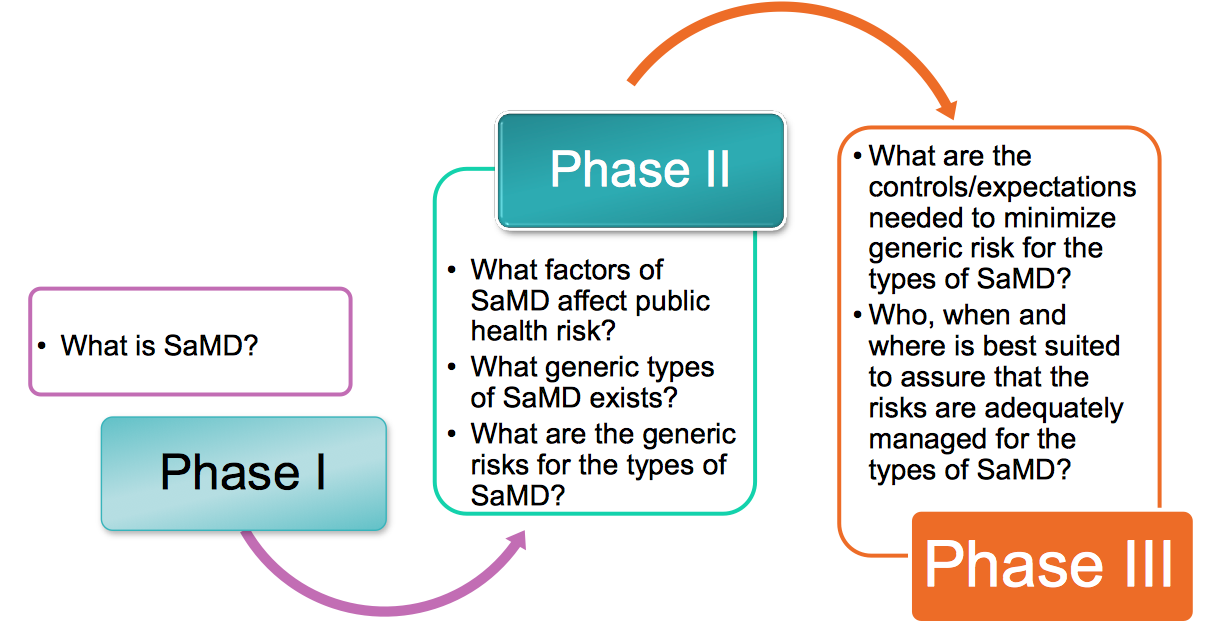
The SaMD project consists of three phases, of which the first has been completed. The second and third phases are currently underway with a working document that has been made available to stakeholders on SaMD controls, but which has not yet been made public. It contemplates a system of common controls and specific controls (based on the risk of the SaMD concerned).

Schermafbeelding 2014-01-12 om 21.07.58

This document will no doubt be discussed at the next meeting 25-27 March in San Francisco. The consultation is planned – again – during the summer holidays this year (better plan for some poolside quality time for that) with a view to closing the document during the 16-18 September meeting in Washington DC, to make it public shortly after that meeting.

A good opportunity to learn more about all of this is the upcoming Informa conference on The Medical Devices Directives and the Revision, which has a software section with a competent authority and with COCIR’s Software Task Force deputy chair, who will no doubt be able to say a lot more on this subject (and if they don’t they will be able to answer questions). That conference is a good opportunity in any event to be updated on the general state of the revision. I’m also there if you want to catch up, and will update you on the on the exciting but still rather opaque subject of the Eudamed cathedral.

Schermafbeelding 2014-01-12 om 21.28.50

Happy Holidays, and an exciting and innovative New Year to you – and a correction

95-016 Kerstkaart2013_Digi

You have a lot to look forward to next year

  • unannounced notified body inspections will start (I hope you, your subcontracts and suppliers are prepared – if not, take a look at this instructive MedCert video),
  • we will or will not close the project of the medical devices regulation revision before the elections during the Greek presidency (no telling what will happen, but who knows what political deals may be sprung upon us – I hear that the Commission is planning for some very Shakespearian drama outcomes),
  • after the Council meeting that was only about the medical devices revision we have no idea where the IVD revision is politically, having been moved to the political back burner or still firmly slipstreaming behind the medical devices regulation,
  • then we have not even started to discuss the clinical regime in the proposed medical devices regulation, which is inconsistent with what you know about GCP from ISO 14155 on important points,
  • market access will remain a point of concern, especially with reimbursement not taking any steps on EU level – why not start a parallel review directive proposal like the FDA has to compensate for the transparency directive that never got extended to medical devices?
  • mHealth and eHealth markets continue to suffer from the EU’s inability to take the NO out of innovation by going carrot on the SMEs via DG Connect to then beat them down with the regulatory stick from DG SANCO – how on earth can I paper label my health app that is a medical device as an SME?
  • the General Data Protection Regulation proposal will also continue to percolate through the system, and if you are planning an eHealth, mHealth, teleWhatever or other patient data intensive business, this development should be top of mind in your company, right up there with the medical devices regulation revision. This nice new law is quite hostile to consent based data health collection and processing, but with the exceptions for processing health data without consent having been trimmed down to basically nothing you can base a business model on you don’t have much choice – damned if you do, damned if you don’t. Another NO in sorely needed innovation.
  • we’re sad to see him go but our multitalented support lawyer Arber is hitting the market, he’s looking for a job as in-house counsel at a medical devices company in Europe (preferably Netherlands or Belgium) so let us know if you need an excellent in-house lawyer with regulatory capabilities. We’ve already trained him for you in EU medical devices and other life sciences legal & regulatory. He already is an EU law expert with in-house legal experience and a unique skill set in languages.

And a correction

It turned out that the consolidated text we prepared for the Medical Device Regulation contained a small persistent mistake in the vigilance paragraph of the proposal where the Parliament consistently changed “serious incident”  to “incident” and which we did not amend consistently.

Big thanks to Oliver Bisazza from COCIR for spotting this (and the good news is that he did not spot any other mistakes). Download your new and corrected version here or from the original blog post.

Speaking of corrections: vigilance obligations for ANY incident – that will be a LOT of extra work for the vigilance people at manufacturers.

Happy holidays!

The EU Council Debate on medical devices regulations: wheelbarrow of frogs

380px-EU_Consilium_Logo.svgWell, we had the Council meeting last Tuesday on among other things Health, in which the medical devices regulation proposal was debated at quite a length. Where are we now and where are things going?

My impression is that it’s a mixed bag or rather a wheelbarrow of frogs and it really depends on who you ask. To me the picture was of a

  1. Commission that wants to move on with the dossier but needs to appease the Parliament even though they don’t agree,
  2. number of member states that have difficulties dealing with the complexity of the dossier and but could generally live with the proposal (like the Latvians) and
  3. a growing number of member states that know very well what this is about but are having difficulties getting their point across to the others about why they are not happy with the proposals as they ended up after the Parliament’s plenary vote.

The debate concentrated on the two points that are really important to the Council: the market approval procedure and reprocessing. The IVD proposal was not discussed at all, regardless of the quite important role that IVDs play in modern healthcare, which will only increase in the coming decades. As we have seen in Parliament the discussion is at such a high level that it really does not do justice to a very important piece of highly complex and technical draft legislation that will have an important impact on healthcare and healthcare costs for decades to come.

Commission

The Commission reported that the Greek presidency has already confirmed it will work on it as a matter of urgency, but there are still problems to sort out. It confirmed that it can live with basically any solution, as long as it does not delay market access unduly. Regarding reprocessing it defended its initially proposed solution: that a reprocessor must be subjected to the same rules as manufacturer, combined with opt-out on a national basis.

The member states

Silly Olympics_Monty Python

Member states aligning for a coordinated effort

The member states are always a colorful lot, and make it a sport to each do something completely different, even in the same game. Below is a selection of the member state views. If you want a concise overview, check the Twitter report of Robert van Boxtel (@RobertMDProject), who tweeted summaries of all member state positions successively during the debate.

Let’s start with some of the extremer and (in my opinion) less realistic views of some member states. The Belgians and Austrians made a splash by arguing that the proposed rules are still way too lenient on implants and high risk products. Hungary decided it would be a good idea to reverse harmonization by requiring manufacturers to notify devices nationally before that can be placed in the market, i.e. back to the situation before the medical devices directive.

Then there are the member states that were a lot more critical about the basic assumptions in the proposal. The UK is in favor of beefing up notified body review rather than adding an additional layer of review, and is against reprocessing. They kindly applauded the Dutch leadership in the medical devices dossier (go Dutch!). Ireland later joined this point of view. Germany thinks the same about the approval mechanism, but completely different about reprocessing because they have 12 years of positive experience with that. The Italians are against PMA and strongly against reprocessing. The Dutch are also against the PMA proposed and emphasized that it is not realistic to frontload the market access procedure in a way that safety does not improve. Rather, post-market surveillance requirements should be strengthened so products can be improved quickly. The Swedes concurred with that and stressed it’s better to not have a regulation at all at the moment than a flawed one. They also stressed that single use products should not be re-used because they are not built to be re-used. The French, on the contrary, are very much in favor of PMA and seem to head up the movement of member state supporters of the PMA system as proposed by Parliament.

Most of the member states have big problems with reprocessing. Basically only the Germans are really positive about it (remember, Rapporteur Roth-Behrendt is also German), supported by the Croatians and Slovakians. Many member states say this should be left to national discretion so they can scuttle this nationally. It seems a consensus could be found around the Commission’s initial proposal as many member states say they could live with that. The Commission proposed that

“reprocessing of single-use devices is considered as manufacture of new devices so that the reprocessors must satisfy the obligations incumbent on manufacturers. The reprocessing of single-use devices for critical use (e.g. devices for surgically invasive procedures) should, as a general rule, be prohibited. Member states retain the right to opt out on national level.”

The Fins were the only ones really in a hurry and urged finishing the dossier before the elections. The Portuguese stood out by not wanting national exceptions for reprocessing, but rather a single European framework.

The Greeks said this dossier will be their highest priority during the Greek presidency starting on 1 January and that it has to move forward as far as they are concerned. On the other hand, they also say that a new regulation should not jeopardize the advantages that the EU currently has in medical devices marketing approval, so there’s your reason to hit the brakes.

There were more member states points of course, but this gives a good overview of the different positions.

The Commission summarized as the end that it had understood during the debate that there is another balance to be struck: between the procedure’s administrative burden and the speed of approval and that the door has definitely not been closed on the proposals on the table in the debate.

The Commission also said that the relation between pre- and post market requirements might be relaxed in the future when the notified bodies function better and the scrutiny procedure could be abandoned again in favor of an approach with more focus on post-market surveillance. I was puzzled to hear this: why first put the EU industry years back by shooting it in the knee with a system that will not work to subsequently shift to a system that might and that you could (and should) start with immediately? Appararently the only reason for this is appeasing  political public opinion fed by the misguided and fact-free idea of framing legislation as stricter and therefore better even if that regulation that does not achieve its goals to everybody’s detriment, industry, patients and taxpayers alike. That does not make sense.

So, now you probably understand my earlier remarks about compromises as we can only make them in Europe, because this wheelbarrow of frogs needs to reach the finish one way or the other with all frogs still on board.

The reactions to the debate have been mellow so far, if it was even picked up in the first place. FierceMedicalDevices reports on the Irish being retroactively more against PMA, while MedTechEurope (Eucomed and EDMA) gives a diplomatic and objective overview of the different positions and timing without whipping out the crystal ball to make predictions.

What next?

drb2

I stil have this many procedural tricks up my sleeve to see this dossier through before the elections!

To paraphrase: it isn’t over until the fat lady has stopped singing. After singing to the Lithuanian Presidency she is now singing to the Greek Presidency, trying to see if she can speed things up to get the deal sealed before the elections. By the way, we from the outside still haven’t seen the data she says she has to support her proposals. So far the only real public data came from the Commission in its initial  impact assessment underlying its proposal and from an attempt by Eucomed to quantify the costs of the ENVI proposal. Some member states have also thought about whether the proposals will achieve what they claim. As far as I’m concerned the rest is free-fact conjecture and political framing, which is of course the best evidence-based foundation for regulations that will impact on everyone’s health, quality of life and the associated costs in the EU for decades, as you will no doubt agree. It reminds me of a favorite Yogi Berra quote: “If you don’t know where you’re going, you might not end up there.” – that’s why you need facts to support proposals.


It will be a kind of magic

As the Lithuanian health minister presiding the Council meeting underlined in his conclusion: the magic has to happen in the months of January to March during the Greek Presidency (“the best months”) so we will have a good idea where things will be going by the start of April. Magic also means a surprise move here and there, which I do not exclude.