ENVI vote postponed once more

ENVICompromising is time consuming business, that’s for sure. And sometimes it’s not easy to reach compromises.

Apparently the ENVI Committee members were not able to reach compromises timely, because the postponed vote on the medical devices regulation proposals that was scheduled for 18 September has now been … postponed, again. The discussion of the regulation proposals is not on the current 18 September agenda anymore and has now been placed on the 25 September meeting’s agenda.

Good news?

This seems very tentatively good news for industry, because it looks like the ENVI members have taken more time to avoid ending up with compromises that will not work for anyone, which is the current rumor. What is really going on is difficult to say because we have no idea what is happening within the committee, who requested the extension and how this extra time may affect the outcome. In any event, if you thought you knew where things were – start rethinking.  Politics are at work here, and the positions seems to be very volatile. It is really difficult to predict which Parliamentary group will support what compromise, and that in a situation where we can only speculate about what’s on the table.

Member states and elections

Compromising is further complicated by the fact that member states have their connections to ‘their’ MEPs and may throw their weight around that way. The compromises I was speculating about push fully on the sore points of the member states, making it doubtful if the dossier will make it in the Parliament in the first reading, which adds considerably to the duration. The late date of the Council meeting on this point (10 December) doesn’t help things, and it seems to become even less likely that the dossier will be finalized before the EU elections.

Stay tuned

Where will we end up? No way to tell at this moment with all the permutations possible. Let’s just hope that the wings are not actually on fire and this dossier makes a nasty crash landing in a compromise that will not help stakeholders except for the politically involved ones.

EU medical devices directives revision: “The wings are not on fire”

drb2

The wings are not on fire!

Everybody (I would hope so for the sake of cultural standards) will be familiar with the famous Monty Python sketch about the two bored pilots that decide to make things interesting by causing panic with the passengers by means of a series of increasingly urgent and ill-considered messages over the airplane intercom.

This sketch almost seems to be a template for the ENVI committee’s process with respect to the medical devices directives revision. Dramatic statements, delayed vote, proposals for amendments that make no sense and/or go in all directions, companies panicking al over the place – all the ingredients are there. Humor aside: it would almost be funny if this was not about the rules that impact the actual lives of patients.

Currently we’re waiting for the 18 September vote (coming Wednesday) and while the ENVI committee is internally preparing its compromise and other amendments to be voted on, the rumors start to flow about what’s cooking. So, based on what I’ve heard I decided to fire up my crystal ball to give you some insight in where I think things might be going on some of the bigger points in the mix. Mind you, this is all highly speculative thinking about a very fluid situation happing in an intransparent stage of the political process.

Compromising? Rather: complicating.

The ENVI committee is now in its compromising process and things are getting more and more complex very quickly. I would not be surprised if MEPs are by now starting to give up on the process hoping that the Council will solve it, because the dossier is becoming too complex for everyone. The same happened with the General Data Protection Regulation that completely spun out of control in complexity and is now firmly bogged down in the committee responsible. I recall statements of rapporteur Roth-Behrendt to the effect that we should be happy that the experts of the Parliament are on the case to help the member states get the Commission’s proposal up to standards. That all sounds a lot less glamorous now. The rapporteur will of course blame everybody else for making it overcomplicated with their devious lobbying and even alleged lying, in a textbook exercise in cognitive bias that we have witnessed at work in the March 2013 workshop and the 29 May ENVI debate.

From what I have heard about the compromise amendments in the making this complexity will only get worse, because EU legislative compromising is about giving everybody just enough of a little something so each of them can claim success. The French have something like an agency sign off, Roth-Behrendt has the EMA (which she helped create) in the mix, the notified bodies stay involved, the member states have committees that play an important role and the Commission is the spider in the web, you can just draw the picture by connecting the dots of interests involved. That kind of process never leads to the best legislative solution, but inevitably to the most overcomplicated and unclear one. Neither will help, as we need legislation that is clear, precise and serves its own purpose. Not somebody else’s political purpose.

Fog of war, still or again

At this point it is impossible to say where things are going, this is fog of war again, or still is. The parliamentarians are in Strasbourg compromising like it’s 1999 and nobody from the outside has a reliable view into this black box. What I have heard is that the vote for the 18th will be based on grouping of the 900 plus amendments, the compromise amendments and the consolidated amendments from political fractions in the parliament into several options that the ENVI members can vote for. What the options are is not clear either at this point.

I think it’s safe to say that one of the options is some form of PMA somewhat along the lines as proposed by the rapporteur Roth-Behrendt in her proposal – a safe bet, because Eucomed launched a renewed attack on that option today which means that in their impression this option must clearly still be on the table and I have no reasons to second-guess them on this point.

Another possible option might be the rumor I heard about the possible creation of a new class of ‘super notified bodies’ under the supervision of EMA. These super notified bodies (I hope they will get spectacular uniforms and logos) would be allowed to certify riskier devices than the other, ‘normal’ notified bodies. Why on earth submit this to EMA supervision? Well, that’s compromise in action for you, since EMA probably doesn’t even want this job or has personnel qualified for it – medicines are rather different animals than devices.

Option 3 could be to basically leave the system of notified bodies as it is, but give the Commission a role in the accreditation of notified bodies (I’m speculating here, but I believe this was in one of the many amendments) to ensure uniform quality. Not a bad idea, but a hard sell to the member states that would get power taken away from them.

Option 4 might be to leave things as they are but increase the member states surveillance over notified bodies (as is currently going on in the Joint Immediate Action Plan). That would fit in what the member states would like, as they have already said they won’t like transfer of power to the Commission or EMA.

There may be more options. As said, I have no idea about whether these thoughts is remotely right and whether other options are on the table, but this is what I can conceive based on what I have seen in the process so far. Also, I have not even begun to speculate how the Roth-Behrendt proposals on reprocessing of medical devices fit into these options or what may happen to all the crazy proposals around genetic testing in the IVD amendments.

Let’s not lose it

You know how that Monty Python sketch ends, right? Everyone jumps out of the airplane in blind panic and the pilots stay behind puzzled why on earth that happened. Well, to continue the analogy: the same happens if you prepare to impose rules that don’t make sense in a situation that calls for rules that actually work, and then hold that over the market for a couple of years, expecting that nobody is paying attention and that you don’t influence decisions of companies about where to go with their innovative medical device first. Expecting that this does not have a detrimental effect one way or the other is somewhat naive. Seriously, having innovative medical devices companies bail on the EU is not what we wish for the EU market for medical devices. We have been doing so well in Europe compared to other markets in terms of safety and time to market even if we got some things wrong that need fixing – let’s not waste this perfectly good crisis by adopting legislation that jeopardizes the advantages that Eucomed has described so well in their Don’t lose the 3 campaign, just because we need a compromise to appease people with proposals that were never a good idea from the start.

Maybe I’m too early with my criticism and maybe 18 September produces a brilliant result. But I’m hedging my bets and am starting to hope that the Council weighs in and channels these proposals into something workable, sooner rather than later.

Healthcare software enforcement alert

Rijksoverheid_logo_02If you are active in the medical software field in the Netherlands you may probably be aware already that the the Dutch healthcare Inspectorate IGZ has announced that it will rigorously enforce medical devices law against medical software that they consider a medical device as of 1 January 2014. They have said so pretty clearly on an invitational conference  last 5 June, and have now started to collected information from the market to determine the general compliance level in what looks like a pretty large information gathering exercise. Several companies I know have received the same letter that has been drafted from the assumption that the company’s software is a medical device. The information that IGZ scoops up in this information gathering exercise will be used to define their enforcement policy for the period after 1 January 2014 and of course, to determine whom to enforce against first.

Self-incrimination

The question of course is if you are obliged to provide this information, and whether if you are perhaps incriminating yourself by providing information in the level of detail requested. At this stage we have no idea what the IGZ is going to requirement as satisfactory compliance benchmark for medical software under medical devices law. We know that some companies are providing the information without giving it a second thought, but I think this may not always be the best idea looking forward.

Practicalities of how-to

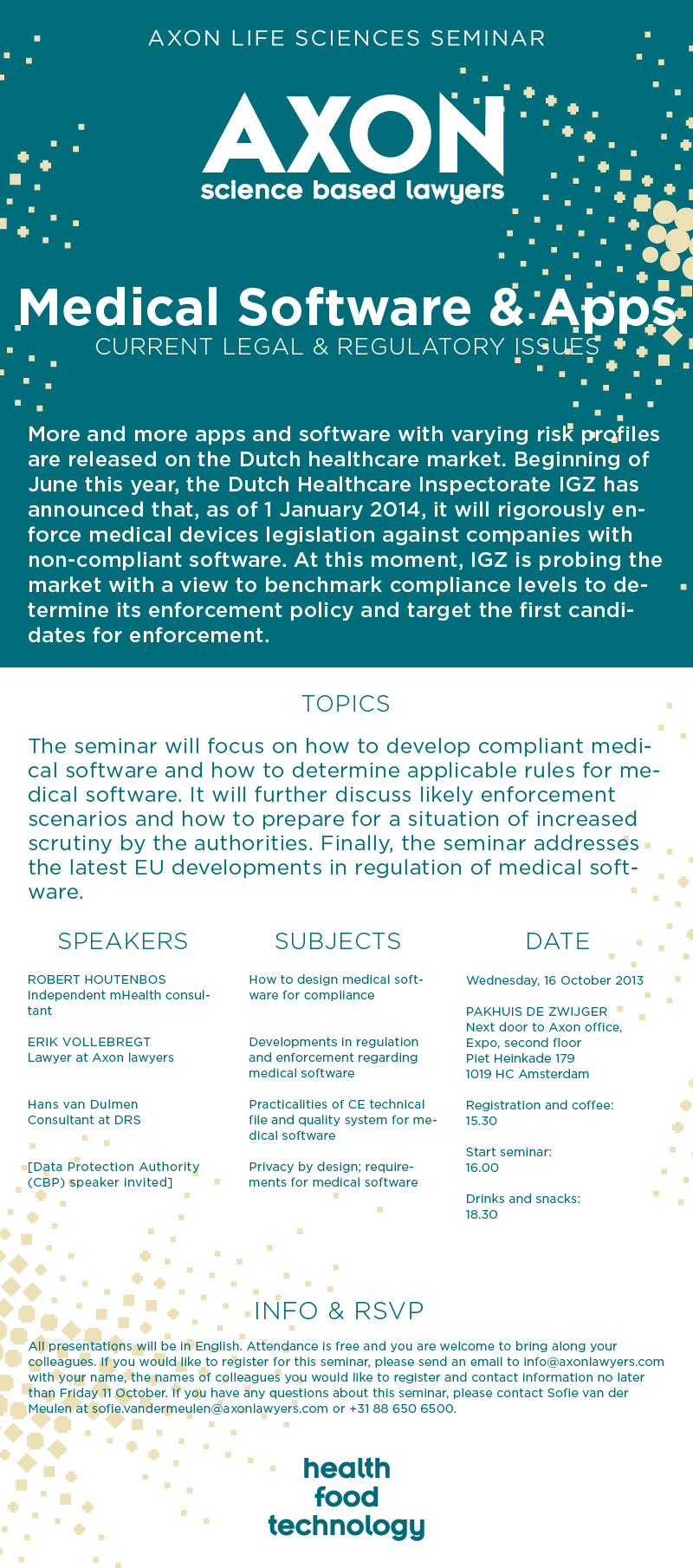
Every company that develops or sells software (apps, websites, electronic health records) for the healthcare industry in the Netherlands and/or has its authorised representative in the Netherlands will be affected by this sooner or later. Since the IGZ has determined that it is going to put the medical software market through this process, I though it would be a good idea to organise a seminar about this at my firm in Amsterdam on 16 October 2013, see below for invitation. We have been able to get some of best medical software experts in the Dutch market for presentations.

The seminar will not only discuss what to do in the various enforcement scenarios we expect, but also how to determine if your app, website or other software is a medical device in the first place, and if so, how to design it for compliance. We will also address the practicalities of CE marking of software and the often overlooked other important compliance element of protection of personal health data compliance.

See you there!

We hope to see you there on 16 October – please RSVP to the email address in the below invitation so we can plan resources for the seminar. If you have any questions beforehand, feel free to contact me or my colleague Sofie van der Meulen.

131016-Medical-Software-and-Apps

Celebration time!

FireworksIt’s time for a celebration!

Why? Did the ENVI committee magically produce a proposal that makes a lot of sense, and ahead of time?

Unfortunately  not – we still have to wait and see what happens on 18 September. But you can count on me writing about it. There will be lots of interesting discussions about this on the Advamed (Washington) and  RAPS (Boston) conferences end of September, and of course on the MedTech Forum (Brussels) event early October, all of them very worth your while to visit.

So what are we celebrating then? Well, the Medicaldeviceslegal blog has just broken the barrier of 100,000 visits.

“Big deal”, you will probably think, “100,000 is not that much in the big scheme of things.” True, but it’s like with some other things – size doesn’t matter, but rather what its effects are. Don’t forget, this blog occupies a specific niche by catering to a small community of readers and only covers EU law. Many people tell me the blog has provided a positive contribution to regulatory and legal knowledge in the medical devices field. In any event, it has become very visible in Google searches. I myself hope that I have made a difference and have helped people in their thinking about regulatory and legal issues in EU medical devices law.

Innovation

As a result of the blog’s success I have been consulted by politicians and authorities in Europe, have many blog subscribers among our competitor law firms and we have had many interesting discussions in the comments sections. Some companies have confided in me that they have incorporated parts of posts on the blog in their SOPs and quality system, which is a great honour of course. Also, the blog has been instrumental in my law firm winning the Golden Hourglass, the Dutch innovation award for law firms among others because it allows my firm to act very internationally for a relatively small boutique outfit and implements a strategy of sharing valuable information for free with everybody to showcase capabilities.

Diversity & crystal ball

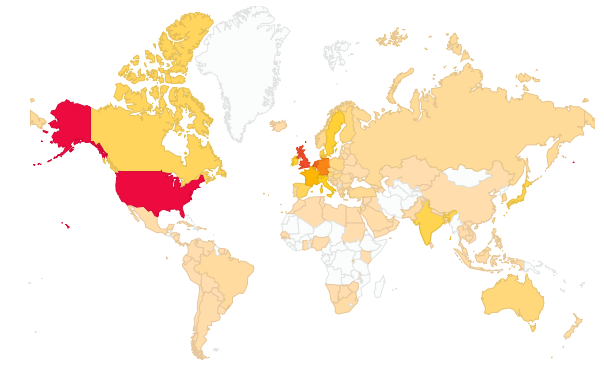
I  am amazed by the diversity of readers. The majority of the blog’s readers is from the US, proving my view that there is a strong need for EU medical devices materials for the US audience. RAPS is doing a good job in this respect, with its EU Fundamentals of Regulatory Affairs book, which contains a comprehensive medical devices section. If you read German you cannot do better than the alpha and omega on EU medical devices regulation, the Anhalt/Dieners Handbuch des Medizinprodukterechts, even if it is in need of updating. If you want a good discussion, especially on standards, join the Elsmar Cove Forums –  the best fora (I think) for regulatory discussion in European and other medical devices affairs.

The US aside I have logged readers from more than 100 different countries, which is amazing. If you look at the map below, there are not many countries left in the world where this blog was not read at some point.

Schermafbeelding 2013-09-03 om 20.10.39

I have been wrong on occasions, but in the end turned out to be close to the mark as to end result. I have sometimes predicted that things will happen that didn’t yet, like that the  Commission will do things they still haven’t done (e.g. the unannounced audits package that we are still waiting for). But, in the end, in retrospect my crystal ball turned out mostly accurate and I hope to have provided you with a worthwhile experience most of the time.

So here’s to the next 100,000 visitors

A big hat tip to you, readers, as gracious as I can manage. You make this a worthwhile effort by reading and commenting. Thanks for your interest and thanks for the many positive comments and support, and for spreading the word to your colleagues.

If I am ever missing subjects that are important to you, just let me know. Ideas are always welcome, as we embark on the journey to the next 100,000 visits.

What will the Intermune and Abbvie cases mean for the medical devices industry?

logo-curiaI have just written annotations to the Abbvie and Intermune cases under EU pharmaceutical law for the next issue of the Dutch legal journal Jurisprudentie Geneesmiddelenrecht (in Dutch, sorry) but of course that started a train of thought on how these cases might influence the medical devices industry, especially because I have already mentioned that these cases may have an impact on some of the proposed ENVI amendments with respect to transparency of clinical information provided for market access, so here it is.

The Abbvie and Intermune cases

A quick and dirty recap for those that are new to these cases: in the EU we have an Access to Documents regulation that entitled citizens to request EU institutions to disclose documents, which can be refused on a number of grounds, among others that these are company confidential information. The regulation setting up the EMA and governing its procedures has a provision on confidentiality of documents in dossiers (article 80). In the past, the EMA would always refuse requests to have access to documentation provided by applicants in a marketing authorisation dossier because it considered the documentation company confidential. At some point, some scientists decided to get the EU Ombudsman involved because they wanted to get access to the clinical data underlying the dossier. The EU Ombudsman decided that the clinical part of the application file did not constitute confidential information in the meaning of article 39 TRIPS and EMA decided to grant access and revisit its policy, at a timely moment because of an increasing call for transparency from the scientific community. So, when competitors of Abbvie and Intermune requested access to the clinical trails part of the application dossiers concerned, the EMA informed Abbvie and Intermune that it was going to grant these requests. To prevent this from happening Abbvie and Intermune independently filed appeals against this decision at the EU General Court in Luxemburg  (which are still pending under case numbers T-73/13 and T-44/13) and filed for injunctions at that same court to enjoin the EMA from letting the djinni of publication out of the bottle, because the appeals did not have the effect of suspending the decisions. They both prevailed, with the President of the Court finding that in view of the large interests at stake, the lack of case law on this point, the fact that confidentiality of business  information is a fundamental right for companies and the fact that non-public information that has been made public cannot be made “un-public” anymore. See here for a good summary of the legal issues in the Intermune case by Arnold & Porter (those in the Abbvie case are identical, with negligibly differing facts).

Transparency in context

Let’s put all of this context.

The EMA has in the mean time adopted a very conservative policy on publication and just says: “Requests for access to documents similar to those contested by AbbVie and InterMune will be considered on a case-by-case basis in the light of the Court orders.” The appeals are underway in a procedure on the merits at the European Court. Judgement may probably be expected last half of 2014.

Both in the revision of the EU Clinical Trials Directive (see amendment 30) and in the revision of the Medical Devices and IVD Directives the ENVI committee proposed an amendment that the clinical substantiation for the market authorization would be public. The pharmaceutical industry was not that happy with this amendment for the Clinical Trial Regulation and we still don’t know what the resulting text for the regulation is because the first reading still has to happen (tentatively scheduled for 10 March 2014). The medical devices industry, for its part, has been surprisingly quiet on this point so far, but maybe they missed it in the fog of war caused by the great number of amendments. I would say this is pretty important stuff that companies would want to engage on in view of the much raised bar for clinical substantiation under the proposed medical devices and IVD regulation proposals.

National competent authorities in the EU in pharmaceuticals are also considering how they can be more transparent about the clinical data underlying the market and are looking at these cases as it will impact their policies too.

Conclusion: the result is a complex multi-level Mexican standoff pending the EU Court’s proceedings on the merits. Authorities being authorities, this will not be a balanced equilibrium because someone will make a move at some point that sets other things in motion, and you do not have to have seen a lot of Tarantino movies to guess what happens then: confusion everywhere.

Why is this important for the medical devices industry?

We don’t know yet if the amendments regarding medical devices and IVD clinical data transparency (there are various) will make it into the Medical Devices and the IVD Regulation, because presently they are only tabled amendments and the ENVI Committee is yet to vote on which of the approximately 900 amendments tabled will be in the ENVI proposal that the EU Parliament’s plenary will vote on. But we will know more by 18 September, when the ENVI committee finally votes. What we do know is that the new regulations will require manufacturers to produce a lot more clinical data (see Eucomed’s position paper chapter 6 for a summary) that will not only be interesting for themselves, but also for competitors (for example the comparative and the equivalency studies the new regulation would require more of would be very interesting for your competitors, as well as scrutiny procedure review of high risk devices ).

What is in the regulation proposals already and unlikely to be changed? Of course there is article 84 in the medical device regulation proposal with its counterpart in the IVD regulation that says that

“all parties involved in the application of this Regulation shall respect the confidentiality of information and data obtained in carrying out their tasks in order to protect the following:[…]

(b) commercial interests of a natural or legal person, including intellectual property rights;”

But hey, that sounds remarkably similar to article 80 of regulation 726/2004 that Abbvie and Intermune were thinking they could rely on until EMA moved the goalpoasts :

“[…] the Management Board, on the basis of a proposal by the Executive Director and in agreement with the Commission, shall adopt rules to ensure the availability to the public of regulatory, scientific or technical information concerning the authorisation or supervision of medicinal products which is not of a confidential nature.”

In the end it’s really all about how you interpret “confidential” in the light of how transparent you want to be to further what specific interests. Confidentiality is what you want it to be.

The fact that the EU Court does not find it obvious that the information is unprotected should not only be a wake-up call for the EMA and national competent authorities in medicines but also for ENVI Committee and the Council (which is preparing its position behind the scenes for coordination with what comes out of the ENVI vote). The proceedings on the merits in the Intermune and Abbvie cases will determine what kind of clinical information is public and what is not. The question is if the judgments in these cases are in time to make a difference for the legislative procedure for the medical devices regulations. Whether the regulations will be finished before the European elections end of May 2014 is a big item of speculation. If they are not, the judgments may make a difference because the outcome can be taken into account in the legislative process. Otherwise, if the scope of publication of clinical data ending up in the medical devices regulations is larger than the scope that the EU Court rules is allowed in the Abbvie and Intermune cases, the validity EU medical devices regulations might be challenged by industry and others because EU internal market law cannot be contrary to fundamental rights.

In the very hypothetical case that EMA gets more of a role in medical devices market access, which still seems unlikely, we can expect that there will be a more or less synchronised approach to pharmaceutical and device clinical data under an EMA policy. If we end up with the more likely option of the MDCG as proposed by the Commission and the technical files being filed in Eudamed by notified bodies, it is obvious that there are some new actors that will have to decide on their policy in this respect (Commission and MDCG) and those that may need to amend/revisit existing policies.

That’s a lot of known unknowns that can still be influenced to an extent, which is precisely why this is a good moment to start to think about this more from an industry perspective.

“S” is for scope: does that include to ‘enhance’?

EU flagThe scope of the concept of medical device is in constant flux. The EU amended the definition slightly in 2007 to accomodate for standalone software as medical device, the GHTF changed its definition not that long ago, and currently the EU is working on a new medical devices definition in the medical devices regulation proposal.

From compensation to enhancement

With more and more developments in bionic enhancements for humans becoming available, there is a tendency for products that could be used to remedy, compensate or alleviate handicaps or injuries to convergerge into enhancements to the human physiology, and perhaps – if you are a Ray Kurzweil fan like I am – for mental augmentationas well. A nice example is this bionic ear, which would compensate quite nicely for a lost ear, but which would also make a very nice enhancement because it allows you to hear a lot better than with a normal, healthy ear. Or how about some ocular implants that allow you to see in other visual spectra than the normal, like infrared or X-ray? I’m sure there are special forces guys that would find it very convenient to be able to see in the dark and look through walls. I myself would like to be able to combine the brute serial calculation power and storage capacity of traditional computers with the associative parallel processing that the human mind enables. That would be awesome! If we believe Ray Kurzweil implants for this purpose should become available in the near future (2029). I would love to be able to do really fast complex calculations and carry all my digital files around in my own head.

How to regulate?

How to regulate these types of enhancements that are not medically indicated because the persons requesting them are perfectly healthy? We had this problem in the EU with cosmetic implants (not breast implants, they have their own classification directive and already were medical devices) that people wanted implanted to look more like a klingon, for example. These products have a risk profile that is very similar – if not identical – to medical devices, so why not regulate them as such? This is exactly what the EU is doing with the current proposal for the medical devices regulation, by providing in the article on definition of medical device:

“The implantable or other invasive products, intended to be used for human beings, which are listed in Annex XV shall be considered medical devices, regardless of whether or not they are intended by the manufacturer to be used for a medical purpose.”

Annex XV contains a list of products that are regulated like medical devices, even if a ‘medical’ reason for using them is absent. This annex can be updated by means of delegated act (article 2 (2) of the proposed medical devices regulation), as to allow new products to be placed on the list without having to go through a full-blown legislative procedure that would otherwise be required.

Currently, the proposed regulation lists the following products:

1. Contact lenses;

2. Implants for modification or fixation of body parts;

3. Facial or other dermal or mucous membrane fillers;

4. Equipment for liposuction;

5. Invasive laser equipment intended to be used on the human body;

6. Intense pulsed light equipment.

New borderlines and legal recourse

The EU will create a flexible way of regulation these types of products. However it will create a new border area (a borderline does not exist, because that concept assumes clear demarcation criteria – which do not exist in practice). Where there are borderlines there are differences of opinion, and where we see those there are ensuing disputes. Naturally, as lawyer I am curious about protection of the rights of companies that may see products placed on the Annex XV list, just like you could currently end up in the Borderline and Classification Manual, without any formal recourse possible against the MDEG’s decision to put the product in it under a specific qualification. What if a company finds that its products are suddenly on the Annex XV list? With a delegated act being an EU institutions legal act, recourse against it should be possible under article 263 TFEU, right? Well, not so fast. Article 263 (4) TFEU provides that:

 “Any natural or legal person may, under the conditions laid down in the first and second paragraphs, institute proceedings against an act addressed to that person or which is of direct and individual concern to them, and against a regulatory act which is of direct concern to them and does not entail implementing measures.”

This provision addresses two types of acts that the so-called “non-privileged applicants” can challenge:

  1. the instruments that are de facto decisions (could be challenged under old article 230 EU)
  2. regulatory acts which are of direct concern to them and does not entail implementing measures (new under Lisbon Treaty)

There are two problems here: de facto decisions are notoriously difficult to challenge (as witnessed by a long line of case law showing how difficult it is to prove the direct and individual concern needed for a de facto decision that can be challenged as non-privileged applicant) while delegated acts to fill in Annex XV seem to be regulatory implementing measures, which are similarly difficult to challenge as the ongoing Seals Products cases show, which are the first about the interpretation of this new concept of regulatory act. This leaves undertakings that see a class of products added to annex XV with no serious option for legal recourse, because national courts will not be able to rule on the contents of the Annex XV list, but only on whether a particular product fall within a category on that list. The only viable solution is to make sure that the companies concerned manage to lob a product of off a proposed draft delegated act list seeking to amend Annex XV by lobbying pro-actively.

Alternatively

There are other instruments in the proposal to determine if a product is a medical device. Article 3 (1) of the proposal provides that

“The Commission may, at the request of a Member State or on its own initiative, by means of implementing acts, determine whether or not a specific product, or category or group of products, falls within the definitions of ‘medical device’ or ‘accessory to a medical device’. Those implementing acts shall be adopted in accordance with the examination procedure referred to in Article 88(3).”

This also allows companies to address the Commission to lobby it into instituting an implementing act to the effect that their product or the category it falls in is not a medical device. That happens by implementing act, which may directly concern a company depending on how specific it is, which will impact on legal recourse. In any event, also on this point we can expect litigation with varying degrees of success, as the colleagues of Covington & Burling also predict.

 RIsk/benefit?

 There is one big setback about this way of regulating these enhancements – as well as cosmetic implants, by the way – as medical devices. As the regulation proposal is currently drafted it requires a positive risk / benefit outcome for medical devices and therefore for enhancements and cosmetic devices on the Annex XV list because they are considered medical devices. And this is where we break new regulatory ground: how will you prove that the risks associated with enhancements related procedures and use (cosmetic or performance wise) are outweighed by the benefits, in other words “that any risks which may be associated with their use constitute acceptable risks when weighed against the benefits to the patient and are compatible with a high level of protection of health and safety”? With ‘normal’ therapeutic medical devices there is the benchmark of normal human healthy performance, but this is not possible with enhancements so it is very difficult to demonstrate as there is no standardized methodology for this. Companies will have to follow the standard tech file pathway but need to find a way to tweak the intended use in a way that for that use there is a positive risk/benefit outcome. I expect a firm bias on the side of very cautious on the part of notified bodies with respect to risk/benefit outcomes for new enhancements, provided that the really interesting ones make it to the Annex XV list in the first place. Because delegated acts are proposed by the Commission but normally prepared by member states civil servants in Expert Groups  used by the Commission and member states have a say about delegated acts via the Council, you can bet that only politically uncontroversial products (read: products member states mostly agree about) will be on the Annex XV list.

Consequently

There will be companies wanting to be on the Annex XV list (to make their implants legal) and companies lobbying to stay off it, but the regulatory process will be difficult and predominantly driven by the member states, with no effective legal recourse. Just like with the current borderline process in the Medical Devices Expert Group on Borderline and Classification under the Helsinki procedure- congratulations, we have made a new procedure but have made no progress.

More on mHealth and e-labeling

eLabeling decision treeFurther to my recent post about e-labeling and my appeal to take more account of the specific mHealth market needs I had a discussion with another devices expert who suggested that the majority of medical apps will be in class I anyhow, in which  case these apps can be used safely without instructions, because the Medical Devices Directive provides for an exception in that case and no IFU is needed. Consequently, the app could contain e.g. an electronic application guide only.

Background

This argument refers to the exemption in Annex I, 13.1 Medical Devices Directive:

“Instructions for use must be included in the packaging for every device. By way of exception, no such instructions for use are needed for devices in Class I or IIa if they can be used safely without any such instructions.”

The IVD Directive has a similar exemption in Annex I, 8.1:

“In duly justified and exceptional cases no such instructions for use are needed for a device if it can be used properly and safely without them.”

Thoughts

While this argument is completely correct in its regulatory logic, I have several thoughts on this:

  1. There is a catch 22 in the EU medical devices rules because the consequence of this argument is that you can only provide the IFU electronically in the cases where you don’t need one because they can be used safely without. My point is that you should be able to elabel on cases where you do need an IFU.
  2. This situation may well lead to a race to the bottom, with app manufacturers understating risks in order to be able to rely on this exemption. That is something we don’t need in the wild west market that the medical apps market currently mostly is. This is certainly not a hypothetical risk if you only look at the current tendency of quite a number of app makers to on the one hand declare medical intended use (e.g.: “use this app to check for melanomas”) but then on the other hand disclaim it in terms and conditions as to try to stay out of the scope of medical devices rules (e.g. “this app does not provide a medical diagnosis , always ask your doctor too and we are not liable for consequences of you relying on the information provided by this app”).
  3. Personally I think that the majority of medical apps that will make really a difference in healthcare (and that policy makers bet on to reduce costs of healthcare) will mostly be in class IIa and occasionally in IIb because they monitor vital physiological parameters, such as heart rate and blood pressure analysis over time and conclusions drawn from that will be important to combat and manage modern diseases caused by obesity. That is not class I functionality but at least class IIa, according the EU MEDDEV on classification. I am not sure at all how authorities would view mHealth solutions that are intended for monitoring of non-vital but still important physical parameters in view of the exemptions for IFU inclusion referenced above. It’s like they will err on the side of caution. I have already seen notified bodies operate quite cautiously in this respect with class IIa apps, for which you could also argue that no IFU is needed.
  4. In the case of IVDs and IVD accessories (like blood glucose management apps) no e-labeling is possible under the regulation and only in exceptional cases under the IVD directive the IFU can be left out (and the same race to bottom considerations mentioned above apply). This is a different and arguably higher burden of proof than the Medical Devices Directive provides.

So

While reliance on low-risk character of the software concerned to escape e-labeling obligations may look like an attractive strategy for apps I do not recommend as a long term strategy in the EU apps market. Still, the compliant companies on the medical apps market will be bogged down by regulatory obligations that have not been written with the realities of the mHealth market in mind. The EU needs a more nuanced regulation of standalone software as medical device for consumer end-users.

E-labeling in the EU – some practical experience and: Save the apps market!

EU flagThe e-labeling regulation has entered into full force a couple of months ago (1 March 2013), and I thought it would be a nice idea to share some of my experience with the new regulation with you.

Stop – step back

When the regulation was published in the OJ I wrote that it was a big disappointment for the market, because a lot of the devices of which manufacturers and users  could benefit from e-labeling were left out of the scope of the regulation. For a lot of details on this, you should read my blog on the regulation  and the one on the draft regulation. What I can say now is that the feeling of disappointment that I wrote about has grown as more and more manufacturers find that their device is out of scope of the regulation. Consequently they are stuck with costly and inefficient procedures, which are often not in the interest of the user or the patient.

Alternatively, you can also view the regulation from a glass half full perspective because, after all, the regulation as a first step to more possibilities.

Mobile apps

In my experience those especially left out are the manufacturers of standalone software that is not intended for professional users, which is a quickly developing and fast growing market. While the regulation covers standalone software, this is limited to standalone software for professional use. Consequently, all other standalone software (yes, this includes all healthcare apps in scope of the medical devices directives) must be paper-labeled. I myself believe that the regulatory logic here leaves a lot to be desired.

Normally, the regulator would want to ensure that the user always has easy access to the IFU, no matter what the device itself does or where it is. This thinking is pervasive in the regulation and other labeling rules. However, this reasoning fails to take into account that for apps on mobile devices the best – no, the absolute very best – way to make sure that a user always has access to the IFU, is to make sure it’s embedded in the app itself. If the app functions, the user has access to the IFU and if it doesn’t the user can always find the IFU online on a website.

Although the EU is advocating the use of mobile apps in healthcare all over the place (for example as part of its eHealth Action Plan, it is doing a great job of making placing on the market of apps in a compliant way pretty much impossible at the same time. Really, the consequence of the current e-labeling regulation is that any app that is a medical device must have a paper IFU and other labeling. If not, it is not in compliance and must not be on the market. This also means that when the supply chain controls under the new medical devices regulation enter into force, distributors and importers of apps that are medical devices (Apple, Google, Microsoft, just to mention some of the big guys in app distribution) are going to be under an obligation to check all these apps for compliance with this requirement (and other requirements for CE marking).

This, of course, is an undesirable result and it is clear that the different directorate-generals of the Commission have missed out on an opportunity to talk to each other and make regulation better for everybody. DG Connect is going pedal to the metal stimulating healthcare apps that are medical devices wherever it can, while DG SANCO pulls the the handbrake.

My opinion is that we need a MEDDEV that provides for an exemption to allow e-labeling of apps – limited and conditional and of course taking into account risk management – just like happened for IVDs with MEDDEV 2.14/3. That should be doable because the Standalone Software MEDDEV 2.1/6 is currently under revision, so it can be written right in, provided that the member states authorities working on the MEDDEV in the software group want it. While this is not currently on the table as far as I know, I think it should be. Like with IVDs at the time, this is necessary now. Otherwise we would miss a good chance to remedy this and the apps market that we would like to see flourish will wither. If the Commission wants to empower patients with medical apps: big cheers and hands in the air. But: this will not work if it is made prohibitively difficult to do so in a compliance manner. Otherwise the Commission’s European Directory of Health Apps will be embarrassingly empty, only because the Commission is unable to sort this out within itself.

Enforcement climate

There is not much experience with enforcement by the respective EU authorities, so it’s too early to tell if there are marked differences between the respective national authorities’ interpretations. This also makes it difficult to predict if there would be momentum to amend the MEDDEV 2.1/6 to create an exemption for e-labeling of apps in scope of the medical devices directives. However, I’m sure the authorities will not disappoint us and create some interesting puzzles of diverging enforcement policies, regardless of the fact that we have a unified legislative instrument now – but that just says categorically “no”.

A flowchart

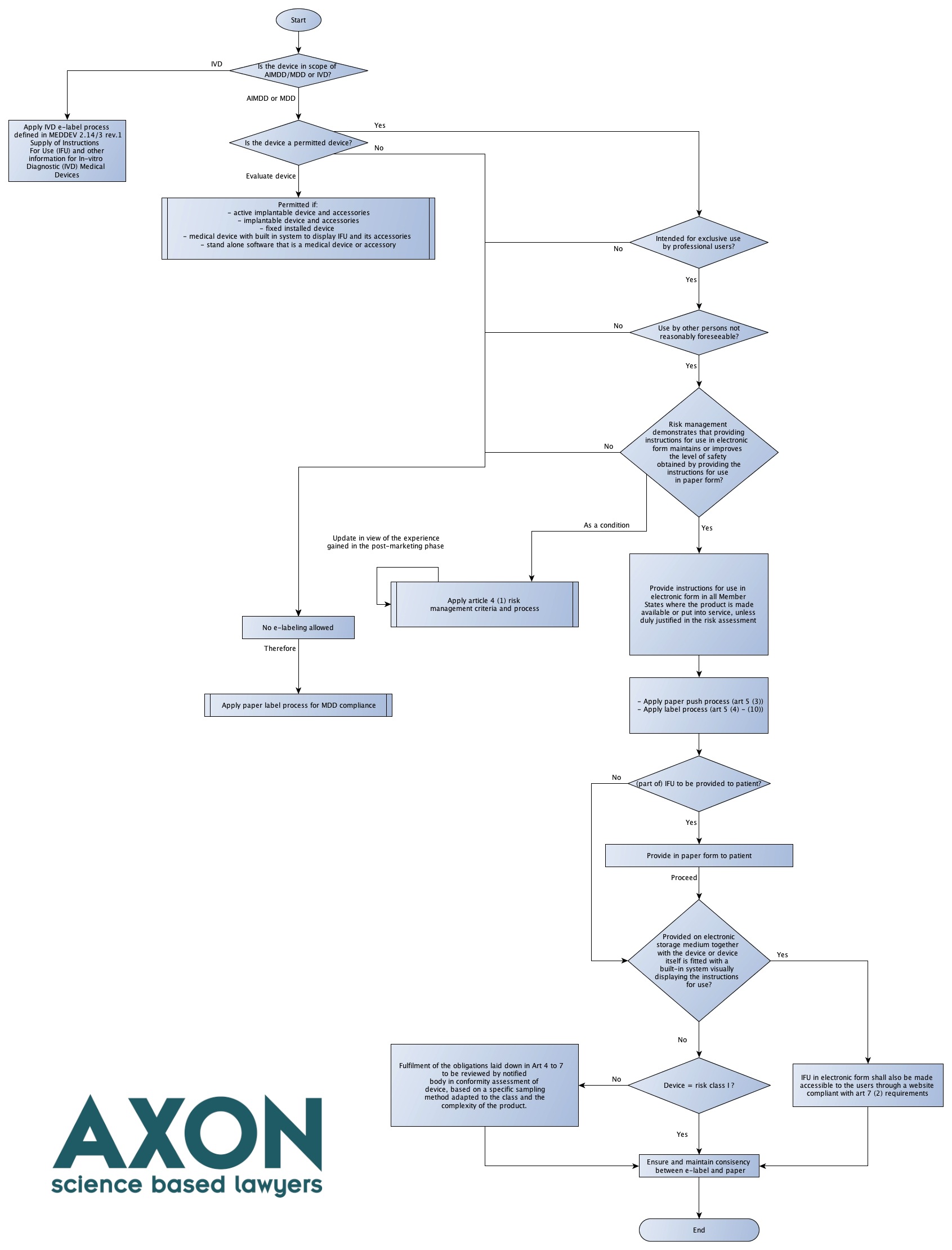
I found that the regulation is a bit dense, although it does follow a process that is logical to an extent. Logic allows for flowcharting, of which I am a big fan because it helps me immensely to understand regulation. So here is my interpretation of the process of the regulation. I cut some corners here and there meaning that the tree is a bit low on detail in some places, but it should be a helpful instrument for understanding the regulation in any event. If the below picture on your screen is too low-res (you can save it by right-clicking and then saving the picture), you can download the full resolution picture here.  Feel free to use, spread and amend it for whatever purpose you like. The only thing I ask is that if you improve it or disagree with it, please let me know so I can incorporate your comments for everybody’s benefit.

eLabeling decision tree

In the mean time… joint immediate action plan, unannounced audits and other things over the summer

EU flag

While everybody is focusing on the legislative process in the ENVI committee and (to a limited extent) on what the Council is doing, significant other developments are playing in the background.

Joint Immediate Action Plan

You may remember that as soon as the PIP scandal’s implications became clear, the Commission initiated the Joint Immediate Action Plan, which is intended to increase market surveillance and notified body oversight pending the adoption of the medical devices regulation and the IVD regulation.

The developments in the joint action plan are not that transparent, but a lot seems to be happening in the background.

Presidency meetings

The Commission representative mentioned during an ENVI Committee hearing that it was quite far along with its implementation. The heads of medical devices agencies (CAMD) met during the Irish presidency, and they also met with the heads of agencies of the medicinal products authorities. However, there was no press about the results achieved in the joint action plan. Currently the Lithuanian presidency is on the ball and has announced that healthcare in general and the progress  on the Clinical Trials Regulation and medical devices proposals are a priority.

Unannounced audits

Some time ago I announced that the Commission was working on a recommendation on unannounced audits by notified bodies and an accompanying Commission regulation for implementation of unannounced audits by the member states, which happily chugged along. This is one of the steps in the joint action plan. This spring I had it on good authority that the recommendation was going to become public in May 2013, triggering the unannounced audits chapter in the notified bodies code. As we have become used to, that date was moved to end of July now, so end of this month. I have it – again – on good authority that this time the date will not be moved; let’s see.

The need to amend your contracts to the new situation in which critical subcontractors (outsourced production, critical parts) will however not change. Several of my clients have started this process in the mean time, not only because I am saying it’s a good idea but because they are do not want to be caught unawares by a surprise inspection that they cannot deal with, if only because their subcontractors have no obligation to cooperate.

Commission Staff Working Paper

Also in the works is a Commission Staff Working Paper setting out the concrete results of the inquiry that the Commission did as part of the joint action plan requesting the member states to set out what they have done and achieved to improve market surveillance following the initiation of the joint action plan. This is probably what was announced and planned for at the end of January at the Irish presidency.

Summer will be interesting

With all these things in the pipeline summer will be interesting. Make sure that your company engages on the unannounced audits instruments when they pass, because in any event in the notified body code there is no transitional period. More about this when the documents become public.

If you are interested in hearing a lot more about these developments and about the revision of EU medical devices law in general, the 2013 RAPS conference in Boston end of September will cover all of this this in detail with at least two sessions, with speakers from notified bodies and the Commission, and I myself. This conference is unique in that it features speakers from Europe that are otherwise very difficult to speak to in person, so if you want the inside from the insight – be there.

ENVI IVD Regulation proposal vote postponed as well

ENVISo far it may have looked like the IVD regulation proposal would be put to a vote in the ENVI committee on 10 July because unlike the explicit movement of the date for the vote on the general medical devices regulation proposal the IVD proposal seemed to stay on track. That turns out not to be the case.

As expected, IVDs vote delayed too

As I predicted, ENVI would not vote on the IVD regulation proposal out of sync with the general medical devices regulation proposal. There are just too many important overlaps, such as proposals to also give EMA a task for centralised market authorisation of certain IVDs. As you can see in the draft agenda of the ENVI committee for 10 and 11 July: there is no mention of the IVD regulation proposal vote, so this will likely move to 18 September or around this date, the date that the general medical devices vote has been scheduled for. Maybe the agenda will be amended, but that seems unlikely.

Will we make the elections?

With these delays, it becomes less and less likely that these two dossiers will be finished before the European elections end of May 2014, unless people start working miracles behind the scenes. Mrs. Roth-Behrendt, the rapporteur for the general medical devices regulation proposal, has not been voted European Ombudsman so she will be around for longer. She may work miracles, but probably not the ones the market and the patients are looking for. If the dossier is not finished before the elections, it will suffer considerable delay. With all the craziness hanging over the market like a big fat dark cloud, I am sure industry doesn’t mind that.

But in the mean time

The question is how things will develop: the ENVI committee seems more and more divided on the big ticket issues, so the proposals will need compromising in order to have a chance to be adopted – but how? I am sure the members of the committee will receive a lot of useful suggestions from all directions over the summer.

Also, you  bet that the ENVI committee will be working on closing its ranks to the outside world, compromising like it’s 1999, with Mrs. Roth-Behrendt’s reputation on the line because she has misjudged her committee members’ willingness to enact legislation that EMA itself says does not work anymore in the pharma system that Mrs. Roth-Behrendt seeks to copy (see more here). Very rational, carbon-copying a solution of which even the agency that applies it says it’s outdated, harms innovation, doesn’t benefit patients and needs to be fixed – wouldn’t you agree? Fortunately more and more ENVI members don’t and neither does the Council. The Commission has shown with an impact assessment supporting its proposal that this will not work for medical devices. Mrs. Roth-Behrendt however claims it will. She even has data to back that up – she says. There’s no way to tell, because of this data that is supposed to back up this wisdom we have seen nothing, rien, nichts, niks, ingenting, nada, intet, нищо, ei mitään, semmi [add 13 remaining EU official other language versions of ‘nothing’] and, in the newest official EU language Croatian: ništa. Zilch, in other words. I hate to sound like a broken record here, but that’s apparently what it takes.

There is more

But then there is more – while everybody is looking at ENVI and fears the worst because of its possible proposals on the big ticket items, the Council working groups have been beavering away in the background on the more technical parts of the regulation proposals: the annexes. I have had some insight in what they are doing and what they propose to change to the Commission proposal. I can say: there will be some surprises for certain medical devices sectors if these proposals make it to the finish line, because the regulatory burden will increase.  And the proposals may well make it, because the Parliament is completely uninterested in the annexes – except maybe as political currency. More about that over the summer!