“U” is for unannounced audits – what’s up with those?

I visited the RAPS Regulatory Convergence conference in Seattle, which provides for a very nice opportunity to catch up with the European medical devices crowd that had gathered in numbers to explain the current changes in EU medical devices law to the US audience and to each other. Apart from the ever charming and authoritative Ms Minor of the European Commission who provided an excellent overview of the current state of the EU medical devices revision, there was a very interesting session on unannounced audits by notified bodies.

What you should know is that the unannounced audits are not something for the mid term future when the revision proposals enter into force somewhere in 2014 or 2015. No, there is a little perfect storm brewing that will make this a reality in 2013 with the following ingredients:

  1. current EU medical devices legislation that already allows unannounced audits by notified bodies;
  2. a new Code of Conduct for Notified Bodies (v 3.0), dated 10 October 2012 that contains a section on unannounced audits “will become applicable directly after official publication and coming into force of relevant regulations, directives or guidance documents from the European Commission or Member States, that require Notified Bodies to conduct unannounced audits”, one of the interesting points here being how a guidance document can “require” unannounced audits – this looks rather like a one-two set-up between the Commission and the notified bodies for the moment, until the regulation proposals for medical devices (proposal here) and in vitro diagnostics (proposal here) enter into force. Indeed, what a coincidence: a guidance document in the form of a Commission recommendation (see below) is in the works and will be published end of this year, to enter into force in 2013. In addition you could wonder about whether this system includes the proper checks and balances (more about that below);
  3. an ongoing process in the Member States pursuant to former Commissioner Dalli’s Action Plan to beef up market surveillance by, among other things, requiring notified bodies to use the instrument of unannounced audits (“Member States to require their designated Notified Bodies to perform unannounced audits of the manufacturers to which they have September 2012 delivered certificates. The frequency of these unannounced audits should be defined by the Commission in a Commission Recommendation, based on the risk of the devices, after consultation with the Member States”);
  4. a draft Commission recommendation on audits and assessments, which, Ms Minor informed us, will be ready by end of 2012, and will be implemented 2013. I have not seen any public drafts of that document, but will be watching out for them. It won’t be very exciting, I predict, as the Commission will make sure that the recommendation will be in sync with the Notified Bodies Code provisions on unannounced audits.

Nice to know all of this of course, but what should you already be doing now as manufacturer?

First, you should start to update your quality system to include a procedure for unannounced audits (as is already a reality for US). If you are planning to copy your FDA procedure for this, think again: “unannounced” in the EU will be really unannounced as in giving you no notice whatsoever and not the short notice the FDA gives you, as was explained in the session at the RAPS conference. The EU is going for the complete surprise effect because this is believed to be the magic bullet for preventing the type of criminal fraud behind the PIP breast implants case. The surprise audits will focus on manufacturing: “The audit shall be based on verifying conformity of a recently produced adequate sample (product, batch, lot) of an approved device type”, as the new notified bodies code puts it.

Secondly, not only you have to be able to account for unannounced audits, but also other parties on which you depend for different steps in the manufacturing process may be visited by surprise. The new notified bodies code provides in this respect: “In case the manufacturer has subcontracted one or more critical parts of manufacture either to own manufacturing locations or to suppliers and they are regarded significant for the safety and performance of the device under review, then the Notified Body needs to determine whether those sites need to be visited as part of the unannounced visit.” That means that if you outsource your manufacturing (which could even include steps as sterilisation in my view) – as a lot companies do – you have make provision for your contractors to be audited at any time. Most of the contract manufacturing agreements and quality agreements in the market will not be equipped to deal with this, so you will need to

  1. update the agreement to oblige the contractor to accomodate this (“Manufacturers must have appropriate contracts with their subcontractors that allow an unannounced visit by their Notified Body”, the code says) and perhaps even agree a mechanism of bonus / malus with the contractor as his compliance will influence the frequency of further unannounced audits (see below in more detail);
  2. draft a procedure for the contract manufacturer to follow and include that in the agreement to avoid surprises; and
  3. train the contract manufacturer in the procedure, also to avoid surprises.

The notified bodies present in Seattle at the RAPS  conference said they will not accept any excuses for not being ready to accommodate a surprise audit. “If you are able to manufacture that day you should be able to receive an audit”, I picked up from the representative of SGS. In the vein of the intention to prevent PIP-like scandals anyone switching on the production line must be ready for a surprise audit.

Thirdly, plan for this to happen at least once per 3 years and plan for the following audit burden:

“• For a legal manufacturer that has subcontracted all critical manufacturing and final inspections steps, and where only documentation is kept and management tasks take place, the minimum duration of the unannounced visit shall be 0.5 day (+ additional time for the subcontractor visit ).• In all other cases where there at least final inspection takes place at the legal manufacturer, the minimum duration of the unannounced visitshall be 1 day.

• The Notified Body shall define the suitable appropriate duration for the visits to additional sites (manufacturing locations and/or critical subcontractors), and shall document the rationale for determining the appropriate duration.”

The audit happens at least once per 3 years, because depending on your risk profile you may be audited more often based on these criteria:

Who pays for the unannounced audits? Take a guess… yes, it’s the manufacturer. And anyone else he can pass these costs on to. That brings me to the point of checks and balances, because what can you do if a notified body places you under higher frequent surprise inspections (which will cost you) and you don’t agree? Well, basically nothing because you have an agreement with the notified body and that agreement will not give you access to an independent legal review of their decision (except maybe if the notified bodies will change the model, which I am not of aware of them doing for the moment), even though the notified bodies are in fact exercising delegated state authority. The only thing you can do if you can’t agree with the notified body is complain to the authorities that the notified body is not performing its task well and that they should be told off. But hang on, under the current climate authorities will be hesitant to tell off notified bodies for increasing inspection frequency, because this is precisely what they would like them to do given the scandals that put pressure on the system. In conclusion, recourse against this type of notified body decision will be problematic to say the very least.

If you need help with your agreements and procedures: my firm has already been thinking about how to deal with this, so feel free to contact me (or try our Question Time feature).

MedTech Forum 2012: “S is for scrutiny, which we’re not sure about”

“S is for scrutiny, which we’re not sure about”, that would be more or less the take home message of the MedTech Forum in Brussels that I attended last week from Wednesday to Friday. This conference is an ideal moment to take stock of the EU medtech industry. No wonder that everyone was there to discuss the newly proposed medical devices and in vitro diagnostics regulations. If you want a summary report of the plenary sessions, a good picture emerges from the tweets on the hashtag #mtf2012 by @meddevlegal (that’s me), @clinicamedtech, @emdt_editor and @maxwellmedtech between 10 and 12 October 2012. The picture that emerges is that the industry welcomes the new rules in general, thinks some details must be clarified and is worried about what the proposed scrutiny procedure will look like after it has gone through the legislative procedure and the Parliament has had its way with the proposal.

As I promised, I would write more on the specifics of the newly proposed medical devices regulation. Scrutiny is a nice one to start with but it will be a very much moving target during the legislative process. For those not following the discussion closely, scrutiny is the newly proposed procedure that allows the new MDCG to call up files from Notified Bodies for class III devices and possibly others to look at in detail and provide the Notified Body with feedback.

Politics

My prediction is that the industry will do its best to clarify the procedure by lobbying amendments and the Europan Parliament will have to make up its mind if it thinks the procedure is strict enough to appease the consumers, patients and other interest groups, even if their arguments mostly show little or no understanding of the current devices legal system. But that’s politics for you. Evidence based argumentation is sadly not a requirement. So the industry might be forced to deal with rules that require “Pre Market Assessment” based on the misconception that devices are regulated as toasters. A big surprise (at least for me) was that the ESC, historically one of the more vocal organisations beating the “devices are toasters” drum, has decided to wisen up in the mean time. Its representative said at the Forum that the ESC is not in favour of a PMA type system after all because of the detrimental effects on innovation and R&D. Too little, too late and thanks for helping to create all this confusion. I sincerely hope they will spend some time explaining their change of position to the EU Parliament’s ENVI Committee now that it seems to have gone ballistic on PMA and has painted itself into a corner on it politically. As you will see below, there are lots of political considerations that found their way into the proposal with respect to the scrutiny procedure.

Commission and Member State reactions

Some of the reactions at the MedTech Forum were quite telling. As I have written, member states are actually not a big fan of a new PMA type process. They simply have no resources or expertise to staff it. The Irish Medicines Board was even more vocal at the Forum. Its representative Pat O’Mahoney stated (paraphrased in my own words): PMA is already here, we do look at devices before they go to the market by means of the prior notified body control. PMA is a non-discussion.

Quite interesting were the Commission’s statements on the new proposal. The Commission, both Commissioner Dalli and high ranking DG SANCO official Mrs. Testori-Coggi reconfirmed that the PIP scandal had nothing to do with the quality of EU medical device law, but was a market surveillance issue. Pat O’Mahony mentioned that there will be steps on the Dalli market surveillance plan during the Irish Presidency at the end of January 2013, when a stakeholder meeting has been planned with the competent authorities and it will become clear what the authorities are working on behind the scene to improve market surveillance.

Another eyebrow raiser came from Commissioner Dalli himself. First, he said he was convinced that the proposal would be adopted before EU parliament elections in 2014. I hope so, because the Commission will also change in 2014 and a new Health commissioner may be less of a CE system champion than Mr. Dalli. Secondly he was very specific and adamant that delays caused by the scrutiny procedure would only amount to “days and not years”. As you will see from the below, I think that the procedure will need some additional work to make sure that this does not happen.

The procedure

Now for some more details on scrutiny. The info pack for the Forum contained a nice fact sheet of Eucomed about the scrutiny procedure (also available on the website). It does a good job of giving a succinct graphic overview of the procedure as it is written out in article 44 of the proposal.

The Eucomed flow chart does however not take all potential permutations in the scrutiny procedure into account. It only looks at the delaying effects of an MDCG request for additional information, which is similar to the ‘clock stop’ that we know from other administrative procedure for e.g. medicinal products market access. I see at least two other permutations not taken into account in it. These concern the nature of the recommendation issued by the MDCG and the ‘due consideration’ that the Notified Body must give to it.

As to the first point, the text of the proposal does not exclude conditional recommendations, for example that the Notified Body should only issue the certificate after completion of additional clinical trails that may take years and cost millions (see the step “MDCG final comment” in the flow chart).

As to the second point, the clause “Subsequent requests for additional information from the MDCG shall not suspend the period for the submission of comments” opens up additional possibilities. Although these might not suspend the period that the MDCG has for submitting comments, they may of course cause the Notified Body to delay issuing the certificate if the MDCG has made it clear to the Notified Body that more comments will be forthcoming that the Notified Body might want to take into account. When asked during the Notified Body clinical session, BSi mentioned that its tactic would be to use its best efforts to implement ongoing dialogue with the authorities while still issuing the certificate as soon as possible, but this is no guarantee.

Other elements remain unclear as well. For example, what will the effect of a Notified Body not taking recommendations into account, because the Notified Body and MDCG have a scientific difference of opinion about, for example, whether additional clinical evidence is necessary for a certificate. That is not inconceivable as the real experts can make more money at a Notified Body than at the authorities and the authorities may lack expertise, so the experts at the authorities may be less expert an inclined to err on the side of being overly cautious. Actually this is a likely scenario because of all the controls on expertise of the respective actors built into the regulation proposal control on authority expertise is glaringly absent. What would happen if a Notified Body tells the MDCG off on scientifically unfounded recommendations? Since the monitoring of Notified Bodies becomes a MDCG affair under the new regulation, that committee may gang up on Notified Bodies that they don’t like and the notifying member state may threaten to pull the notification of the Notified Body does not  agree with the MDCG more. What is more, there is actually nothing in the proposal that prevents members from making this a condition for notification in the first place as Annex VI contains only minimum requirements. The Commission may even pose this as a condition later by means of delegated act.

Open ended scope

Finally there is the gaping open end of the scope of the scrutiny procedure. The Commission may decide that other devices than class III may be covered by scrutiny for a predefined period. How long such a period may be the proposal does not say – it might be for as long as ‘necessary’ under the current text. Such measures may be justified only by one or more of the following criteria:

(a) the novelty of the device or of the technology on which it is based and the significant clinical or public health impact thereof;

(b) an adverse change in the risk-benefit profile of a specific category or group of devices due to scientifically valid health concerns in respect of components or source material or in respect of the impact on health in case of failure;

(c) an increased rate of serious incidents reported  in respect of a specific category or group of devices;

(d) significant discrepancies in the conformity assessments carried out by different notified bodies on substantially similar devices;

(e) public health concerns regarding a specific category or group of devices or the technology on which they are based.

All of these options seem to me more politically motivated than suited to actually solving the problem. For example (b), (c) and (e) will not be fixed by increasing scrutiny at market access but rather with beefing up market surveillance by the Member States. (d) is an accreditation and Notified Body supervision problem that the Member State authorities must deal with. But wait, what was the problem with all of the forementioned things again? Ah right, no resources at the Member State level. So we go for the cosmetic solution that we can sell politically. (a) seems motivated by Member States’ desire to have more control over the revolutionary and unknown. Again, a political rather than safety point. Why? This type of products benefits typically from the EU’s competitive advantage in bringing these products to the market quickly and safely, which is envied by other jurisdictions. Why sacrifice this if much more proportional measures can be taken, like beefed up post marketing clinical follow up and/or increased monitoring of its performance some time after market access (like under the EMA conditional access mechanism for medicinal products)? Oh wait – increased Member State monitoring means resources …

Well…

I am sure that more points will pop up with respect to the scrutiny procedure as we think about it more, and remember that the procedure itself will be a moving target due to the Parliament’s stake in it PMA discussion. So nothing definite yet, but a lot of food for thought.

Seminar on the new EU proposal on medical devices regulation

Dear readers, while I am working on the promised blog posts on parts of the new regulation proposal for medical devices, I would like to let you know about the two and a half hour afternoon seminar that my firm will organise this 14 November in cooperation with Philips Healthcare and the Qserve Group. As a novel feature the seminar will be broadcast to the internet live (audio and video feed). As usual the seminar will be in English and at a time that allows as many foreign attendees to be present and attendance, whether in person or virtual, is free and unrestricted in numbers so feel free to forward the invitation to anyone you think might be interested. We only ask that attendees register beforehand.

New EU medical devices regulations proposals out – first impression: nothing unexpected but devil is in the details

Today was a big day with a half hour press conference by Commissioner Dalli (for Twitter summaries see here and here) to festively launch the two much anticipated EU medical devices regulation proposals (one for general medical devices, including active implantables, and one for IVDs).

The generalities of the proposals, as you can read in the press release and the Commission’s communication on the subject, are not a surprise given what we already know. However, the devil is in the details and there are some significant changes in specific matters. For those not interested in details: see the ultra short summary by Reuters. For those that are interested in some gems already unearthed, check Robert van Boxtel’s timeline on twitter.

I hope you will forgive me that the below analysis is not comprehensive: the entire proposal for the general medical devices regulation alone is 194 pages and I am sure I have missed a few points. I won’t discuss the new IVD regulation proposal in this post, but I could establish that my earlier blog on what I expected it to be was pretty accurate and will discuss that at a later occasion.

I am planning to do a series of blogs to discuss distinct parts of the regulation, so this is just a first and very personal impression of what jumped out at me in the proposal for the general medical devices regulation (MDR).

In a nutshell the aim of the MDR is that supervision of notified bodies, conformity assessment procedures, clinical investigations and clinical evaluation, vigilance and market surveillance are significantly reinforced, whilst provisions ensuring transparency and traceability regarding devices are introduced. Eucomed is happy with it because much stays the same (no PMA) except for the scrutiny procedure (see below), but their worst fears may still come true in the legislative process that the proposal has now entered.

Political dimensions

The political dimension is quite apparent. The Commission makes a big point of referring to its eHealth strategy in the explanatory memorandum to the MDR proposal, as well as referring to international harmonization via the GTHF and contributing indirectly to public health under its new Lisbon Treaty competences acquired by integrating clinical trials rules into the regulation (now that they did not make it to the proposal for the revised clinical trial directive). And of course there is the fact that the Commission is quite done with the member states’ sometimes really different way of looking at things and make a mess of the internal market that way, and therefore forces everyone in line now with a directly applicable regulation.

Scope

The non-viable human tissue gap is closed by stipulating that substantially manipulated tissues and cells that are not covered by the ATMP regulation are in scope of the MDR, just like finished products from cells and tissues covered by the EU Tissues and Cells Directive. Human tissues and cells that are not substantially manipulated and products derived from such tissues and cells, should not be covered by the MDR. Anyone (including me) that has worked with the ATMP regulation knows what a bone of contention and disagreement the “substantially manipulated” criterion is and how different member states apply it to the detriment of innovative therapies, so brace for stubborn persistence of the current borderline problems here.

Also added to the scope are implantable or other invasive products without a medical purpose that are similar to medical devices in terms of characteristics and risk profile (e.g. non corrective contact lenses, implants for aesthetic purposes).

Demarcation provisions for products that contain or consist of viable biological substances (e.g. living microorganisms) and food have been included.

A special regime has been added for products that cause real borderline headaches, i.e. products composed of substances or combinations of substances that are intended to be ingested, inhaled or administered rectally or vaginally and that are absorbed by or dispersed in the human body, such as the lactic acid tampons. In short, they are classified in the highest risk class and should comply with the relevant requirements of Annex I of Medicinal Products Directive 2001/83/EC.

The producers of software, handhelds and other devices that, whilst not being medical devices, can be used in combination with them should beware that the accessory definition has been significantly expanded by adding the word “assist” in the definition (“an article which, whilst not being a medical device, is intended by its manufacturer to be used together with one or several particular medical device(s) to specifically enable or assist the device(s) to be used in accordance with its/their intended purpose(s)”). Obviously, “assist” is something different than “enable”, signifying that the accessory does not need to be a conditio sine qua non (as “enable” would suggest) for intended purpose but merely being helpful in some way might be enough for the product to be regulated as medical device.

Entry into force

It applies from three years after entry into force (entry into force being moment T for what follows, which I postulate two years from now based on normal duration of the legislative procedure). However, the requirements for manufacturers and importers to submit devices to Eudamed for registration and for notified bodies to enter certificate details in Eudamed  apply from 18 months after date of application (i.e. as of T plus three years plus 18 months). Furthermore the section on designation of notified bodies and the establishment of the Medical Device Coordination Group (MDCG) shall apply from six months after entry into force (so as of T plus 6 months). However, prior to T plus three years , the obligations on notified bodies emanating from the accreditation provisions shall apply only to those notified bodies which submit an application for notification, so the newly notified notified bodies.

Geographic scope

Apart from to the EU countries the MDR also applies to the countries that have entered into international agreements with the EU which confer on that country the same status as a Member State for the purpose of application of this Regulation, as it is currently the case with the EEA (Norway, Liechstenstein, Iceland), the Agreement between the European Community and Switzerland on mutual recognition in relation to conformity assessment and the Agreement of 12 September 1963 establishing an association between the European Economic Community and Turkey from 1963.

Governance

The proposal provides for a legal basis for the MDGC to remedy the lack of democratic foundation for currently operating committees such as CMC and MDEG in which member states cooperate with respect to certain aspect of the current MDD. The MDGC consist of member state representatives chaired by the Commission and will have as tasks:

(a) to contribute to the assessment of applicant conformity assessment bodies and notified bodies;

(b) to contribute to the scrutiny of certain conformity assessments under the scrutiny procedure;

(c) to contribute to the development of guidance aimed at ensuring effective and harmonised implementation of this Regulation, in particular regarding the designation and monitoring of notified bodies, application of the general safety and performance requirements and conduct of the clinical evaluation by manufacturers and the assessment by notified bodies;

(d) to assist the competent authorities of the Member States in their coordination activities in the fields of clinical investigations, vigilance and market surveillance;

(e) to provide advice and assist the Commission, at its request, in its assessment of any issue related to the implementation of this Regulation;

(f) to contribute to harmonised administrative practice with regard to medical devices in the Member States.

Supervision of notified bodies

Unsurprisingly in the light of the PIP scandal and the subsequent Commissioner Dalli Plan to improve market surveillance, the MDR includes much beefed up requirements for the accreditation and supervision of notified bodies. One important one is quality control for outsourced auditing work.

Classification and conformity assessment

This includes procedures for resolving classification disputes between manufacturer and notified body by member states, overseen by the Commission, the dreaded scrutiny procedure for applications for conformity assessments for devices classified as class III, with the exception of applications to supplement or renew existing certificates. The procedure will delay the grant of certificates but there does not seem to be an outright veto by the MDCG, as the notified body shall give due consideration to any comments received and It shall convey to the Commission an explanation of how they have been taken into consideration, including any due justification for not following the comments received, and its final decision regarding the conformity assessment in question. The Commission may define other categories of devices than class III to which the scrutiny procedure will apply during a predefined period of time.

Quality system

A requirement has been introduced that within the manufacturer’s organization a ‘qualified person’ should be responsible for regulatory compliance. Similar requirements exist in EU legislation on medicinal products and in the national laws transposing the AIMDD/MDD in some Member States. A similar requirement applies for authorized representatives.

Clinical trials

The Commission seems to be planning to set up a parallel system for devices clinical trials including database (why not use the existing EudraCT medicinal products database?). Because the new clinical trail directive proposal does not include medical devices, the Commission has mirrored that directive in the MDR, including provisions for international multi-centre trials. The MDR includes a procedure for post marketing clinical follow up trials within the scope of the CE mark. However, there remains a lot to be addressed, which the Commission reserves the right for to do in implementing acts. That it nothing to look forward to because this has not spelled good news for the ATMP regulation and never worked under the current MDD. If the implementing acts are not finalized well before the date of application, clinical trial planning and execution will be at risk as these require long term planning.

Vigilance and marketing surveillance

As was to be expected, there will be a regulation 765/2008 type supply chain control mechanism as we have already seen in the new Toy Directive that obliges each link in the chain to verify that the previous one was compliant. Each link will have their own regulatory responsibility for compliance related to their role in the supply chain.

Much of the vigilance MEDDEV is taken on board into the MDR.

A lot of procedural rules are added in which the member states authorities play a crucial role. Given that the lack of resources for medical devices market surveillance on national level is one of the big points that the MDR will not solve, you can see where this is going: market surveillance may well not improve as long. The good (ahem) news is that member states get the express competence to levy fees for their work to implement the MDR, so they might use this to levy some additional resources for much needed additional FTEs.

Combination products

Device/drug combinations are addressed with an amended procedure with as big novelty that the EMA/competent authority can now veto a certificate being provided by the notified body, which is not currently the case.

The MDR also amends the medicinal products regulation with a procedure for drug/device combinations, to the effect that “the marketing authorisation dossier shall include, where available, the results of the assessment of the conformity of the device part with the relevant general safety and performance requirements of Annex I of that Regulation contained in the manufacturer’s EU declaration of conformity or the relevant certificate issued by a notified body allowing the manufacturer to affix a CE marking to the medical device. If the dossier does not include the results of the conformity assessment referred to in the first subparagraph and where for the conformity assessment of the device, if used separately, the involvement of a notified body is required in accordance with [the MDR], the authority shall require the applicant to provide an opinion on the conformity of the device part with the relevant general safety and performance requirements of Annex I of that Regulation issued by a notified body designated in accordance with that Regulation for the type of device in question, unless the authority is advised by its experts for medical devices that involvement of a notified body is not required.”

Software

There is a new essential requirement section for software, both incorporated and standalone. There is even a requirement for software intended to be used in combination with mobile computing platforms: that shall be designed and manufactured taking into account

the specific features of the mobile platform and the external factors related to their use. There is no definition of “mobile computing platform”, contrary to the draft FDA guidelines for mobile medical apps that – although heavily criticised in the US – did a much better job in this respect. Also, software is explicitly taken into account in design and risk management rules.

And there is of course the new accessory definition to take into account, because accessories have to meet all device requirements. Any software that “assists” a medical device might become regulated as a medical device itself.

Single use and reprocessing

Reprocessing of single-use devices is considered as manufacture of new devices so that the reprocessors must satisfy the obligations incumbent on manufacturers. The reprocessing of single-use devices for critical use (e.g. devices for surgically invasive procedures) will be prohibited.

Transparency

There are a number of measures to improve the rightly criticized lack of transparency of the EU system:

• a requirement that economic operators must be able to identify who supplied them and to whom they have supplied medical devices;

• a requirement that manufacturers fit their devices with a Unique Device Identification (UDI) which allows traceability. The UDI system will be implemented gradually and proportionate to the risk class of the devices;

• a requirement that manufacturers/authorised representatives and importers must register themselves and the devices they place on the EU market in a central European database (likely Eudamed);

• an obligation for manufacturers of high-risk devices to make publicly available a summary of safety and performance with key elements of the supporting clinical data;

• and the further development of Eudamed, which will contain integrated electronic systems on a European UDI, on registration of devices, relevant economic operators and certificates issued by notified bodies, on clinical investigations, on vigilance and on market surveillance. A large part of the information in Eudamed will become publicly available in accordance with the provisions regarding each electronic system.

So… why not ask if me if you’re not sure

This is my first impression. I’m sure you’ll find lots of other first impressions that focus on different things. As announced, I am planning to write about the respective elements of the proposal in a lot more detail in future posts so you can expect those in the near future.

For the moment, if you have questions or just want to test a hypothesis, my firm has now implemented Question Time on the website, a feature that allows you to plan a 15 minute telephone, Skype or FaceTime meeting in our calendars to talk to us about whatever subject in EU medical device law (or pharmaceuticals, or biotech, or food law), at completely no cost. We figured we would try this as experiment to allow companies to have a sense of whether something might really be an actual problem that needs lawyer attention before they start paying fees. Mind you, some necessary terms apply, e.g. to manage possible conflicts of interest. If you are interested in this experiment, why not book yourself a slot to try it out. My colleagues and I are looking forward to speak with you.

What to expect in the new EU in vitro diagnostics regulation?

Our seminar on IVD legal and regulatory issues of 12 september was a big succes. We had the passionate story of Henk Viëtor about Skyline Diagnostics’ efforts to bring its products to the market and presentations of my partner Carine van den Brink about marketing, advertising and online sales of IVDs and me about software under the IVD directive and developments in patient data regulation. All presentations will be posted on my firm’s website by the end of the week.

And we had the interesting, detailed and comprehensive overview of the impending proposal of changes to the IVD directive provided by Sabine Oshe, Head of Medical Devices Certification BSI Germany, one of the premier notified bodies in the market that has been close to the legislative proposal in its official capacity.

As you know, the revision of the general medical devices directive and the active implantables directive run in parallel, so  many of the procedural changes that we can envisage not to be strictly IVD related, will also show up in the new regulation for medical devices, for example – as Ms Oshe informed us – alignment with the market surveillance ‘supply chain regulation’ 768/2008, as has already happened with another CE directive (although it was not revised as regulation), the Toy Directive. It is no surprise that this will also happen for the IVD regulation, and, as I expect, for the medical devices regulation. The result is increased obligations for the manufacturer, and new ones for the authorised representative, importer and distributors. Take a look in the Toy Directive, and expect something like that.

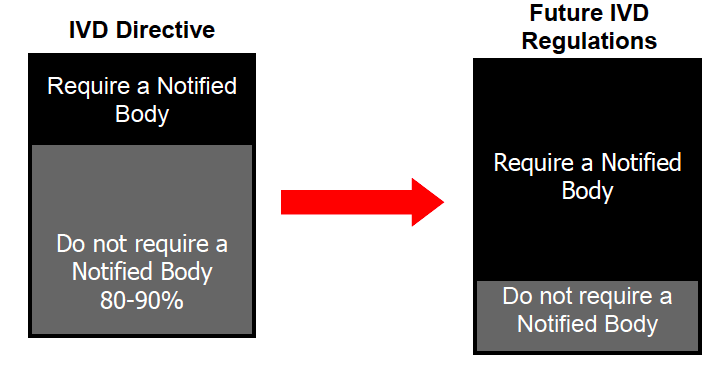
I will summarise her presentation in this post, and provide some of my own comments in the bargain. Out of all of the information provided, I think that this picture about the increased regulatory burden on the IVD industry says more than a thousand words: the majority of regulated IVDs will require intervention by a notified body.

General requirements

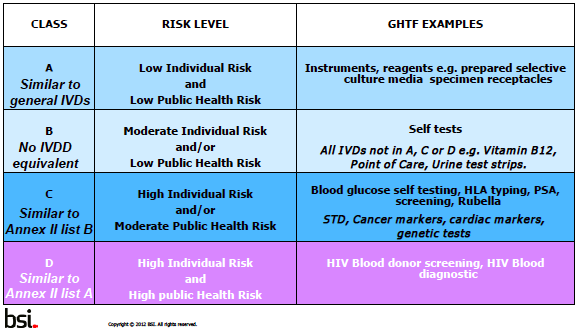
As was expected, it was confirmed that the GTHF approach to classification will replace the correct illogical and outdated list-based system, more or less like so:

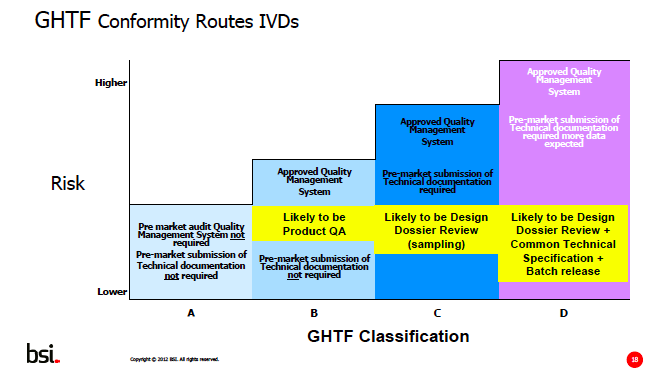
The corresponding conformity assessment routes also follow the GTHF model like this:

Clinical substantiation

A lot will change in terms of substantiation of the device and the consistent implementation of this in its quality system by the manufacturer and the verification thereof by the notified body, leading to more in-depth audits and mandatory surprise visits by the notified body. Expect the assessment team standards in the notified body code to be implemented in the regulation. Notified bodies, for their part, will need to work hard to access more specific external expertise and reference laboratories for the mandatory testing of samples collected during the increased supervisory activities (such as batch verification).

Post marketing

As was to be expected following Commissioner Dalli’s Joint Action Plan regarding market surveillance, there will be a strong focus on increased measures for post market surveillance/ PMCF in some form, vigilance,  traceability to facilitate recall and  greater communication between member states including the Eudamed database.

Interim measures

As for interim measures (the regulation will likely not enter into force before 2015 and may then still have a transitional period) expect all the measures set out in Commissioner Dalli’s Joint Action Plan.

Implementing legislation

In the works are a Commission Implementing Regulation on the design and the supervision of Notified Bodies under Directive 90/385/EEC on active implantable medical devices and 93/42/EEC on medical devices. IVDs are not included at present but its philosophy is likely to apply. The reason is that the Commission feels severely let down by the member states with respect to their supervision and accreditation of notified bodies and seeks to bolster the notified bodies substance and supervision. In addition there will be a Commission Recommendation on the audits performed by notified bodies in the field of all medical devices, including IVDs.

And….

This is a very rough summary of the presentation and I hope I did justice to the level detail of the information conveyed in it. Ms Oshe informed me that BSi plans to organise a webinar as soon as the text is officially public, which I recommend to watch for. Of course I will also blog about this as soon as I have the opportunity.

EU court decides another borderline case regarding “pharmacological effect”

Last Thursday the EU Court rendered judgment in the mouthwash case, C-308/11 Chemische Fabrik Kreussler vs Sunstar. The judgment immediately brought one of my favorite Yogi Berra quotes to mind:

“You’ve got to be very careful if you don’t know where you are going, because you might not get there.”

This statement is spot on for this much anticipated judgment, which, as I already predicted, did not turn out as interesting as one had hoped because the EU Court does not have the competence to dive deep into the facts and resolve a preliminary reference on the facts. I predicted the court was very likely not going to give a useful answer to this question that would shed more light on how to answer the scientific questions as to how to demonstrate the absence or presence of a pharmacological effect and that is more or less what happened.

What was this about again?

We are dealing with an indirect pharmacological effect situation. As the court describes the facts:

“It is apparent from a monograph dating from 1994, on the properties, effects and possible applications of chlorhexidine, that mouthwash solutions containing a chlorhexidine solution of 0.2% reduce salivary bacteria and, in this way, have a therapeutic or clinical effect in cases of gingivitis.”

Kreussler argued that as a result of this indirect effect, there was a pharmacological effect that caused the mouthwash to be a medicinal product.

So what do we know more after this judgment? 

In my opinion, not that much unfortunately.

First, we know now that a court can use MEDDEVs and other Commission guidance documents to resolve a problem of interpretation, and that a national court should stay within the boundaries of the law (i.e. the Medical Devices Directive or any other applicable directive) when interpreting such guidance. And we know that you should preferably use the relevant guidance, so you should use cosmetics guidance to resolve a cosmetics borderline dispute. So far nothing new or even remotely exciting.

Secondly, this case looked interesting because of its potential to really learn something about the interpretation of the concept ‘pharmacological’, one of key concepts determining the borderline between medical devices and medicinal products (as well as between medicinal products and other products). As you know, the last paragraph of the definition of medical device in article 1 (2) (a) of the Medical Devices Directive relies on it to demarcate devices and medicinal products. The question posed to the court was a rather technical one: the German judge dealing with the dispute asked whether

“for a substance to be regarded as exerting a ‘pharmacological action’ within the meaning of that provision, it is necessary for there to be an interaction between the molecules of which it consists and a cellular constituent of the user’s body, or whether an interaction between that substance and any cellular constituent present within the user’s body may be sufficient.”

Given the fuzziness and apodictic nature of its case law on the demarcation of medicinal products against other products so far the EU court was not going to allow itself to be painted into a corner by limiting the concept of pharmacological mode of action only to products that directly impact on the human biochemistry because, in the court’s words:

“that it is not apparent either from Directive 2001/83 or from the guidance document on the demarcation between the Cosmetic Products Directive and the Medicinal Products Directive that the molecules of the substance in question must necessarily interact with a human cellular constituent in order for it to be regarded as a substance which exerts a ‘pharmacological action’.”

and that

“a substance the molecules of which do not interact with a human cellular constituent may nevertheless, by means of its interaction with other cellular constituents present within the user’s organism, such as bacteria, viruses or parasites, have the effect of restoring, correcting or modifying physiological functions in human beings”

Further on in the judgment the court carefully repeats its case law that the effect must be “appreciable” and that this must follow from “an assessment, with due diligence, of each product individually, taking account, in particular, of that product’s specific pharmacological, immunological or metabolic properties, to the extent to which they can be established in the present state of scientific knowledge”.

For the effect to count as pharmacological we already knew that we must look at (as the EU Court dutifully repeats for us in the judgment):

    1. an effect, which must be appreciable
    2. all the characteristics of the product, including, inter alia, its composition, the manner in which it is used, the extent of its distribution, its familiarity to consumers and the risks which its use may entail
    3. composition – including its content in active substances
    4. use as intended

What we know more now is that we should still look at all of the above, but that the effect does not necessarily need to be direct (” it is not necessary for there to be an interaction between the molecules of which it consists and a cellular constituent of the user’s body, as an interaction between that substance and any cellular constituent present within the user’s body may be sufficient”).

The net result is a careful partial falsification of the concept “pharmacological” by the court by explanation of ‘what you cannot a priori exclude it to include’, but still no actual explanation of the concept that a scientist, regulatory professional or lawyer can really work with in day-to-day practice. Of course, falsification is sound scientific reasoning and yes, it does add some knowledge, but we would have liked more guidance from the court. However, with the other pending cases a pattern starts to emerge that will help manage the borderline of the medical devices regulation better. I will of course revisit this when judgments in the other cases have been rendered. Future developments in legislation will not change this I expect, because as far as I know from what is going on behind the scenes neither the definition of medical device nor that of medicinal products seem about to change. So, to get back to Yogi Berra: the EU Court took the fork in the road when it arrived at it, but we still don’t know where we are going- and if we will ever get there.

In Vitro Diagnostics seminar at Axon Lawyers on 12 September

Dear readers, I hope you don’t mind some modest self-promotion: my firm is organising a seminar on EU recent (and future) legal and regulatory developments with respect to in vitro diagnostics, with very interesting external speakers.

The seminar is free and you are welcome to attend with as many colleagues as you like (just make sure to let us know using the RSVP details in the below invitation so we can change to a bigger room if necessary because we have a lot of participants already). If you cannot make it to Amsterdam for the seminar you will miss out on the drinks afterwards. However, if you would like to receive the presentations and handouts nonetheless, you’re welcome to give us your details.

New EU rules for (active) medical devices utilising non-viable tissues of animal origin

While everybody is starting up again after the summer and had 26 September as first major horizon date in their head (the date on which the Commission has said it will publish the proposed new EU medical devices rules), the EU decided to go ahead and change the rules for (active) medical devices utilising tissues of animal origin in a separate legal instrument, a Commission Regulation.

What is it about?

Commission Regulation 722/2012 concerning active implantable medical devices and medical devices manufactured utilising tissues of animal origin has just been published in the Official Journal of the European Union on 9 August 2012. It replaces the existing requirements contained in Directive 2003/32/EC and provides for procedures required when using tissues from TSE-susceptible animals in medical devices. The Regulation will apply from 29 August 2013. The obligation for Member States to verify that Notified Bodies have the up-to-date expertise to assess the conformity of medical devices in line with Regulation 722/2012) will enter into force on 29 August 2012. The Regulation did not come as a complete surprise (because a publicly available draft version had been shared with WTO members as part of the obligations in the  Technical Barriers to Trade committee), although the timing of a Commission Regulation being final and published is always difficult to predict. Furthermore, why couldn’t this subject wait for inclusion in the new Regulation that is supposed to cover both active implantable and ‘other’ medical devices by merging Directives 90/385 and 93/42?

Any important changes?

Yes, at least some, although it is mostly merging of the Directive and the MEDDEV that currently deal with this subject. New is that the instrument is a regulation, which is a logical step in the process of the EU regulating more by directly applicable regulation in the life sciences industry rather than by directive, the latter leaving the Member States too much wiggle room for own interpretation. The new regulation expands the scope by including active implantable medical devices under Directive 90/385. It covers devices utilising tissues of animal origin (non-viable tissues and tissue derivatives originating from bovine, ovine and caprine species, deer, elk, mink and cats, to be precise) and links to Regulation 1069/2009 that provides for rules for sourcing of animal by-products not used for human consumption, as well as to Decision 2007/453 with respect to assessing the risk of the source country.

The general system set up under Directive 2003/32 stays the same (Annex I prescribing specific essential requirements for the devices concerned, some of which are updated and some of which are new), except that the procedure has been streamlined in a way that we may see under the new regulation for high risk medical devices in response to the ENVI complaints that I wrote about here and here. The regulation sets up a system for regulatory fast-tracking of summary evaluation reports regarding use of starting materials that have obtained a ‘TSE certificate of suitability’ from the European Directorate for the Quality of Medicines, based on the ‘coordinating Competent Authority’ model set out in section 6.0 of the MEDDEV. The Regulation provides for a model summary evaluation report in Annex II.

I have heard through the grapevine that the new general medical devices regulation may use a similar system, allowing Member States to comment on the Notified Body’s evaluation of high risk devices prior to CE marking, except if the evaluation shows that the device has been designed and evaluated in conformity with EU standards developed by a body to be appointed for this, perhaps  SCENHIR that issued scientific reports on among other things reprocessing of devices in the past and which is now working on breast implant guidelines, or the JRC, the Commission’s inhouse scientific service.

Another important but not so new novelty in the Regulation is that the manufacturer has a positive obligation to collect, evaluate and submit to the Notified Body information regarding changes with regard to the animal tissue or derivatives used for the device or with regard to the TSE risk in relation to the device (a responsible manufacturer would do this already because  this was already included in section 8.0 of the the non-binding MEDDEV). If the Notified Body subsequently concludes that such information leads to an increase of the overall TSE risk, the conformity of the device concerned must be assessed again, including the step of involving member states’ competent authorities.

Finally, the Regulation is more prescriptive in the evaluation required for renewal of a certificate by a Notified Body by setting out a minimum list of aspects to be evaluated by the Notified Body.

Of course among the points not discussed in this post there are other interesting details, like the new rigorous process for tallow derivates, copied straight from Annex I of the MEDDEV, so also not that new but now mandatory.

Why couldn’t this wait for the revision?

For two simple reasons, I think. First, it will take quite a while for the revision to trickle through the legislative process and enter into force (three years likely, with another year of transitional period). Second, Commissioner Dalli has in no uncertain terms requested member states to increase market surveillance for medical devices in early 2012. Out of all possible things the Commission does not need another PIP breast implant-like scandal to put another dent in the reputation of EU medical devices regulation, so it must have decided that devices utilising tissues of animal origin had sufficient potential in that respect to warrant regulating them ahead of schedule. Part of the market surveillance increase effort was an appeal to Member States to check if their Notified Bodies were still up to the task. A clear hint to this effect is made in recital 8 and article 4 (1), obliging the Member States to verify that the notified bodies designated to assess the conformity of medical devices manufactured utilising animal tissues have the necessary expertise and up-to-date knowledge to perform this task and to inform the Commission by 28 February 2013 of their findings. It is not excluded that the new revision Regulation will absorb this Commission Regulation by superseding it when it enters into force, so manufacturers should consider starting to plan for that to happen.

Update on Commission reaction to ENVI resolution – no PMA proposal on the table

In my previous post on this topic I wrote that it looked like the Commission had changed tack to propose a pre-market authorisation (PMA) for medical devices after all. It turns out that I had drawn that conclusion prematurely. This post serves to update and correct the picture. As more information became available after the hearing in which Commissioner Dalli addressed the European Parliament it seems that the Commission has not changed course on the point of PMA.

Commissioner Dalli was paraphrased to have said:

‘There is a need for a flexible system that delivers innovation as fast as possible to favor patients. Innovative devices arrive in the EU market 3 years in advance than the US market. That is why there is no need for PMA. PIP is not about authorization, is a fraud! PIP proves the weaknesses in the way legislation is implemented in post-market phase.’

As I understand now the Commission is going to propose a system to ensure that authorities are secure in the work that notified bodies are doing, consisting of a pre-market scrutiny mechanism for the quality of Notified Body assessments for high-risk devices.

Let’s take a look at the background to the resolution, because there is less support for a PMA system than there seems to be. First, the European Parliament only passed the PIP resolution which includes the call – by a thin majority – of the Parliament for a shift towards a PMA system for medical devices. That means that the Parliament is still divided over whether PMA for medical devices would be such a good idea to increase patient safety, even if the ENVI Committee,   the European Parliament’s Health Committee, likes the idea of a pharma-like system, including PMA, for medical devices as the way forward for increased patient safety.

Secondly, while stakeholders from industry remain strongly opposed to a PMA system, they are actually in powerful company. A Dutch report of an informal working meeting of the member states’ ministers of health during the Danish Presidency of the EU on 23-24 April this year that just became available, reports that none of the EU member states was in favour of a PMA system except for France, because they are not convinced that this will solve the problems that were specific to that situation (deliberate fraud). However, that was end of April. Things may have changed in the mean time but this does not seem very likely.

In the mean time the proposal for the new regulation has entered the phase of “Interservices Consultation”, which means that other Directorate Generals (DGs) have a number of  weeks to submit comments on the proposal, which period ends by 7 July 2012. DG SANCO, the DG responsible for the proposal, is expected to seek to finalise the proposal with any observations it wants to take on board, resulting in a final version around 17 July 2012.

Final adoption and publication of the proposal is scheduled for 26 September 2012. The document will then enter the so called co-decision procedure in which the European Parliament and the Council (which consists of the responsible ministers of the member states) have the opportunity to amend the text and to reach an agreement on their amendments within the following 18 to 24 months.

The likely political struggle on the point of PMA – assuming that the Commission does propose a pre-market scrutiny mechanism for the quality of Notified Body assessments for high-risk devices – will in my view revolve around an effort of the pro-PMA forces in the Parliament to seek amendments effectively resulting in specific devices to undergo scrutiny rather than the NB’s work. Indeed, the Commission expects this struggle as both the Council and the Parliament are under pressure to score their political points.

So, here you are with the latest developments on the proposal – and completely on point this time (I hope!).

It’s official: the ENVI resolution is out in final version – EU Commission changes tack to propose PMA for devices

Some time ago I wrote about the proposed ENVI resolution that the the EU Parliament’s ENVI committee adopted in reaction to the PIP breast implants scandal in the EU. At that time the final text was not out because the EU Parliament still had to vote on it. Now it has and the adopted resolution does not differ very much from what we expected based on the ENVI Committee’s press release, so I won’t repeat myself in any detail.

As I wrote, the Parliament has given the Commission a shot across the bow and the unexpected (at least for me) happened. The Commission has changed its course now as a result and seems to have given in to political pressure to include the P-word (PMA, Pre-Market Authorisation) so it will include some form of PMA in the proposal, says Eucomed. The question that is open is if the Commission will propose a PMA system for risk classes IIb and III (as the Parliament would like, see point 7 of the resolution). The jury is not out on that yet, although the proposal would apply to “high-risk” devices. This is certainly a big change as the Commission was still saying in March this year that it would not consider PMA for medical devices. Now the proposal (which is expected in September this year) will be more interesting than ever, especially for companies with devices in class IIb and higher that have not been cleared for market access yet. It is a big departure from what many were expecting.

I would expect this development to spark off a run on the notified bodies by companies trying to get their high risk devices to the market before the new regulation will enter into force, which is currently expected 2015-2o16. If I were these companies, I’d make sure to have a slot booked at my notified body of choice as they will be running out of available slots very quickly now. You would hope the Commission would include a thought out transitional regime in the proposal, but better not count on that to happen.

Also, I am very curious where the Commission will find the resources for setting up a PMA system and how it will manage. As I wrote, nobody has money or resources for it, so I expect the proposal to be a creative balancing act – likely a procedure at a notified body with increased member state oversight and member state final sign-off on the notified body’s work before a high risk device (whatever that will turn out to be) may be made available on the EU market. This would be the only way I can think of to make this work. The only other way would be to make the industry pay for the PMA system as much as possible via user fees. This does not seem to be on the table yet – otherwise Eucomed would be a lot less supportive in its press release about the Commission’s plan to include PMA in the new regulation (“Industry would be supportive of such a mechanisms provided it proves to enhance patient safety and would not slow down the approval process of medical devices.”).

So, I’d really like to be able to tell you more at this point – but am very sorry I can’t for the moment. I will however keep watching developments closely and blog whenever there are developments to report.