M&A in the medical devices sector: full seminar

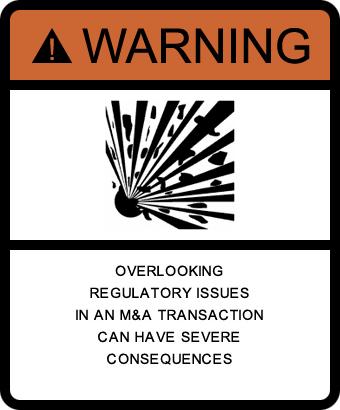
On Wednesday 13 April I organised a seminar and realtime webinar at my firm about M&A in the medical devices sector, to discuss the legal and regulatory implications of an M&A project in the medical devices industry, what mistakes are typically made and how to prepare a medical devices company for an M&A transaction, whether it is a target or a buyer. A topical subject, now that M&A activity seems to be picking up again, for example with J&J eyeing Synthes presently.

Speakers were Hans Dulmen, CEO of Dulmen Regualtory Services, Jan van Lochem, Vice President Healthcare at BSi and myself. The full presentations of the seminar are here.

Hans van Dulmen gave a detailed account of the possible impact of an M&A project on a medical device’s quality system and about how to prepare a company, device or product line to be sold to another company with the least regulatory and organisational surprises. I think he also gave some good due diligence tips, both for seller and buyer due diligence.

Jan van Lochem addressed M&A transactions from the perspective of a notified body and emphasized a timely assessment of the impact of the acquisition on a company’s quality system and planning of the necessary assessment of the changes by the company’s notified body. Poor planning can cause problems, notably if the acquired devices cannot be integrated in the acquirer’s quality system timely and may not be covered by the seller’s declaration of conformity anymore.

I myself spoke about the legal issues that may arise, such as regulatory warranties, due diligence and possible renegotiation of distributor, agent and supply contracts, what to look for in a due diligence of a medical devices company from a medical devices specialist point of view (with specific emphasis on FCPA and anti-bribery law) and transitional service agreements for handover of a device from one quality system to the other.

The general conclusion of the seminar was that the issues discussed unfortunately often do not get the attention they deserve, often leading to unnecessary and costly problems and hold-ups.

It was all well attended and well rated seminar. We are currently remastering the full webinar recording, which I will also post when the work on it is done.

Outsourced clinical investigation: legal aspects

Last Wednesday 13 April I spoke at Informa’s 6th Annual Clinical Evaluations and Investigations for Medical Devices conference about legal aspects of outsourced clinical investigation in the medical devices industry.

Proceeding from showing that the CRO, the site, the investigators and the manufacturer have potentially differing interests that the agreement must align the presentation describes how to deal with business compliance issues (anti-kickback and fraud regulation) and regulatory issues. Especially business compliance issues become more and more important because such issues coming up later may not only lead to government action against a company resulting in fines, but may also lead to invalidation of the clinical studies affected if the investigators turn out to have been improperly influenced, and is something that you will not find in ISO 14155, the standard for medical devices clinical trials.

The presentation furthermore gave a detailed roadmap of an agreement for outsourced clinical investigation and a number of drafting tips per clause of the agreement roadmap. Some mechanisms were clarified in more detail, both from CRO and manufacturer perspective such as IP, milestones, termination regime and choice of law and forum.

Finally, I hope to have shown how vitally important it is for a good clinical investigation outsourcing agreement that the regulatory affairs staff and the lawyers concerned approach it as a joint project so the best results are achieved because nothing is overlooked, rather than review the agreement one after the other and assume the other department.

Mind the reminder for Medical Devices and M&A seminar

I know, nobody likes reminders.

But this one is for a good cause: our free seminar / webinar about M&A  in the medical devices sector this Wednesday 13 April in the afternoon. 

It is a good opportunity to learn how to avoid the EU regulatory and legal pitfalls that you later spend a lot of time and resources remedying (if they are capable of being remedied in the first place). 

The subject will be addressed from multiple angles: notified body, regulatory consultant and legal, providing you with a complete perspective on what you might overlook and the ensuing consequences. You don’t want to make a mistake so costly that it obviates the entire commercial rationale behind a merger – but it happens in practice, as we will show.

There still is some room for attendees in Amsterdam, and there is of course unlimited room in the webinar. Subscribe here for either the webinar or seminar.

Standardisation, anyone?

Today I attended the NEN (Nederlands Normalisatie instituut (Dutch Standardisation Institute)) meeting about “Software and the MDD”, where I presented about recent developments in software and the MDD (apologies to the English language readers, it’s in Dutch). I emphasized the enormous growth of software applications with a medical intended purpose and the fact that their publishers/developers seem to be completely unaware that there are rules governing this type of applications or choose to ignore them. I have met disbelief and even covert hostility on occasions when I suggested that there are rules governing therapeutic and diagnostic software applications that are made available commercially.

The event proved an interesting meeting set up by NEN to sound the Dutch medical devices sector to see if there was an interest to set up a NEN facilitated platform in the Netherlands for stakeholders in the field of medical software, i.e.manufacturers of medical devices software, end users such as hospitals, consultants and government. The platform would serve to discuss recent and future developments, exchange ideas about standards and implementation thereof and to provide advice with respect to pending standardisation projects, both requested and unrequested.

Hopefully there will be sufficient industry, government, consultants and hospital/doctors interest to get this group off the ground, because I think there would be a lot that the different sides to the discussion could gain in terms of influence of standards in development, e.g. for eHealth. Just look at the incredible success of the Proposal for guidelines regarding classification of software based information systems used in health care of the Swedish Medical Products Agency’s Working Group on Medical Information Systems that is currently being used as the basis for the European Commission software MEDDEV under developments (expected this autumn).

So, everyone interested in this effort: don’t hesitate if you want to get involved. There is a lot to gain for everyone.

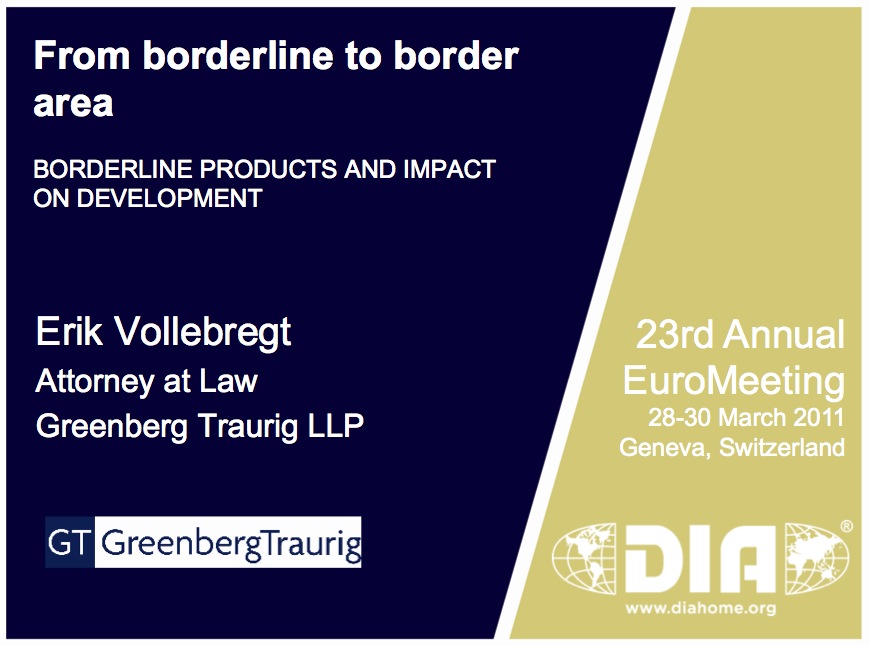
From Borderline to Border Area

Traditionally the borderlines between different categories of regulated products (medicinal products, medical devices, food, cosmetics, etc.) have been looked at as strict lines. More and more however it becomes evident that although the binary decision whether a product is on one side or the other is complicated because science can support a border area in which the same product may be classified under different regimes, depending on what science can support in the particular case. I am writing “can support” because even big pharma companies recognize that our understanding of the human biochemistry is still very limited, as Mr Niese, Head of Development at Novartis, explained in a lot of detail at the last DIA Euromeeting. This, and the increasing convergence of products, gives companies a significant room to manoeuvre with positioning of their products, as was recognized by Ms De Vries of the Dutch Ministry of Health at that same session at the DIA Euromeeting (Session 1101, presentations can be downloaded as of today by DIA attendees).

I myself presented on the underlying EU Court case law on the subject, which, as you will see from my presentation, is surprisingly modern and flexible in that it proceeds from the fact that the determining factor for application of borderline criteria should be what science as it stands can support with respect to a particular product. That means that application of the hierarchy clause in the Medicinal Products Directive (art. 2 (2)), is not as automatic as is often assumed. Under the recent case law of the EU Court, there can only be doubt as to the regulatory regime if the science supporting a particular product is inconclusive.

As a result, companies have on the one hand perhaps greater insecurity about what regulatory regime governs their products and they may be prone to at claims that the product has been admitted under the wrong regime and although governments are making a push at EU level to facilitate approval of combination products there are also statements made by regulators that the Recast of the EU Medical Devices Directive will address borderline problems one way or the other (although we won’t be sure until the proposal is published beginning of 2012). On the other hand however companies have greater flexibility and increased choice in the regulatory regime that they choose to make their product available under. There may be important strategic reasons to choose one regime or the other, e.g. reimbursement possibilities, time to market, etc. This is a good opportunity as long as a company has the scientific proof to support it.

European Commission consults on EU medical devices reimbursement harmonisation

The European Commisison has opened a consultation on 28 March on the revision of the Transparency Directive, the EU directive that regulates certain formalities with regard to reimbursement of medicinal products in the EU member states’ national reimbursement systems.

Oversimplified the Transparency Directive provides that EU member states must take a decision about inclusion of the medicinal product in the national reimbursement system within a fixed period (90 days) and according to transparent criteria.

The Commission writes in the clarification of the consultation document:

At present, the Transparency Directive only applies to medicinal products. Nevertheless, medical devices can also be subject to pricing and reimbursement regulation in the Member States. For this reason, this consultation also calls for contributions regarding the relevant of the directive to the medical devices market.

These initiatives need to be seen in conjunction with other EU initiatives touching on the pricing and reimbursement of medical devices, such as the upcoming Cross Border Healthcare Directive, which provides for a basis for cross-border health technology assessment that will obviously have an influence on pricing and reimbursement. So, even though the EU has no competence to legislate directly on the subject of pricing and reimbursement of healthcare, it finds its ways to exert indirect influence where possible. The medical devices industry stands to gain a lot however from more transparent and predictable rules and procedures with respect to pricing and reimbursement.

The consultation period ends on 25 May 2011 and is an opportunity that the medical devices industry to make its views known in the EU that it should not miss.

Update on EU medical devices Recast regarding combination products

The DIA Euromeeting in Geneva was an excellent opportunity to meet a number of the regulators involved in the process of the Recast of the EU medical devices directives. Since a lot is going on on a high level and it is still not clear which way the Commission will go on a number of very general systemic points, I thought it would be nice to cover a number of very interesting points I picked up about combination products that governments will be pushing for to be included in the Recast.

Regulation of combination products will become more and more important as products develop from combining technologies to converging technologies, a trend that is very apparent in companion diagnostics.

For that reason the Dutch government representative advocated the setting up of a supra-directive borderline committee, much like the FDA’s Office for Combination Products. A multi-disciplinary team of experts could administrate an integrated consultation procedure for combination products based on the principle mode of action of the principle intended purpose of the product. To make this possible, the medicinal products directive would need to be adapted to include a consultation procedure for a medicinal product incorporating a medical device (because the medical devices directive already has a procedure in Annex I, point 7.4 for medical devices incorporating a medicinal product).

The government will be pushing for the consultation procedure for medicinal products incorporating a medical device and the ‘supra-directive borderline committee’ as these are two points high on the wish list for the Netherlands to be included in the Recast. As I hear from sources involved in the Recast project, end of this week agreement will be reached on the high level policy points that the Commission will subsequently take on board for the proposal that is scheduled to be made public beginning of 2012.

Multi-jurisdictional advertising of medical devices – UK, Netherlands and Germany

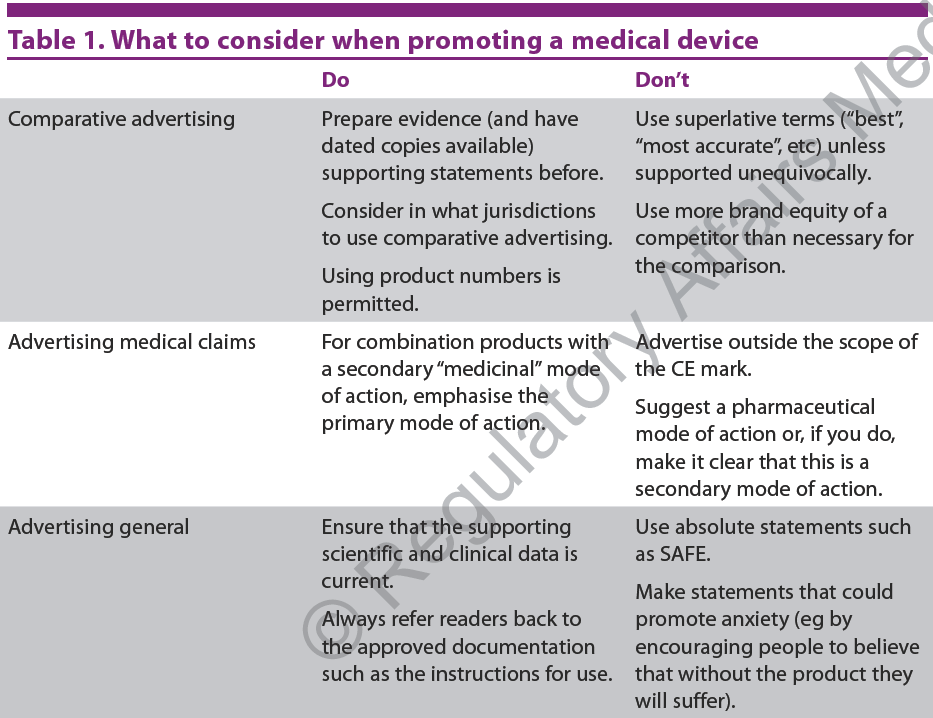
Advertising and promotion of medical devices are not harmonised under the EU medical devices directive, resulting in a fragmented legal landscape that differs from one EU member state to the other. To provide companies with more overview of this landscape, I wrote an article about the legal landscape for advertising and promotion of medical devices in the UK, Netherlands and Germany together with friends and former colleagues Alexander Denoon and Mathias Klümper, which is published in the March/April issue of RA Medtech, who kindly allowed publication of the article in their layout on our websites.

For all nuances about misleading and comparative advertising as well as how to avoid off-label advertising you should of course read the article itself and for advertising of reimbursement of medical devices this post that I wrote about that subject previously. For some very high level take aways, however, why not check out the do’s and don’ts table at end of the article:

EU court puts major stick in wheel of single EU patent court

Today the Court of Justice of the EU delivered its much awaited opinion about the compatibility of the envisaged European and EU patent court with the EU treaties, as requested by the Council that had prepared the international agreement that would set this up. This envisaged court was one of the building blocks to form part of a single (or singlish) EU patent and patent dispute resolution mechanism, although the patent court is formally not connected to the efforts of a group of EU member states to move towards a unitary EU patent.

The negative opinion of the joint Advocates General was a sign that the EU court might not issue a favorite opinion on the Patent Court’s intended functioning. The Court indeed shares the main objections made by the AGs that the international agreement in the way it was set up would lead to the member states giving away competence to the Patent Court that could also include interpretation of EU law. However, the agreement did not ensure that questions of European law in cases heard by the  Patent Court could or would be referred to the European court. Normally where an infringement of European Union law is committed by a national court, a case may be brought before the Court to obtain a declaration that the Member State concerned has failed to fulfil its obligations. However, if a decision of the European and Community Patent Court were to be in breach of European Union law it could not be the subject of infringement proceedings nor could it give rise to any financial liability on the part of one or more Member States.

In those circumstances, the Court considers that the envisaged agreement, by conferring on an international court which is outside the institutional and judicial framework of the European Union an exclusive jurisdiction to hear a significant number of actions brought by individuals in the field of the Community patent and to interpret and apply European Union law in that field, would deprive courts of Member States of their powers in relation to the interpretation and application of European Union law. The agreement would also affect the powers of the Court to reply, by preliminary ruling, to questions referred by those national courts. Accordingly, the agreement would alter the essential character of the powers conferred on the institutions of the European Union and on the Member States which are indispensable to the preservation of the very nature of European Union law. Consequently, the Court concludes that the envisaged agreement creating a European and Community Patent Court is not compatible with the provisions of European Union law.

M&A seminar: EU legal & regulatory aspects

Some time ago I wrote about issues often overlooked in medical devices M&A transactions. Because of the reactions to it I decided to organise a seminar at my law firm’s Amsterdam office about it on Wednesday 13 April that should provide a good insights in the subject. With speakers from notified body BSi (Jan van Lochum, vice president Healthcare), from DRS regulatory consultants (Hans van Dulmen) and of course myself you will get a good insight in the regulatory and legal aspects of mergers and acquisitions in the medical devices company. The seminar is free and will be made available in real time as webinar, so if you cannot travel you can participate if you have a computer with internet connection and a telephone. Participation is free. I hope to welcome many of my readers!

Here is the invitation, just for good measure (you may need to click the CT screen to start the animation and see the invite):

Information and Registration

Wednesday, April 13, 2011

Greenberg Traurig, LLP
Atrium Building, 8th floor
Strawinskylaan 3127
1077 ZX Amsterdam

Registration and coffee: 15.30
Seminar starts: 16.00
Drinks and snacks: 18.30

This seminar will provide a unique opportunity to hear about mergers and acquisitions (M&A) in the medical device industry from a notified body, from a regulatory consultant and from the legal viewpoint, ensuring high quality yet practical content and ample opportunity to get your questions answered.

To register for this seminar, please send an email to medtech@eu.gtlaw.com with your name, the names of any colleagues you would like to register, and your contact information.

To register for the webinar, please click here.

Whether you will attend in person or online, your response is requested no later than Wednesday, April 6.

If you have any questions about this seminar, please contact Wycke van der Ploeg  at vanderploegw@eu.gtlaw.com or +31 (0) 20 30 17 400.