EU Court holds that user interface copyright is not computer program copyright

Just before Christmas the European Court rendered a judgment that is important for medical devices companies that have devices that run software and have a graphic user interface (GUI). The case concerned a dispute between the Czech subsidiary of the Business Software Alliance and the Czech authorities about collective rights administration for software copyrights under the EU directive for the legal protection of computer programs, which defines the scope for copyright on computer programs in the EU. The Czech government and BSA had a dispute about whether the administration of the rights under that directive also included the administration for rights on the GUI of the computer programs concerned. The Czech government said it did not, and that by the way GUIs were not even copyright protected. In the ensuing dispute that was subsequently escalted to the European Court by the Czech court, the BSA maintained that “a computer program can be perceived at the level both of the source or object code and of the method of communication (communication interface)” and that the copyright on a computer program therefore covers both.

The European Court however held that:

“interfaces are parts of a computer program which provide for interconnection and interaction of elements of software and hardware with other software and hardware and with users in all the ways in which they are intended to function. In particular, the graphic user interface is an interaction interface which enables communication between the computer program and the user. In those circumstances, the graphic user interface does not enable the reproduction of that computer program, but merely constitutes one element of that program by means of which users make use of the features of that program. It follows that that interface does not constitute a form of expression of a computer program within the meaning of Article 1(2) of Directive 91/250 and that, consequently, it cannot be protected specifically by copyright in computer programs by virtue of that directive.”

That does not mean however that GUIs are not (copyright) protected at all. They can be protected by copyright as separate works if they are original in the sense that they are their author’s own intellectual creation, the European Court ruled.

What does this mean? There are several consequences to the fact that a GUI and the computer program that the GUI allows the user to interact with are not protected by a unitary copyright. Here are some that immediately come to mind.

First, different copyright rules will apply to a program and a GUI. The EU computer programs directive provides specifically that there is no requirement of originality for a computer program to be protected by copyright, because it is assumed (see article 1 (3) of the directive). GUIs on the other hand have to be original to be protected by copyright, as the European Court ruled in this case.

Secondly, a medical devices company that contracts out software development that includes both code and GUI must review its contracts for loopholes that may arise as a result of the copyrights on the program and the GUI being split up. For example, a license or transfer of the copyright on the computer program must now also include a license or transfer with respect to the rights in the GUI. Obviously, future contracts must take this division into account.

Thirdly, where regulatory warranties in the development and/or license agreement cover the computer program only, the medical devices company must be aware that there are specific regulatory requirements for GUIs in the EU medical devices directive (see Annex I, point 12.9).

Food for thought about software policy of medical devices manufacturers and those who develop medical devices software.

Eucomed Compliance Panel speaks out on sponsorship of medical conferences

Many medical devices companies have invested in making their marketing actvities aimed at healthcare professionals Eucomed Code of Ethical Business Practices compliant. Although the Eucomed code has a lot of authority in the market and was updated some time ago as to make it enforceable by adding the Compliance Panel and national dispute resolution bodies in 2009, there has not been any formal output of the Compliance Panel so far, until now.

One of the ever problematic issues is what Eucomed allows in respect of sponsoring of conferences, because this is an important competitve instrument. Therefore, the Eucomed secretariat decided to request a formal interpretation of the rules due to the numerous requests by its members and congress organisers about sponsorship invitations regarding third-party congresses and conferences. This interpretation provides significant additional detail on what Eucomed considers ethical sponsoring. The Compliance Panel made six points (full decision here):

  1. The Program must be rigorous from a scientific and/or educational point of view. This means that its content must include current scientific information of a nature and quality which is appropriate to the Healthcare Professionals who are attendees at the Third Party Educational Conference.
  2. The faculty responsible for delivering the Program must be competent and qualified to make the particular delivery involved and must disclose that they are sponsored by a Eucomed Member, if this is the case.
  3. Representatives of Eucomed Members should not act as faculty unless the Program is part of an appropriate Eucomed Member Sponsored Satellite Symposium.
  4. Information on the Program and the identity of faculty should be made available to potential Eucomed Member sponsors sufficiently in advance in order for those sponsors to be able to make a reasoned judgment as to the rigor and quality of the Program, provided however that subsequent changes, deletions and additions to the Program made by the Third Party Conference Organizer are acceptable (including modifications made after a Eucomed Member has committed to sponsor either the Third Party Educational Conference, Healthcare Professionals and/or faculty) to the extent that such changes, deletions and additions are reasonable and do not significantly modify the quality or nature of the Program.
  5. The Program should not include leisure or sports events and should not advertise leisure or sports events or sporting facilities which may be available at the Third Party Educational Conference location.
  6. The Program must involve full days, with both morning and afternoon scientific and/or educational sessions, unless the Third Party Educational Conference is a half day event or commences or ends on a mid-day. Such half-day sessions are permissible, but there should not be any non-scientific or non-educational events or activities organized for the other part of the day. Furthermore, there should be no significant gaps in the Program which would permit Healthcare Professionals to engage in leisure, sports or other non-scientific or non-educational activities. For example, early morning sessions should not be followed by late afternoon or evening sessions with large blocks of free time in between.

Although the Eucomed recommendations and codes are not generally binding, they are generally considered to be the gold standard in business compliance in the medical devices industry in the EU, like the Advamed rules in the US (Eucomed and Advamed cooperate ever more closely on business compliance issues by the way). And how does a company implement all of that? I have written about that extensively in the FDLJ.

New EU competition rules on R&D, information exchange and standards

The European Commission has revised its rules for the assessment of co-operation agreements between competitors, so called horizontal co-operation agreements. The most important changes for the medical devices industry are in the areas of standardisation, information exchange and R&D.  The new rules replace the previous Horizontal Guidelines and the two Block Exemption Regulations for R&D and for specialisation and joint production agreements, which entered into force in 2001. These changes are part of a larger package revising the EU competition rules for horizontal cooperation agreements adopted on 14 December 2010. All changes are described succinctly in a convenient Q&A document of the Commission.

Key features of the reform relevant to the medical devices industry are a new chapter on information exchange in the Horizontal Guidelines, a substantial revision of the chapter on standardisation agreements and extension of the scope of the R&D agreements block exemption. The documents conctaining the new texts can be found here.

Standards

The Guidelines promote a standard-setting system that is open and transparent and thereby increases the transparency of licensing costs for intellectual property rights used in standards. The revised standardisation chapter sets out the criteria under which the Commission will not take issue with a standard-setting agreement (‘safe harbour’). Moreover, the chapter gives detailed guidance on standardisation agreements that do not fulfil the safe harbour criteria, to allow companies to assess whether they are in line with EU competition law.

Standards are important to the medical devices industry, for example in e-Health, of which the development is slowed down as a result of lack of standards. Declaration of compliance with standards is the core of the EU CE system.  A known problem with standards is that someone may have a patent, or a patent pool, that you need a licence for to be able to conform to the standard. Patent owner may keep these patents secret until the standard is finished and implemented, a so-called ‘patent ambush‘. The  new Guidelines promote a standard-setting system that is open and transparent and thereby increases the transparency of licensing costs for intellectual property rights (IPRs) used in standards. The revised standardisation chapter sets out the criteria under which the Commission will not take issue with a standard-setting agreement (‘safe harbour’). Moreover, the chapter gives detailed guidance on standardisation agreements that do not fulfil the safe harbour criteria, to allow companies to assess whether they are in line with EU competition law. The rules focus on the process of setting the standard and the subsequent terms on which the standard is made availabel to others.

The safe harbour criteria for the process are that:

  1. the standard-setting process is transparent and open to all;
  2. the standardisation agreement imposes no obligation to comply with the resulting standard; and
  3. the standardisation agreement provides access to the standard on fair, reasonable and non-discriminatory (widely known as “FRAND”) terms, including by providing a fair and balanced policy for intellectual property rights .

In summary the requirements for the terms for access to the standard are that the terms:

  1. are established through a transparent and inclusive process;
  2. are non-binding and effectively accessible for anyone;
  3. are not likely to become a de facto industry standard; and
  4. do not relate to price-sensitive aspects of competition (such as prices, rates, discounts, rebates, and interest) or important characteristics of consumer goods or services.

The revised rules now clarify that it is normally not contrary to competition law if standard-setting organisations provide for their members to unilaterally disclose, prior to setting a standard, the maximum rate that they would charge for their intellectual property rights (IPRs) if those were to be included in a standard. Such a system could enable a standard-setting organisation and the industry to take an informed choice on quality and price when selecting which technology should be included in a standard.

Information exchange

Information exchange can take many forms, such as disclosure of information via published materials and coordinated public announcements, through a common third party such as a trade association or via direct communication between competitors. It can be pro-competitive, for example, when it enables companies to gather market data that allow them to become more efficient and better serve customers, like EDMA’s publications about the IVD markets. However, there are also situations where the exchange of market information can be harmful for competition, for instance when companies use sensitive information to align their prices by disclosing an individual company’s intended future prices or quantities (including future sales, market shares, territories, and sales to particular groups of consumers). The Guidelines give guidance on how to assess the compatibility of information exchanges with EU competition law.

R&D

The Commission has extended the scope of the old R&D Block Exemption Regulation, which now not only covers R&D activities carried out jointly but also so-called ‘paid-for research” agreements where one party finances the R&D activities carried out by the other party. In addition, the new Regulation gives parties more scope to jointly exploit the R&D results.

The Commission made some last minute changes compared to the consultation draft:

  1. the block exemption is not conditional on disclosure by the parties of their background IPR prior to starting the R&D;
  2. parties to an R&D agreement may benefit from the block exemption even if they limit their rights of exploitation to certain field-of-use areas;
  3. there is a transitional period until 31 December 2012 for agreements that cease to be block exempted as a result of changes introduced.

When does it enter into force?

The Horizontal Guidelines will enter into force as soon as they have been published in the Official Journal of the EU, which should take place in the coming days. The R&D and Specialisation Agreements Block Exemption Regulations will enter into force on 1 January 2011, with a transitional period of two years (until 31 December 2012) during which the previous Regulations will remain in force for such agreements that fulfil the conditions of those Regulations but do not fall under the new Regulations.

Legal horizon and convergence

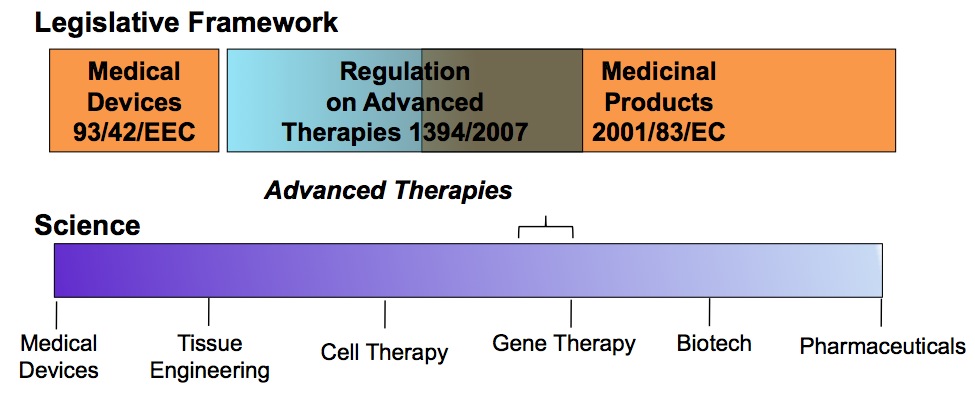
Convergence is all around us. The traditionally well defined different groups of medical devices, medicinal products and biotechnology products are more and more moving closer and closer together to form a genuine ‘regulatory continuum’ rather than well-defined regulatory silos. This concept is illustrated well in the European Commission’s well-known ‘bridging the gap’ picture coined when the advanced therapies regulation was in the legislative process (however, if you are more medicinal products centered like the EMA, your picture would look more like this). Products designed for a particular therapy more often turn out to be borderline products, or rather, ‘border area’ products. This, of course, has consequences for the design of a product. Rather than designing a product assuming from the start that it fits a particular regulatory silo, companies should design and research with the end in mind: what type of product do I want to make, and for what reasons? Will it be reimbursed – and if it is not, will my business model still work? Better think about these things when you can still change direction.

Important reasons can be company strategy. If a company seeks to bring its first product to the market quickly with relatively low investments, it should definitely not design towards a medicinal product or an advanced therapy medicinal product. In the first case the burden of clinical proof is very high (and very costly and time consuming to meet), while in the second case the clinical burden of proof may not even be clear so you have to spend additional time in a scientific advice procedure to help the authorities establish a regulatory frame of reference to evaluate your product by. Medical devices are quicker to the market, but have their own problems, like a short life cycle that requires a relatively quick recoup of investments for a business model to work.

In all cases there is uncertainty about what the legal and regulatory horizon will look like in the short, middle and long term. Because if there is one certainty in the field of life sciences, it is that the rules are constantly changing.

These and other questions were discussed in a seminar I organized with Kempen & Co (a life sciences investment bank), DNage (a life sciences company) and JPS Advocatuur (lawyer and regulatory consultancy) at my law firm last 15 september, and this was my presentation.

New European Commission guidelines for clinical investigations

Just before the holidays the Commission has issued guidelines on an issue that suffers a lot from the lack of harmonisation in  the EU: clinical investigation for medical devices. Now that the medical devices directives as amended by directive 2007/47 (effective as of 21 March 2010) require more focus on the substantiation of clinical evaluation with actual clinical data produced in a clinical investigation.

The guidelines,

  • MEDDEV 2.7/3 (CLINICAL INVESTIGATIONS: SERIOUS ADVERSE EVENT REPORTING UNDER DIRECTIVES 90/385/EEC AND 93/42/EEC) and
  • MEDDEV 2.7/4 (GUIDELINES ON CLINICAL INVESTIGATION: A GUIDE FOR MANUFACTURERS AND NOTIFIED BODIES)

are contained in two documents which both address the clinical investigation referred to in Annex 7 of the Active Implantable Medical Devices Directive and Annex X of the Medical Devices Directive and are part of the European Commission’s efforts to provide for more harmonisation in this area, because the directives themselves do not give any guidance on how to perform a clinical investigation. A known problem is for example that the national competent authorities have different views about SAE reporting, for which  MEDDEV 2.7/3 now provides guidance. MEDDEV 2.7/4 provides guidance for manufacturers and notified bodies on when clinical investigation is necessary and how a clinical investigation should be designed and performed.

A good overview of these and other issues in a wider context is provided in a number of presentations on clinical investigation from the recent Eucomed MedTech Forum. Obviously, as clinical trials have an ever more international dimension, it becomes more and more important that the rules are harmonised in the EU. For lack of a clinical trial directive such as we have for medicinal products, the Commission undertakes informal harmonisation through MEDDEV documents that are drafted in close consultation with industry and competent authorities. This is another step that seeks to improve legal certainty for all parties involved.

Internet sales, parallel imports, repacks of medical devices

I often run into questions that are a mixture of problems relating to parallel imports of medical devices, repackaging/relabelling, trademark law and internet sales. Obviously, manufacturers do not like it when another party adapts the packaging and other aspects of the labelling of a medical device to be able to sell it in another country. Apart from the case law on repackaging of medicinal products for the purpose of parallel imports there was never any EU case law that gave good pointers as to how this question should be addressed under EU law. The MHRA is for example quiet in this point in its guidance on parallel imports, in which it explicitly only addresses medical devices rules related matters.

The problem with the medicinal products case law was that parallel imports are only possible to countries where a valid marketing authorisation is in effect and the label, IFU etc have been approved for that market in the language concerned by the authorities. This is different with medical devices, where a manufacturer can have its IFU and label checked for one EU member state only in the process of CE marking, while the device is subsequently allowed free circulation in the entire EU.

A case pending at the European Court about repackaging of cosmetic products that were sold via the internet after having been stripped of the original packaging may shed some light on this problem. The European Court’s Advocate General gave an opinion in that case today. The court found this a sufficiently important even to warrant a press release and it does not do that with all opinions given by its A-G’s. Let me quote from that opinion what I consider the important part on the interface between regulatory obligations relating to the label and trademark law:

“73. First it must be remembered that, pursuant to Article 7 of Directive 89/104 [the EU Trademark Directive], exhaustion is the main rule. Consequently the possibility for the trade mark proprietor to oppose further commercialisation of his goods after he has already realised the economical value inherent in the trade mark in relation to those goods must be interpreted narrowly.

74. Secondly, it cannot be excluded that the outer package even of cosmetic products is such that its removal neither impairs the functions of the trade mark of indicating the origin and quality of goods nor damages its reputation. This may be so for example with less-expensive cosmetic products.

75. Hence, the existence of legitimate reasons for the trade mark proprietor to oppose further removal has to be analysed case by case. In this respect the High Court has raised two scenarios, namely that of unboxed goods without the information required by Directive 76/768 on cosmetic products and the case where absence of such information would constitute a criminal offence in the Member State where they are offered for sale or sold.

76. In my opinion the requirement of compliance with the cosmetics directive, or in fact any other EU measure relating to product safety or consumer protection is inherent in the protection of the reputation of a trade mark. Damage to the reputation of a cosmetic product could be caused for example by severe allergic reactions of a group of consumers where the list of ingredients is omitted. However, whether selling of unboxed cosmetics is or is not criminalised in national law is irrelevant in this respect. What may damage the reputation of the trade mark is the absence of pertinent consumer information required by the harmonised European rules, not the consequences national legislation of Member States entail in such cases for the traders.

77. Hence, even if trade mark law does not protect in itself the objectives of Directive 76/768 [the EU cosmetics directive] as such, further commercialisation of trade mark protected products not complying with that directive can, as such, as has rightly been pointed by Advocate General Stix-Hackl, seriously damage the reputation of the trade mark and thus form a valid reason for the proprietor to oppose.”

In other words, reselling a medical device of which the label containing the OEM’s trademark has been removed or altered significantly as to render it non-compliant under medical devices rules is infringing the OEM’s trademark. Anyway, the European Court has the final word on this, so let’s first see if this opinion is followed by the court. Chances are high though, as the court usually follows its Advocate General.

EU Court rules on internet sales restrictions for medical devices

EU member states are not under all circumstances allowed to restrict the sale of OTC medical devices only brick-and-mortar shops which specialise in medical devices. That is the outcome of the recent Ker-Optica judgment of 2 December 2010, concerning a dispute about the legality of Hungarian legislation which authorises the sale of contact lenses only in shops which specialise in the sale of medical devices and which prohibits, consequently, the sale of contact lenses via the Internet.

The European Court ruled on two points of law important to the medical devices industry seeking to sell medical devices online to consumers.

First, it clarified the scope of the e-commerce directive with respect to the national rules in question: the e-commerce directive covers relating to whether or not medical devices can be sold via the internet because medical devices are not excluded from the scope of the e-commerce directive. However, national rules that seek to regulate how medical devices are supplied to the end user (e.g. only after a prior examination for fitting) fall outside the scope of the e-commerce directive and can, consequently, not be assessed by the rules that directive imposes. Those rules have to be assessed under the general EU rules on free movement of goods. Given that the sale of medical devices via the internet falls within the scope of the e-commerce directive, the European Court ruled that those sales cannot be prohibited, even in cases where a prior examination by qualified staff would be necessary, because that examination can be separated from the subsequent internet sale.

Second, what then are the restrictions that general EU free movement of goods rules impose on national requirements to sell certain medical devices only from shops with qualified personnel? First of all, these rules hinder access to the market of the member state that has those rules more for foreign traders than for local traders, reasoned the court with references to the DocMorris case about internet sales of medicinal products (if you are interested in the legal mechanics of that case, I wrote an annotation of that case in the legal journal NTER). That restriction must therefore be justified. However, the European Court finds that the type of devices in question does not justify this type of restriction for these three reasons (paraphrased wording from the judgment):

  1. As regards the requirement that the customer must be physically present to have his eyes examined by an optician at the sales outlet, it must be observed, first, that precautionary examinations, carried out for investigative purposes, can be undertaken by ophthalmologists in places other than opticians’ shops. However, there was no requirement that an optician must make every supply of lenses dependent on a precautionary examination or on medical advice having first been obtained or that those conditions are imposed, in particular, on each occasion when there is a series of supplies of lenses to the same customer. Accordingly, undergoing such examinations and obtaining such advice must be held to be optional, and consequently it is primarily the responsibility of each contact lens user to make use of them, while the task of the optician in that regard is to give advice to the users. If that is the case, customers can be advised, in the same way, before the supply of contact lenses, as part of the process of selling the lenses via the Internet, by means of the interactive features on the Internet site concerned, the use of which by the customer must be mandatory before he can proceed to purchase the lenses.
  2. Member states can require that the determination of which type of contact lenses is the most appropriate should be undertaken by a optician, who is under an obligation, at that time, to check the positioning of the lenses on the customer’s eyes and to make available to the customer advice on the correct use and care of the lenses. However, that is normally only required when contact lenses are first supplied. At the time of subsequent supplies, there is, as a general rule, no need to provide the customer with such services. It is sufficient that the customer advise the seller of the type of lenses which were provided when lenses were first supplied, the specifications of those lenses having been adjusted, where necessary, by an ophthalmologist who has issued a new prescription which takes into account any change in the customer’s vision.
  3. While the extended use of contact lenses must be accompanied by supplementary information and advice, those can be given to the customer by means of the interactive features of the website of the internet sales provider, e.g. through a qualified optician whose task is to give to the customer, at a distance, individualised information and advice on the use and care of the contact lenses. The provision of such information and advice at a distance may, moreover, offer advantages, since the lens user is enabled to submit questions which are well thought out and pertinent, and without the need to go out.

In summary: because the legislation in question was not proportionate, it was contrary to the general rules on free movement of goods.

This judgment has important consequences for national rules impacting internet sales of medical devices in the EU. Any restriction to internet sales, even if it is intended to protect consumer health, must also be proportionate to that goal. Even in case of devices for which initial clinical / fitting advice would be prudent, member states re not allowed to completely ban internet sales of the devices. The same is true for national advertising rules that impact the advertising of medical devices sold via the internet. Companies that experience difficulties with their internet sales in EU member states now definitely have an interest to take a good look at the possibilities to attack the legislation concerned.

Another important point of this case is in my opinion that the European Court views medical devices (at least OTC devices) as different from medicinal products, because it held in the DocMorris case that the restrictions on internet sales of medicinal products were not justified. It will be interesting to see if the European Court rules different in the case of other medical devices, e.g. self tests for high risk medical conditions.

Finally, this judgment may prompt the European Commission to start to think about including regulation of advertising in the upcoming Recast of the EU medical devices rules.

To place on the market (or not)

That is the question. It is in fact on of the core questions of the three medical devices directives (the Medical Devices Directive, the In Vitro Diagnostics Directive and the Active Implantable Medical Devices Directive), which make the crucial acts of “placing on the market” and “putting into service” subject to compliance with the regulatory requirements under these directives.

With very little publicity (I saw a link under the News heading on the DG Consumer Affairs website to it only on 29/11/2010) the Commission published a new interpretative document on “Placing on the market of medical devices” dated 16/11/2010.

This document is very important for any medical devices company. The document discusses how the definition of “placing on the market” in the three directives must be interpreted by reference to English, German and French language versions of the directives and subsequently with a lot of references to the new market surveillance rules as well as old CE marking acquis when there is placing on the market in two scenarios that are treated very distinctly by the Commission:

  • the manufacturer is established in the EU (points 8-14); and
  • the medical devices are manufactured outside the EU and subsequently imported (points 15-18).

It also discusses import of devices by private persons for personal use (point 19); rather obviously that does not count as placing on the market.

While the document allows for considerable flexibility for a manufacturer based in the EU to play with the moment when a medical device is placed on the market, such flexibility does not seem to be allowed for devices manufactured outside the EU and subsequently imported into the EU. For EU manufacturers a product is considered placed on the market:

“(10) […] when the product is transferred from the stage of manufacture with the intention of distribution or use on the Community market. Even though the term “transfer” is not used in the legal definition, the German term “Überlassung” in the definition of Inverkehrbringen as well as the term “supply” in the definition of making available (like “Abgabe” in Bereitstellung or “fourniture” in mise à disposition) underline that a certain type of transfer needs to take place.

(11) The transfer can consist in a physical hand-over and/or be based on a legal transaction. It can relate to the ownership, the possession or any other right transferred from the manufacturer to a distributor or to the end user. A transfer of a product is considered to have taken place, e.g., when it is sold, leased, given as a gift, rent out or hired. Where a manufacture operates an own distinct distribution chain, the transfer can also occur to that distribution chain.”

For imported products on the other hand

“(15) […] they must at least be released for free circulation in the internal market before they can be considered as being placed on the EU market (see Articles 27-29 of Regulation (EC) No 765/2008).” and “(17) […] If the transfer of the finished device from the manufacturer (or a distributor) established outside the EU to the importer takes place prior to or during the customs procedure, its release for free circulation will also be the moment of its placing on the market.”

Although the Commission refers to the Blue Guide in point 10 of the document, it is remarkable how well this corresponds with the European Court’s view of the concept of what placing a product on the market for the purpose of the interpretation of the EU product liability directive in the O’Byrne case. In that case the European Court spent quite some words defining where production ends and distribution begins in a complex multinational undertaking in which several subsidiaries are involved in the manufacturing process of a medicinal product.

In my view the interpretative document has the important – and perhaps unintended – possible consequence that advertising of a non-CE marked medical device does not constitute (or may likely not constitute) placing on the market of that medical device. Some have argued that medical devices must be CE compliant before any ‘offer to transfer’ may be made or before they can promoted lawfully on the EU market, by reference to the MDD or IVDD only. If we look at the interpretative document however the Commission fixates on the actual placing on the market (and not just advertising that this may happen at some point in time when CE marking has been completed). This actual placing on the market is defined as a physical act or legal transaction-based handover pursuant to which a device is transferred from the stage of manufacture with the intention of distribution on the EU market (see points 10 and 11). In my opinion a promotional announcement that a particular device is in the pipeline but is not yet available because the regulatory process is not yet completed does not constitute ‘placing on the market’ under the theory of the interpretative document. This would also fit in with the exception provided for in article 4 (3) of the MDD (the trade fair exemption), because this provision aims to create an exemption for advertising of a device that is not yet CE marked, “provided that a visible sign clearly indicates that such devices cannot be marketed or put into service until they have been made to comply”. In other words, no misleading of the public about the regulatory status of the advertised device. This may be extrapolated to other forms of publicity, since the MDD does not limit this exemption to trade fairs only (it rather gives a non-exhaustive list of ways to advertise a device: “trade fairs, exhibitions, demonstrations, etc.”). I am aware that this interpretation may seem very controversial, but it can be defended under the concept of placing on the market as clarified by the Commission in the interpretative document.  Before you get your hopes up as manufacturers and distributors: don’t forget also that there may be national law in EU member states that regulates advertising of non-CE marked devices. However, insofar as that would go contrary to the MDD under in the interpretation defended here, it is contrary to EU and should not be enforced. A lot more can be said about this. Discussion, anyone?

RoHS recast advances, some changes proposed for medical devices

In a press release of 24 November 2010 the European Commission announced that the European Parliament has voted to revise the RoHS directive (EU legislation on the use of hazardous substances in electrical and electronic equipment). The draft legislation, proposed by the Commission in 2008, should, according to the Commission,  strengthen the existing law by streamlining procedures for future substance restrictions and by making it coherent with other chemicals legislation, such as REACH. Today’s vote confirms the first reading agreement with the Council on the revised legislation.

The RoHS Directive has prevented many thousands of tonnes of banned substances from being disposed of and potentially released into the environment since it came into force in 2003. It has led to important changes in the design of electrical and electronic products in the European Union and worldwide and facilitates the recovery of many rare substances and materials used in electronics.

RoHS currently covers a vast spectrum of products that use electricity, including small and large household appliances, IT and telecommunications equipment and consumer goods such as radios, TV sets, video cameras and hi-fi systems but NOT medical devices. Under the present directive medical devices manufacturers were dealing with RoHS issues mainly through their supplier’s actions to conform to RoHS requirements, e.g. components. That will change with the new directive: it will extend its scope to include medical devices.

Key elements include:

  • greater coherence with other EU legislation, such as REACH and the new legislative framework for the marketing of products
  • The extension of the scope to all electrical and electronic equipment, including medical devices and monitoring and control instruments.
  • Electrical and electronic equipment that was outside the scope of the current RoHS Directive but which will be covered by the revised Directive, does not need to comply with the requirements during a transitional period of 8 years, giving producers time to adapt;
  • A lighter and more effective mechanism for reviewing or amending the list of banned substances is introduced, enabling further substances to be considered on the basis of scientific evidence and specific criteria, and in line with REACH. Changes may then be made through comitology;
  • The rules for granting exemptions from the substance ban are further streamlined to provide legal certainty for the economic operators and to ensure coherence with REACH;
  • Important definitions are clarified to ensure the directive is applied in a harmonised manner throughout the EU.
  • Better enforcement of the Directive at national level will be achieved through alignment with the marketing of products legislative package.

It is interesting that notified bodies are being granted a role in the process for exemptions of the requirement to substitute substances with less harmful ones.

But we knew this already from the 2008 proposal. The Parliament did however propose a number of additional changes in the document that it approved.

So, what is new?

Let’s take a look at the Parliament’s proposed changes for medical devices speciflically:

  • the definition of medical device was amended: a medical device within the meaning of point (a) of Article 1(2) of Directive 93/42/EC which is also electrical and electronic equipment (underlined text added) – nothing shocking, otherwise it would not fall within the scope of the RoHS directive.
  • active implantable devices are now completely excluded from the scope of RoHS – and not provisionally until 2020 as was the case in the earlier draft
  • the Annex II substances ban does not apply (for the deadlines listed) to cables or spare parts for the repair,the reuse, the updating of functionalities or upgrading of capacity (the underlined text is new) for medical devices
  • The Annex II substances ban now applies to medical devices which are placed on the market three years after the date of entry into force of the newDirective (this was 1/1/2014) and to in vitro medical devices which are placed on the market from five years after the date of entry into force of this the new Directive (this was 1/1/2016) – the dates will shift and manufacturers will have more time than originally planned if the directive is not adopted before 1/1/2011 (unlikely to happen)
  • The procedure for amending the list of applications exempted from the restriction in Article 4(1) specific to medical devices and monitoring and control instruments (Annex IV of the amended draft) has changed – the Commission had proposed comitology as process but this has changed to ‘individual delegated acts’ pursuant to article 290 Lisbon Treaty

What happens next?

The text voted on will now need to be formally adopted by the Council. So, the Council needs to agree with the changes proposed by the Parliament. The new Directive will enter into force 20 days after its publication in the Official Journal of the European Union. Member States will then have 18 months to transpose it into national law. Until then, the existing RoHS Directive (Directive 2002/95/EC) continues to apply.

Business compliance and M&A

With the US authorities announcing that the pharmaceuticals and medical devices industries are squarely in the bullseye of FCPA enforcement and the UK Anti-Bribery Act‘s entry into force around the corner (April 2011), the need for companies in these industries to avoid the risks associated with contravention of these rules increases more and more. Also, Eucomed and Advamed, the EU and US self-regulatory organisations that are particularly active in this area are now increasing their cross-Atlantic cooperation. You will probably find out a lot more about that on the conference they are organizing on 19-20 May 2011  in London. I am definitely planning to attend.

In practice companies spend a lot of resources to draft a business compliance that is often rigid and weighted down with bottlenecks at crititcal stages (e.g. approval by a legal department that does not have sufficient staffing to deal with compliance requests quickly). Such business compliance programmes are often also only focused on facilitating day-to-day processes and might be organized much more efficiently and effectively, as I have argued on occasions. As a result, compliance risks in M&A transactions are often overlooked, especially if the target is not too big.

Why bother assessing business compliance risks in an M&A project in the first place? Here is the thing: the buyer of a medical devices company may be held liable for past anti-bribery violations from a company it acquires. And the buyer may not only be liable under national law of the target, but also under statutes of other jurisdictions with extra-territorial effect, such as the FCPA and UK Anti-Bribery Act. Getting this wrong may lead to financial exposure that is greater than the value of the target and may in addition lead to very bad press for the buyer, as well as significant restraints on its operations in the future as a result of agreements with authorities, e.g. a deferred prosecution agreement with US authorities. And last but not least, managers implicated may go to jail or be have to pay fines.

Accordingly, a (medical devices) company considering to buy a target in the medical devices industry should review, as part of the acquisition due diligence process, the both the national and the foreign activities of the target company. This way, the buyer can assess not only the risks the target’s operations will present going forward with respect to compliance with anti-bribery laws, but also potential exposure stemming from the target’s past activities.
The due diligence process should also address whether the target has any weaknesses in accounting and record keeping requirements and internal controls procedures. It is important that this due diligence is tailored to the country and business of the target company and conducted at the same time as the deal diligence so that a medical devices company may act upon any information it receives before the deal is finalized.

Particular attention should be paid to among others the following types of information that a buyer typically obtains during the due diligence process:

• The percentage of the target’s business derived from public sector contracts;
• The types and identities of agents and consultants the target uses and their compensation arrangements;
• The assets and processes impacted by arrangements with agents and consultants used by the target (e.g. a license for a patent with a surgeon from a hospital that the target sells products to);
• The target’s countries of operations;
• The involvement of public sector officials in the target’s business (as consultants, owners, directors or employees);
• The condition of the target’s internal controls and books and records; and
• Whether the target has ever been accused of violating anti-bribery laws.

This is not an exhaustive list, but it gives you an idea of the things a buyer should be looking for. However, these issues are equally important for a seller to address in the framework of its vendor due diligence, as to avoid nasty surprises that may jeopardize the deal or may lead to pre-closing adjustment of the purchase price.

Was this information useful for you? If so, please consider subscribing to this blog by leaving your email address by clicking the “sign me up” button to the right of this article and you will be notified of new postings. Or, if you prefer to be notified via RSS, you can subscribe to this blog’s RSS feed.